
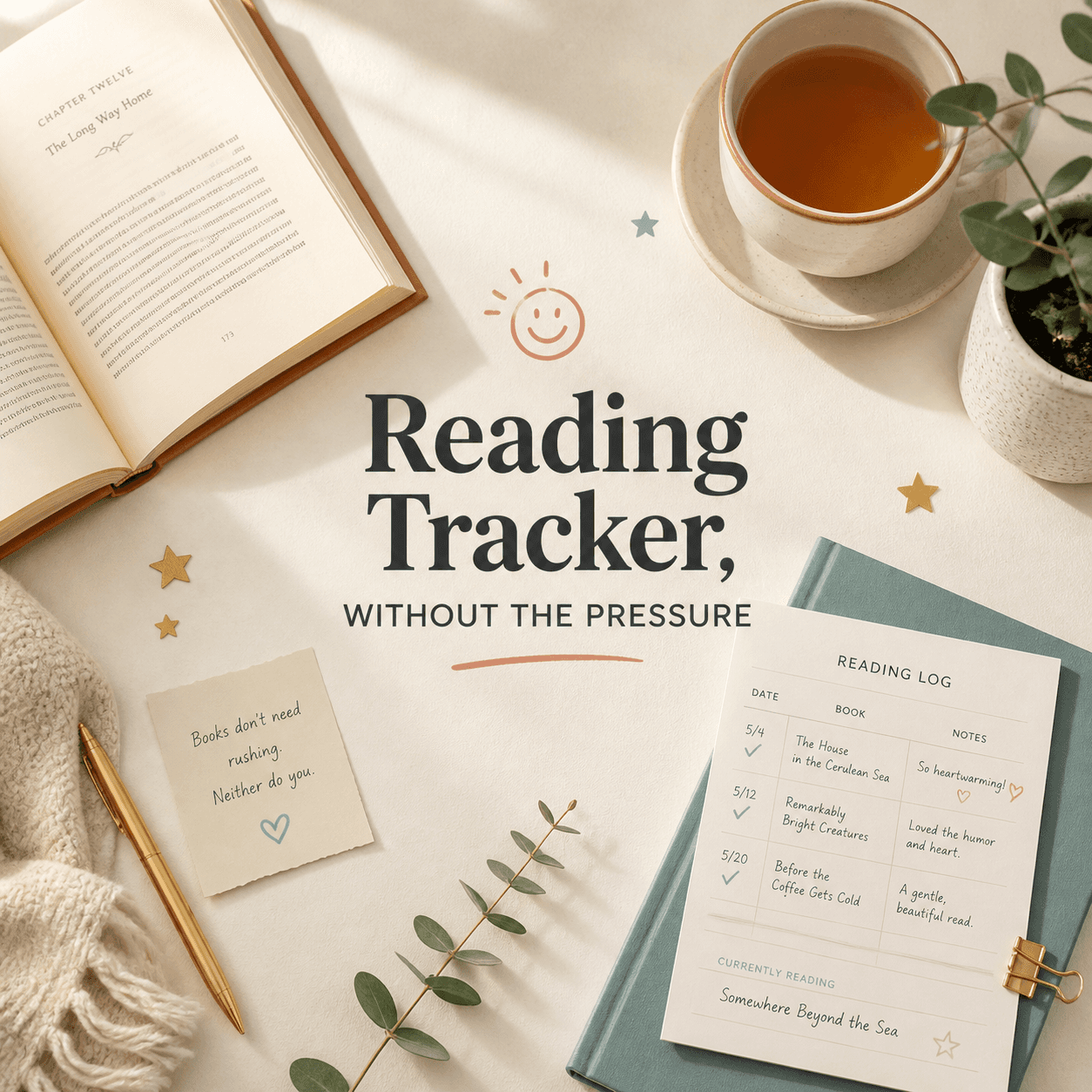
There’s a specific kind of tired I get when I open a reading app and it immediately asks me to be a machine.
Pages. Percentages. Streaks. Daily goals. A little chart that looks like it belongs in a finance dashboard. And suddenly I’m not reading a novel, I’m managing a tiny, personal KPI.
Which is… not why I read.
I love the idea of tracking. I really do. I want to remember what I read, and when, and what it did to me. I want to look back and see seasons of my life through book covers. I want to notice patterns. Like, oh. Every time I’m overwhelmed I reach for short essays. Or, apparently I only read cozy mysteries when I’m craving safety.
But the problem is, most trackers try to make reading productive. And reading is not a treadmill. It is not a proof of discipline. It’s a place you go.
So this is a small, gentler way to track your reading without turning it into homework. It’s not perfect or rigid. It’s intentionally a little soft around the edges. Because you are a person. Not a spreadsheet.
And if you want more of this kind of cozy, reflective reading life stuff, that’s basically what we do over at GlimmerReads. The whole site is built around remembering what stories change in you, not just how many you finished.
The real reason tracking can start to feel gross
A lot of trackers are built on an assumption that more is better.
More books. Faster pace. Longer streak. Bigger numbers.
But reading has invisible value that numbers can’t touch. The paragraph you reread three times because it felt like someone finally said the thing you couldn’t name. The chapter that made you put the book down and stare at the wall for a while. The moment you text a friend at midnight because you just met a fictional character who feels realer than your coworker.
Those things don’t show up on a bar chart.
And if your tracker only celebrates volume, it quietly tells you that slow reading is failure. Rereading is waste. Pausing a book to breathe is quitting.
No thanks.
I want a tracker that says: you showed up. You felt something. You noticed. You carried it with you.
That’s it. That’s the whole point.
What we’re building instead (a joy-first reading tracker)
Here’s the vibe:
- It takes less than two minutes to update.
- It doesn’t punish you for not reading every day.
- It does not care if you DNF a book. Actually, it respects you for it.
- It keeps the emotional and reflective parts close.
- It helps you remember what mattered, later.
This tracker has three layers, and you can stop at any layer you want.
- The tiniest log (so you remember what you read)
- The “glimmer notes” layer (so you remember what it did to you)
- The seasonal look-back (so you can see your reading life as a life)
Layer 1: The tiniest log (the one you’ll actually use)
If tracking makes you freeze up, start here. This is the minimalist version that still gives you a record.
You only track five things:
- Title + author
- Format (print, audio, ebook)
- Dates (started, finished… or just month)
- Status (finished, paused, DNF)
- One-line vibe (more on that in a second)
That’s it.
You don’t need page counts. You don’t need reading time. You don’t need a rating if ratings make you feel weird. The log is not a review site. It’s your memory support.
The one-line vibe (the secret ingredient)
Instead of a star rating, you write a tiny “vibe line” like:
- “Foggy, beautiful, slightly devastating.”
- “Like eating toast in a warm kitchen.”
- “Sharp and useful but I had to go slow.”
- “Not for me, but I see why people love it.”
- “A plotty little snack. Loved it.”
This is joy-tracking. It’s emotional metadata. Later, when you’re trying to remember what that book felt like, this will be the thing that brings it back.
If you want, borrow the GlimmerReads language and literally call these your “glimmers.” Tiny captured light.
A simple table you can paste into Notion or Google Docs
Here’s a starter you can copy:
| Book | Format | When | Status | Vibe line |
If you hate tables, don’t use one. Use bullets. Use scribbles. Use a notes app. The medium does not matter. The gentleness does.
Layer 2: Glimmer Notes (how to track without squeezing the magic out)
This is the part most trackers skip. And it’s the part that actually makes tracking worth doing.
After you finish a book (or while you’re in it, if you’re like that), you write three tiny notes. Not an essay. Not a book report. Three small anchors.
The Three Glimmer Notes
1. The line I don’t want to lose
A quote. Or a scene. Or even a paraphrase you typed out while half-asleep.
2. The feeling it left behind
Not “it was sad.” More like:
- “It made me feel steadier about my own weird choices.”
- “It reminded me I’m allowed to want tenderness.”
- “It made me miss my childhood friend in a sharp way.”
3. The thing I’m carrying forward
One small takeaway. A question. A shift. Examples:
- “I want to be braver about starting over.”
- “I need to stop confusing intensity with love.”
- “I’m going to take more walks without my phone.”
That’s the whole reflection. Three notes. Done.
If you can do that, you will remember the book years later. Even if you forget the plot. Especially if you forget the plot.
What if the book was just… fine?
Then your glimmer notes can be honest and simple:
- Line I don’t want to lose: “N/A, nothing grabbed me.”
- Feeling it left behind: “Neutral. A little bored.”
- Carry forward: “I don’t actually like this trope unless it’s doing something new.”
That still counts. That is still you learning your own reading self.

Layer 3: The seasonal look-back (where the joy actually lives)
Every three months, or honestly whenever you remember, you do a short “reading season” recap.
Not a performance recap. A memory recap.
You answer a few prompts:
- What did I reach for when I was tired?
- What surprised me this season?
- What book felt like a friend?
- What did I avoid, and why?
- What theme kept showing up? (grief, reinvention, home, ambition, softness)
- What do I want more of next season?
This turns your tracker into a tiny personal record. Less Goodreads. More, this is who I was in spring.
If you want more prompts like these, GlimmerReads has a whole library of bookish journaling prompts in the Reading Room style. The kind that doesn’t demand perfection. Just presence. You can start here: https://glimmerreads.com.
The “no guilt rules” that make the tracker work
A joy-first tracker needs rules. Not strict rules. More like boundaries that protect you from turning this into a self-improvement project.
Here are mine. Steal them.
1. Streaks are banned
If you miss a week, nothing happens. You are not behind. Reading is not Duolingo.
2. DNFs are data, not failure
DNF notes are allowed to be short and blunt:
- “Too stressful right now.”
- “Not the kind of romance I like.”
- “Beautiful writing, but it dragged.”
- “Life is short.”
Sometimes the most self-trusting thing you do all month is stop reading a book you don’t want to be in.
3. You track rereads like they matter (because they do)
Rereads are often the books that hold you together. Track them proudly. Add a vibe line like: “Came back for the comfort.”
4. You can skip ratings forever
If ratings make you overthink, don’t use them. Your vibe line is enough.
5. You are allowed to track only what you want to remember
Some people love tracking pages and minutes. If that genuinely delights you, go for it.
But if it makes you tense, cut it. The tracker serves the joy. Not the other way around.

My favorite formats (pick the one that feels easiest)
You don’t need a special system. You need something you’ll keep touching without dread.
Option A: A single notebook page per month
This is the simplest analog method.
At the top: “June Reads”
Then a list:
- Title, Author. Vibe line.
- Three glimmer notes if it was meaningful.
That’s it. One page.
Option B: Notes app on your phone
Create one note called “Reading Log.”
When you finish a book, add:
Title
Vibe line
Line I don’t want to lose
Feeling
Carry forward
You can do it while brushing your teeth. It’s that low pressure.
Option C: Notion (but keep it tiny)
Notion people (hi, I am one sometimes) tend to build a whole library with filters and formulas. And then we never update it again.
If you use Notion, keep only the five columns from Layer 1, plus a “Glimmer Notes” text field. No more.
Option D: A printable tracker (if you love paper but want structure)
If you like having a cozy printable, make one sheet with:
- Books list
- Vibe line space
- Three glimmer notes boxes
You can tuck it into your journal. Or tape it inside the front cover.
A quick example (so you can see how un-fancy this can be)
Let’s say you read a book in two weeks. Here’s what your tracker entry might look like.
Book: The Blue Castle by L.M. Montgomery
Format: Print
When: May
Status: Finished
Vibe line: “A brave, cozy rebellion. Sweet in the bones.”
Line I don’t want to lose: A sentence about choosing your own life.
Feeling it left behind: Hopeful, like I could do one hard thing I’ve been avoiding.
Carry forward: I want to stop waiting for permission.
This takes maybe 90 seconds. And it keeps the essence.
If tracking has felt like pressure before, try this tiny reset
Do this for the next book only. Not the next month. Not the next year.
Just the next book.
- Write the title and author somewhere.
- When you finish (or stop), write one vibe line.
- If you want, add one glimmer note. Just one.
That’s enough to begin.
And something shifts when you do this. The tracker stops being about output. It becomes a gentle companion. Like, oh right. I’m building a life with books in it. Not a score.
A softer kind of call to action (if you want it)
If this is your kind of reading life, the reflective kind, the cozy kind, the trying to remember what mattered kind, you’ll probably like GlimmerReads.
- The Reading Room has essays and book lists that focus on meaning, not hype.
- The journaling prompts are built for people who want to feel a little more steady.
- And the newsletter, The Weekly Chapter, is paced like a calm weekly ritual. A monthly theme delivered in small pieces, so it doesn’t overwhelm.
You can wander in whenever. No pressure.
https://glimmerreads.com
Wrap up (the whole point, again)
A reading tracker shouldn’t make you feel watched. Or graded. Or behind.
It should feel like a small lamp you leave on for yourself.
A record of where you went. What you loved. What you couldn’t finish. What you’re still thinking about. The tiny glimmers you want to keep in your pocket.
And if your tracker helps you return to reading with more tenderness, more honesty, more you.
Then it’s working. Even if you only tracked three books this year. Even if you tracked one.
That still counts. That’s still a reading life.


No responses yet