I used to think “reading deeply” meant reading slowly.
Like, tea. Candle. No phone. And maybe some sort of morally superior pencil.
But most of the time? Life is noisy. You read on your lunch break. On the couch while someone else watches a show. On your phone in a line that does not move. And then you close the book and realize you remember… the vibe. Not much else.
So here’s a small trick that actually helped me. It is stupidly simple, almost annoying. And it has made more of my reading stick.
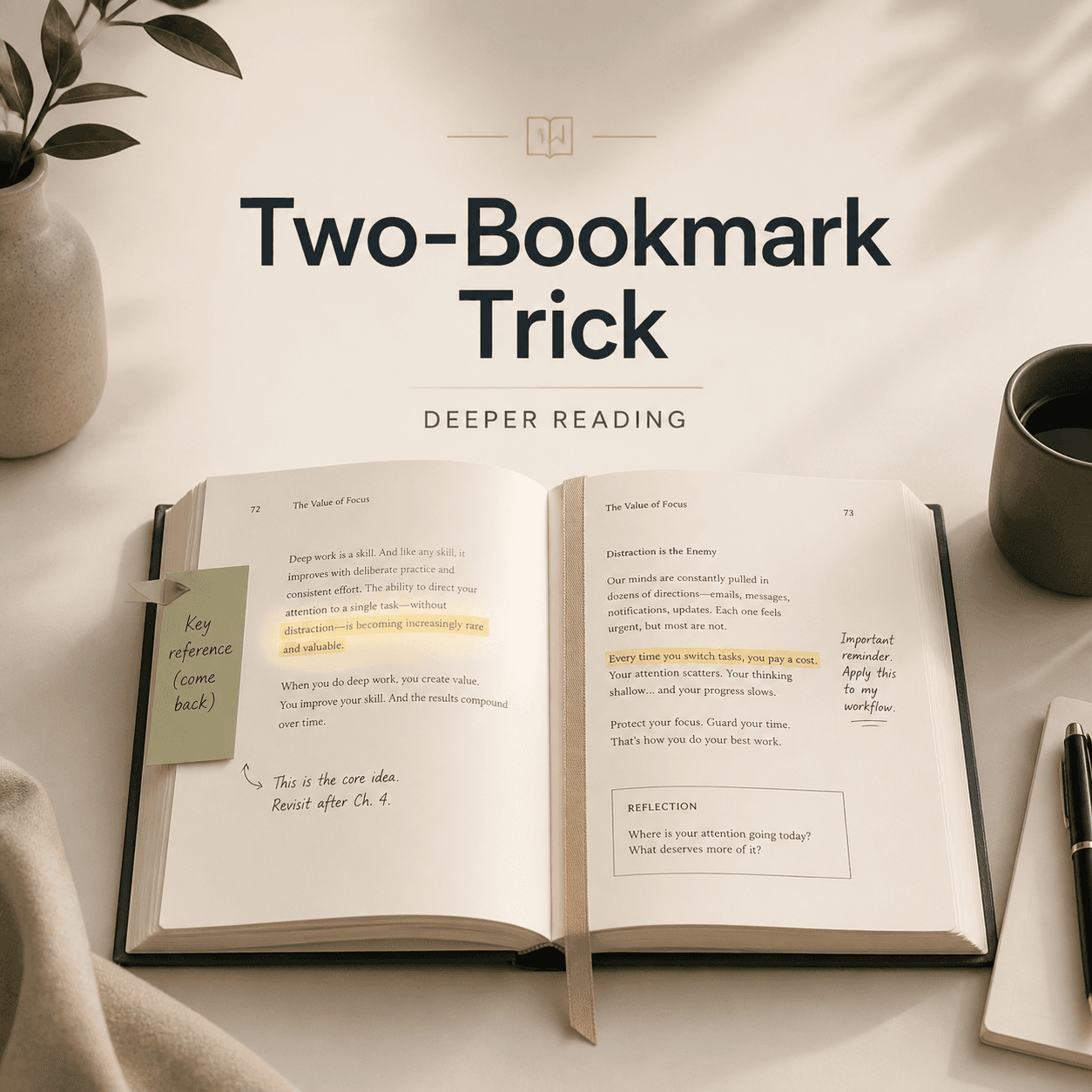
It is called the Two Bookmark trick.
Two bookmarks. Two jobs. That is it.
And weirdly, it changes the whole relationship between you and the page.

What the Two-Bookmark trick is (in plain terms)
You keep two bookmarks in the same book.
Not as backup. Not as aesthetic. Not as a “just in case I lose one” situation.
Each bookmark has a different role:
Bookmark #1: The Place Bookmark
This is the normal one. The one that holds your page.
Bookmark #2: The Meaning Bookmark
This one moves around. It marks the last line that changed something in you. Or confused you. Or made you pause. Or made you go, wait, what. It marks a spot you want to return to later, not necessarily right now.
That second bookmark is the whole point.
It turns reading into a tiny ongoing conversation with yourself. Without needing to stop and journal mid chapter. Without turning the book into homework.
Just a soft signal: this mattered.
Why this works (when “highlighting everything” does not)
If you are anything like me, there is a specific phase you have probably gone through:
- You start highlighting like a disciplined scholar.
- You highlight more.
- You highlight half the page.
- You stop because now the whole book is yellow and you still do not remember what it meant to you.
Highlighting is not the problem. The problem is your brain cannot tell what is important later when everything is treated the same in the moment.
The Two-Bookmark trick does something gentler.
It says:
You do not need to decide everything right now. Just mark a return point.
It creates a second layer of attention.
One layer is progress. The other layer is presence.
And it gives you a built in “review” system, which is what most of us skip completely. We read. We finish. We move on. We wonder why nothing sticks.
How to actually do it (step by step)
This is the whole method. No extra apps. No special notebook required.
Step 1: Pick two different bookmarks
Make them visually different so you do not mix them up.
A ribbon plus a sticky note works. A thick bookmark plus a skinny one. A receipt and a proper bookmark. Whatever.
If you want labels, label them. I have literally written:
- PLACE
- MEANING
on two scraps of paper before. Not cute. Effective.
Step 2: Read normally with Bookmark #1
Just read. Turn pages. Live your life.
Step 3: When a line “pings” you, move Bookmark #2 there
A ping can be:
- a sentence you want to steal and keep
- a moment that hurts a little (in the good way)
- a paragraph that makes you see a character differently
- a line that makes you feel understood
- an image you can practically taste
- a point you disagree with but cannot shake
- a sentence you did not fully get but you know it matters
You do not stop to analyze. You do not explain it yet. You just move Bookmark #2.
That is the deal.
Step 4: At the end of a reading session, revisit Bookmark #2 for 30 seconds
Not 30 minutes. Thirty seconds.
Flip back. Re read that spot. Ask one question:
What did this change in me, even slightly?
If you want to take a note, take a note. If not, fine. The reread alone does a lot.
Then you either:
- leave Bookmark #2 there (if you want to return again), or
- move it forward the next time something pings you
That is it.
The part nobody tells you: this is a memory trick
A lot of “deeper reading” advice is secretly productivity advice. It assumes you want to extract information from books like a machine.
But if you are reading novels, memoir, essays, poetry, even narrative nonfiction, you are also reading for a different kind of knowing. The kind that is felt before it is named.
The Two-Bookmark trick helps because it adds two memory boosts:
- Interruption without derailment. You notice something, but you do not abandon the story to document it.
- Spaced repetition. You reread a meaningful line later, and your brain goes, oh, this again. This must matter.
It is the smallest possible form of reflection.
Which is basically what we do at GlimmerReads all the time anyway. Not “what was the plot,” but “what shifted.”

What counts as a “Meaning” moment? (Examples)
Sometimes I hesitate because I think the moment has to be profound.
It does not.
Here are a few real examples of what my Meaning bookmark has held:
- A line describing a kitchen light at 2 a.m. because it reminded me of my grandmother’s house.
- A character’s small lie that felt like my own old habit.
- A sentence about grief that I did not agree with, but it made me argue back in my head.
- A metaphor that I wanted to write down later because it was just… good.
- A paragraph where I got bored. Yes, bored. Because that is information too.
“Meaning” does not mean beautiful. It means noticed.
And if you keep honoring what you notice, your reading life gets sharper. More personal. More yours.
A simple variation: the Two-Bookmark trick for nonfiction
Nonfiction can be trickier because you may have multiple pings per page, and then the Meaning bookmark is basically doing cardio.
So here is a modification:
- Bookmark #1 still holds your place.
- Bookmark #2 marks the most useful idea from this reading session only.
You limit it to one.
At the end, you flip back and write one sentence somewhere:
This matters because __________.
That one sentence will do more than ten highlights you never revisit.
When this trick feels too slow (and what to do)
There are nights when you just want to read. No pausing. No little rituals. No reflecting.
Good. You should have those nights.
So on those nights, do the lazy version:
- Still use two bookmarks.
- Still move Meaning when something pings you.
- Do not revisit it at the end.
Just leave it.
Because the magic can also happen later, when you finish the book and flip through the Meaning spots like a trail of breadcrumbs.
Sometimes I do that on a Sunday afternoon. Sometimes months later. And it is honestly a little emotional, seeing what my past self flagged.
Like, oh. That is where I was.

The “after” step that makes it even better (optional, but good)
If you want to turn this into a tiny practice, one that fits GlimmerReads style of reading and remembering, try this:
When you finish a book, go back through your Meaning bookmark trail and choose three moments.
Just three.
Then answer these in a note, a journal, or even an email draft to yourself:
- What did I underline with my attention? (What kept repeating, emotionally?)
- What did this book give me a word for?
- What is one small next step I want to take because of it?
That last one is the difference between “I read a book” and “a book moved through my life.”
If you like this kind of reflection, you would probably enjoy The Weekly Chapter over on GlimmerReads. It is built for exactly this. A monthly theme, weekly prompts, gentle nudges, and bookish companionship that does not feel like a classroom.
Common questions (because yes, people ask)
Do I need fancy bookmarks?
No. Use whatever is near you. Receipts. Index cards. A folded scrap of paper. I once used a tea bag tag.
What if I am reading on a Kindle or phone?
You can still do it.
- Bookmark #1 is your normal “go back to my place” behavior.
- Bookmark #2 is a note or highlight used sparingly, only for pings.
If your device lets you filter highlights later, great. If not, just add a symbol like “!!” at the start of the note so you can search it.
What if my Meaning bookmark keeps landing on the same page?
Then you are in a dense part of the book. Or you are in a dense part of your life. Either way, that is interesting.
You can also decide: only move Meaning once per chapter. That constraint helps.
A quick example: what a session looks like
Let us make it concrete.
You sit down. You open your novel. Bookmark #1 is on page 87.
You read. Two pages in, a line hits you:
“She realized she had been waiting for permission to be sad.”
You slide Bookmark #2 to that page. Keep reading.
Ten pages later, you stop for the night. Before closing the book, you flip back to Bookmark #2, reread the line, and you think, oh. Yeah. That is me too. You do not write anything down. You just feel it.
Then you close the book.
Next time you read, Bookmark #1 keeps you moving. Bookmark #2 waits, quietly, like a small anchor.
That is deeper reading. Not because you did more. Because you noticed more.
Let’s wrap this up (the smallest takeaway)
The Two-Bookmark trick is not a productivity hack. It is not a study system.
It is just a way to keep a second thread while you read.
One bookmark for where you are.
One bookmark for what matters.
And over time, you stop finishing books and forgetting them. You start carrying them. In a good way.
If you try it and it clicks, and you want a little more structure for the remembering part, browse the Reading Room at GlimmerReads or join The Weekly Chapter. It is the same idea, really. Paying attention. Then returning. Then letting the story change you, just a little, on purpose.
FAQs (Frequently Asked Questions)
What is the Two-Bookmark trick in reading?
The Two-Bookmark trick involves using two bookmarks in the same book, each with a distinct role: one to mark your current reading place (Place Bookmark), and another to mark the last line that triggered a meaningful reaction or curiosity (Meaning Bookmark). This method helps create an ongoing conversation with the text without interrupting your reading flow.
How does the Two-Bookmark trick improve reading retention compared to highlighting?
Unlike highlighting, which often leads to over-marking and confusion about what truly matters, the Two-Bookmark trick gently signals important moments by marking only lines that genuinely ‚ping‘ you. This adds a second layer of attention—progress and presence—and encourages spaced repetition by revisiting meaningful spots later, making your reading more memorable.
How do I implement the Two-Bookmark trick step-by-step?
Step 1: Choose two visually distinct bookmarks and label them if needed (e.g., PLACE and MEANING). Step 2: Read normally, using Bookmark #1 to hold your place. Step 3: When a line resonates, moves Bookmark #2 to mark it without stopping to analyze. Step 4: At the end of your session, spend about 30 seconds rereading the Meaning bookmark spot and reflect on its impact before continuing.
What qualifies as a ‚Meaning‘ moment worthy of marking with Bookmark #2?
A ‚Meaning‘ moment can be any line that changes you, causes confusion, makes you pause, or evokes an emotional response. Examples include sentences that remind you of personal experiences, challenge your views, reveal character insights, or contain vivid imagery. It doesn’t have to be profound—any line that ‚pings‘ you counts.
Why is the Two-Bookmark trick considered a memory enhancement technique?
The trick works as a memory booster by allowing interruption without losing track of your reading and incorporating spaced repetition through revisiting marked lines later. This minimal reflection helps embed deeper understanding and emotional resonance beyond just recalling plot points.
Can I use any type of bookmarks for this method?
Yes! The key is to have two different types of bookmarks so you don’t confuse their roles. For instance, use a ribbon plus a sticky note or a thick bookmark alongside a thin one. You can even label them for clarity. The goal is functional distinction rather than aesthetics.


No responses yet