
There’s this tiny, annoying thing that happens when you finish a book you loved.
You close it. You sit there for a second. Maybe you even whisper, wow. And then life barges in. Dishes. Emails. Someone asking what’s for dinner. Your brain goes, cool cool cool, we will totally remember the parts that mattered.
And then… you don’t.
A week later you’re trying to explain the book to a friend and all you’ve got is: it was good. There was a character. There was, like, a vibe.
This is where a book journal sounds like a great idea, and then immediately sounds like a project. Fancy spreads. Color-coded tabs. Washi tape. Neat handwriting. A perfect pen that makes you feel like a person with a morning routine.
Yeah. No.
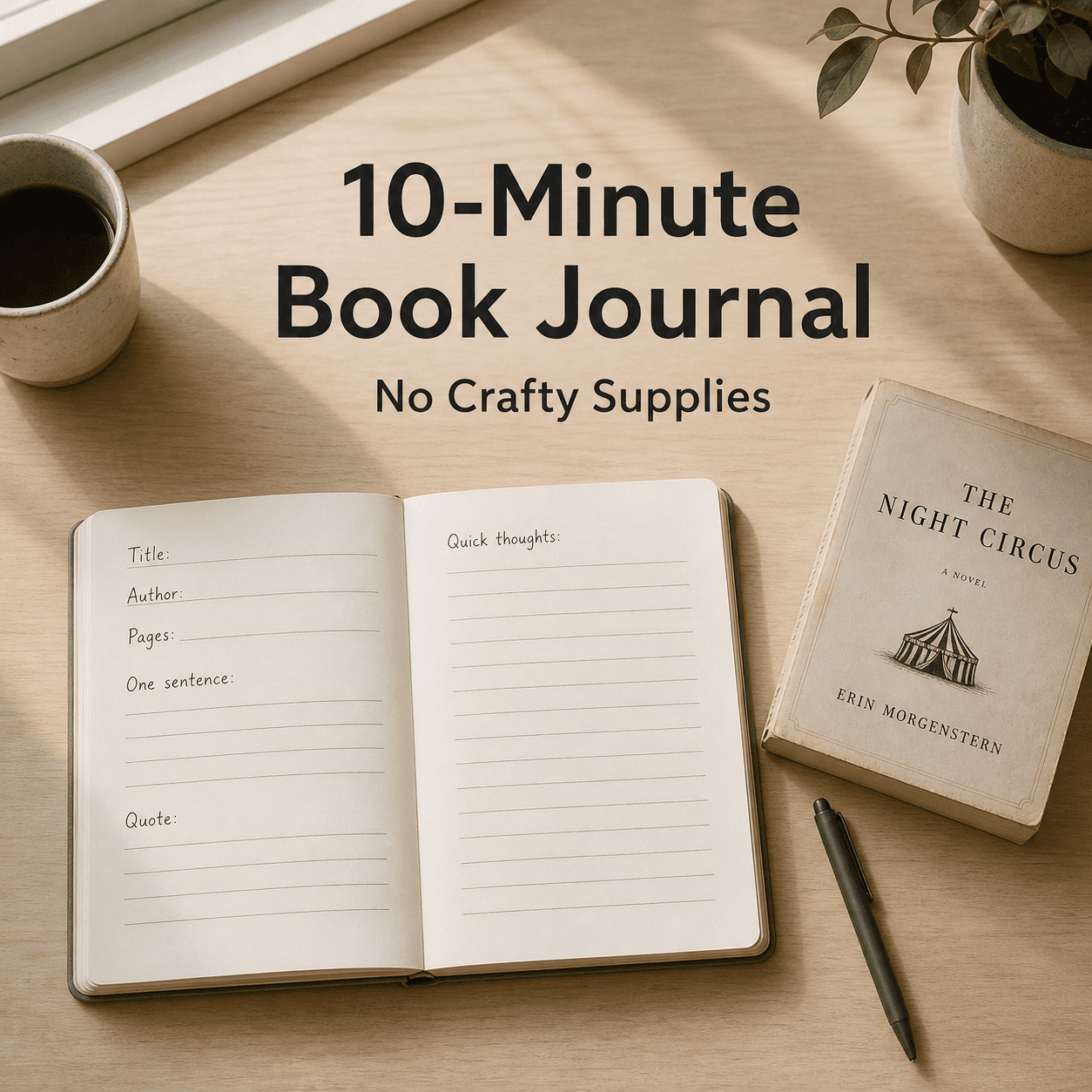
This is a 10-minute book journal. Minimal. Slightly messy on purpose. No craft supplies. No pressure to “keep up.” Just enough structure to help you remember what you read and what it did to you.
And honestly, it can change how reading feels. In a calm way. Like you’re actually letting the story land.

Why bother journaling at all (if you’re already reading)
Because reading is not just input.
It’s this quiet little conversation between you and the page. Sometimes you don’t realize what you needed until a sentence hits you in the ribs. Or a character makes a choice you would never make. Or you see your own pattern, but from the outside.
The problem is we move on too fast.
A 10-minute journal is basically you saying: hold on. Let me keep the good parts. Let me notice what changed.
And you do not need to write a lot to do that. You just need a repeatable container.
The rule: 10 minutes, one page, done
Here’s the whole system:
- Set a timer for 10 minutes
- Write on one page (or one note)
- Stop when the timer ends
- No catching up later (this is important, weirdly)
If you miss a day or a week or a month, nothing breaks. You just do the next entry when you finish the next reading session, chapter, or book.
This is journaling that fits into real life. The kind where sometimes you’re tired and your handwriting looks like it was done on a moving bus. Still counts.
What you need (spoiler: not much)
- Any notebook, even the free one you got at an event
- Or a notes app if you prefer digital
- A pen you won’t lose every five minutes
That’s it.
Optional, if you like a tiny bit of structure:
- A bookmark you can write on (or a sticky note) to capture page numbers as you go
- A folder in your phone called “Book Journal”
No highlighters required. No printer. No aesthetic pressure.
The 10-minute template (copy this)
This is the core. If you do nothing else, do this.
1) The book basics (30 seconds)
- Title + author
- Date finished (or current page)
- Format (print, audio, ebook) if you care
2) The micro summary (2 minutes)
Write 3 sentences max:
- What is this book basically about?
- What changes by the end?
- What’s the central tension?
If you go over three sentences, it’s fine. But try. The limit forces clarity.
3) The “glimmer” moment (2 minutes)
A glimmer is that small bright thing you want to keep. A line, an image, a scene, a feeling.
Write:
- The moment
- Why it stuck
- Page number if you have it
4) The heart reaction (3 minutes)
This part is the point. Answer one:
- What did this book touch in me?
- What did it make me rethink?
- What did it soothe? What did it irritate?
No performance. You’re not writing a review. You’re writing a receipt for your own brain.
5) One takeaway (2 minutes)
Finish this sentence:
- “I want to carry this:” _______
It can be a lesson. Or a reminder. Or a question.
6) Rating, but make it useful (30 seconds)
Skip stars if you hate stars. Try one of these:
- For mood: cozy, tense, bittersweet, weird, tender
- For pace: slow burn, propulsive, meandering
- For reread: yes, maybe, no
Done.

A real example (so you can see how “messy” is allowed)
Book basics:
The Night Circus by Erin Morgenstern. Finished: June 14. Print.
Micro summary (3 sentences):
Two magicians bind their apprentices into a competition inside a traveling circus. The circus becomes the battleground, and the people inside it become collateral without knowing. Love complicates the rules and the cost.
Glimmer moment:
The circus arriving overnight. The quiet shock of waking up to wonder. I want more “overnight wonder” energy in my life. (early chapters, no page number because I’m lazy, apparently)
Heart reaction:
This made me realize I miss enchantment. Not big life changes, just small moments that feel like a secret. Also, I’m drawn to beautiful containers even when they hide something sharp. Noted.
I want to carry this:
Build tiny rituals that feel like stepping into another world.
Useful rating:
Mood: dreamy, bittersweet. Reread: yes.
That’s it. Not an essay. Not a book report. But if I read it again in a year, I’ll remember what mattered.
When to do it (pick one trigger)
If you try to journal “whenever,” you won’t. Most people won’t. So pick a trigger that’s already happening.
Choose one:
- After each reading session (10 minutes, but you can do the same template in shorter form)
- At the end of each chapter (only if chapters are long, otherwise no)
- When you finish the book (my favorite, simple)
- When you DNF (yes, do this too)
My suggestion: do it when you finish. And for longer books, do one quick mid-way entry to catch your thoughts before they shift.
The 3-minute version (for low-energy days)
Some days you finish a book and your brain is toast. Still, you can leave yourself a breadcrumb.
Set a timer for 3 minutes and write only:
- One sentence summary
- One quote or moment
- One feeling
- One thing I’m taking
You’ll be shocked how helpful this is later. Tiny notes are time travel.
“No crafty supplies” doesn’t mean “no personality”
You can keep it plain and still make it yours. Here are a few low-effort additions that don’t turn into a hobby store situation:
A one-word label
At the top of your entry, add one word:
- “Healing”
- “Escape”
- “Unsettling”
- “Warm”
- “Brave”
- “Tender”
A single line you always write
Like:
- “What I needed from this book was…”
- “The part I’m still thinking about is…”
A small symbol
If you want. Just one.
- A star for “reread”
- A dot for “recommend”
- A squiggle for “beautiful writing”
That’s the maximum. Don’t let it grow teeth.
What to write when a book is “fine” (not life-changing)
This is important because most books are not going to rearrange your soul. And you still might want to remember them.
If it was just fine, answer these:
- What did it do well?
- Where did it drag?
- Who would like it more than me?
- What was I in the mood for when I picked it up?
That last question is sneaky useful. Sometimes the book isn’t the issue. Sometimes you were hungry and exhausted and trying to read literary fiction like it was a cozy blanket.
DNF journaling (the gentle exit interview)
DNF entries keep you from repeating the same mistake. And they remove guilt. Because you’re not “quitting,” you’re collecting data.
Use this mini template:
- Where I stopped: page / %
- Why I stopped: (be honest, not polite)
- What I wanted instead: tone, pace, theme
- What I still liked: even one thing
DNF entries also make your future book picks way better.
The secret upgrade: track patterns, not pages
If you want this journal to actually support personal growth (without turning into a self-help spreadsheet), track patterns.
Once every 5 entries or so, glance back and ask:
- What moods am I drawn to lately?
- What themes keep repeating?
- What kinds of characters am I rooting for?
- What am I avoiding?
This is the kind of reflection GlimmerReads is all about, that idea that stories don’t just entertain us, they show us where we are. If you want more prompts like this, the Reading Room posts on GlimmerReads are built for exactly that kind of gentle, meaningful digging.
Not intense. Just honest.
A simple layout for your notebook (so you don’t overthink it)
If you’re using a physical notebook, here’s an easy setup:
- First 2 pages: Index
- Every entry: write the book title big enough to scan
- In the index: list title + page number
That’s it. No bullet journal scaffolding. No rulers.
If you’re digital:
- Keep one note per book
- Use a consistent title format like:
2026-08 | Book Title | Author - Search becomes your index
10-minute prompts for when you’re stuck
Sometimes you sit down and your mind goes blank. Try one of these, pick one, done.
- What would I tell my past self before reading this?
- What did I underline mentally, even if I didn’t highlight?
- Which character felt most real to me, and why?
- What was the book quietly arguing?
- What did it make me want to do next?
- If this book had a “weather,” what would it be?
- What did I learn about myself as a reader?
Make it sustainable (aka the part that actually matters)
A book journal only works if it doesn’t demand a personality transplant.
So:
- Keep the timer. It’s a boundary.
- Let entries be uneven. Some will be long. Some will be 6 lines.
- Don’t try to journal every book if you don’t want to. Journal the ones you want to remember.
- If you miss, don’t “catch up.” Just resume.
The point is not to build an archive that impresses strangers. The point is to build a small practice that makes your reading life feel like yours.
Want a done-for-you version of this?
If you like this style of journaling, you’ll probably like The Weekly Chapter newsletter on GlimmerReads. It’s organized around a monthly theme, broken into weekly prompts and reflections, so you’re not constantly asking, okay but what do I write.
And if you want to do it with other readers, there’s also the community book club angle, which, honestly, makes reflection easier because you borrow other people’s insights and then suddenly you see your own.
The whole thing, one last time (so you can screenshot it)
The 10-Minute Book Journal:
- Title, author, date
- 3-sentence summary
- Glimmer moment (and why)
- Heart reaction
- “I want to carry this:”
- Useful rating label
Timer on. One page. Stop.
That’s the practice.
Not crafty. Not complicated. Just a small way to make books stay with you a little longer, in the ways that count.


No responses yet