
You finish a book. You loved it. You were fully in it.
Then someone asks, two weeks later, “What’s it about?”
And your brain does this very specific thing where it produces… vibes.
A girl. A house. Maybe a war. There was rain at some point. A line you underlined that felt important. But the actual plot, the chain of what happened and why it mattered, has already started slipping away like you left it on a café table.
If that’s you, you’re not a “bad reader”. You’re just a human with a brain that is constantly trying to save storage space.
This post is a small system I use that fixes it without turning reading into homework.
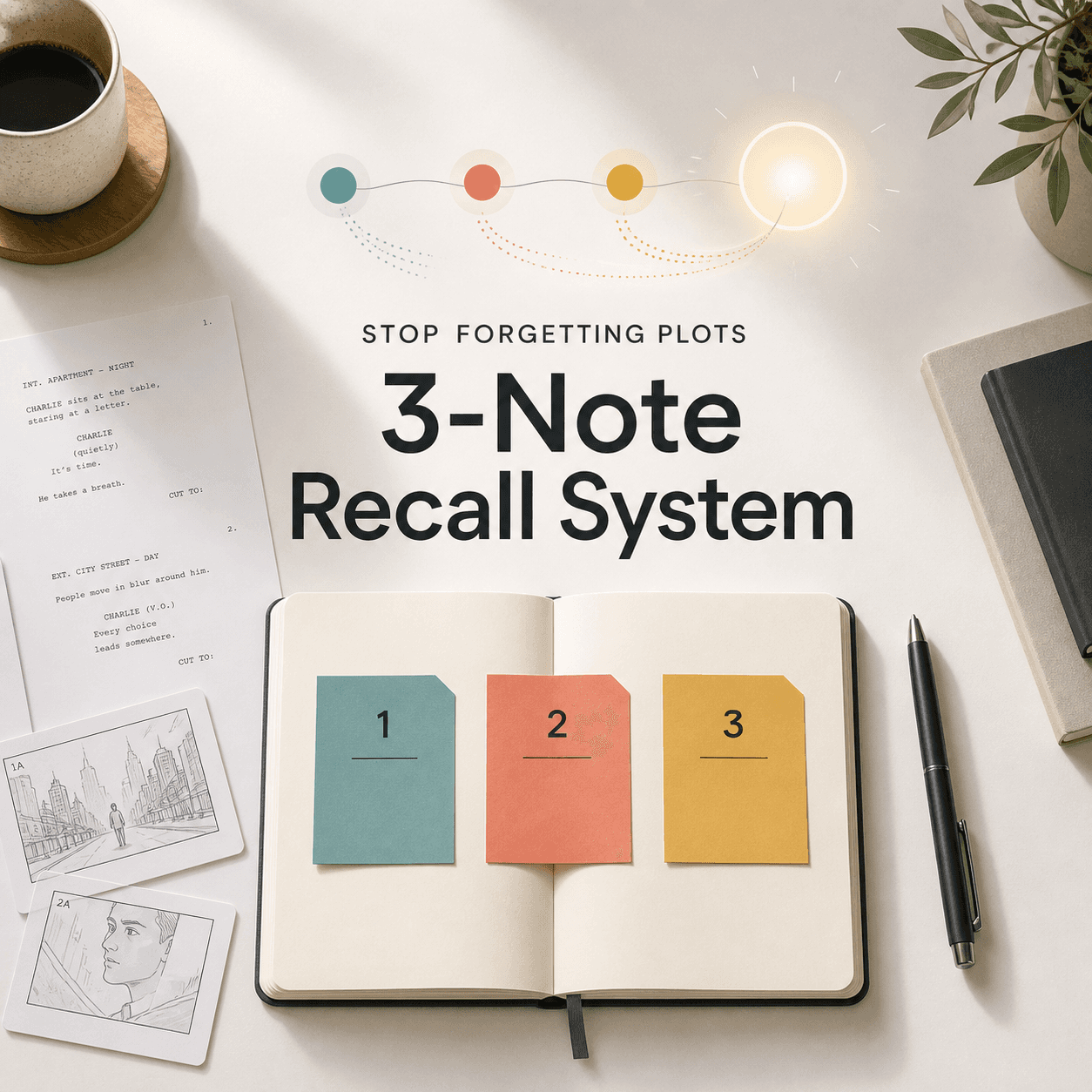
It’s called the 3 Note Recall System. It’s literally three notes. Not three pages. Not a spreadsheet. Not an elaborate template that you abandon after two books.
Just three notes that make the plot stick. And honestly, they also make the book feel more… yours.
Why plots disappear so fast (even when you’re paying attention)
A plot is basically a sequence of decisions and consequences.
But when we read, we don’t store it like a timeline. We store it like a feeling. A couple of scenes. A character’s face. The mood of a chapter. That one argument in the kitchen. The ending, maybe.
And then life happens. You start another book. You answer emails. You watch a show with a similar premise. The brain blurs it all together.
Also, most of us read in little pockets of time. Ten pages before bed. A chapter on the train. Fifteen minutes between errands. Which is cozy and normal and how reading fits into real life, but it’s not always great for memory.
So instead of fighting that, the 3 Note Recall System works with it. It gives your brain three sturdy hooks to hang the story on.
The 3 Note Recall System (the whole thing)
Here are the three notes:
- The Want
- The Turn
- The Cost
That’s it.
And you write them like a normal person. Messy, short, half sentences. Not polished. Not for anyone else.
You can do this at the end of a reading session, or after you finish the book. I’ll show you both ways.
But first, what these actually mean.
Note 1: The Want (what is the story reaching for?)
This is the simplest note, and weirdly, the most powerful one.
The Want is what the story is chasing. What the main character wants, yes. But also what the book itself wants to explore.
It can be concrete:
- “She wants to find her sister.”
- “He wants to win the case.”
- “They want to survive the winter.”
Or it can be quieter:
- “She wants to be chosen.”
- “He wants to stop feeling like a fraud.”
- “They want to go back to the way things were, even though they can’t.”
Write one sentence. Two if you need it.
Examples (made up, but you’ll recognize the shape):
- The Want: “Mara wants to leave her small town, but she also wants someone to notice she’s been drowning there.”
- The Want: “This is a book about belonging. Like, who gets to stay.”
That second line is allowed. You can be vague if it’s honest.
If you can capture the want, your brain stops storing the book as a cloud of scenes. It becomes a direction.
Note 2: The Turn (what changes everything?)
Most plots have a hinge.
A moment where the story stops being “this could go either way” and becomes “oh no, now we’re in it”.
The Turn is not “the climax” necessarily. It’s the pivot point. The thing that changes the stakes, the relationships, the plan.
Sometimes it’s dramatic.
- The body is discovered.
- The letter arrives.
- The betrayal happens.
- The door opens and someone is standing there.
Sometimes it’s internal.
- She realizes she’s been lying to herself.
- He admits what he did.
- They decide not to go back.
Write it like you’re texting a friend:
- The Turn: “When she found the second journal in the attic and realized the timeline didn’t match.”
- The Turn: “The moment he chose to protect his brother instead of telling the truth.”
If you’re unsure which moment is the turn, pick the one that made you sit up, or the one that made the rest of the book feel inevitable.
Your memory loves inevitability. It loves cause and effect.
This note gives you that.

Note 3: The Cost (what did it take?)
This is the note that makes the plot stay, and also makes the book feel meaningful.
The Cost is what the character loses, sacrifices, admits, or can’t unlearn.
It’s the emotional price tag of the story.
And no, it doesn’t have to be tragic. It just has to be real.
- “She got what she wanted, but she lost her oldest friend.”
- “He solved the mystery, but now he can’t go back to who he was.”
- “They stayed together, but only after telling the truth out loud.”
Write it plainly.
- The Cost: “She had to burn the bridge with her mother for good.”
- The Cost: “He learned he can’t rescue people who don’t want to be saved.”
- The Cost: “They won, but it didn’t feel like winning.”
When you write the cost, you lock in the ending without needing to remember every scene that got you there.
Because even if you forget details, you’ll remember what it took.
The system in one tiny example
Let’s pretend we read a fictional book called The Orchard House.
Here’s what your three notes might look like:
- The Want: “Nina wants to sell her late grandmother’s house and finally move on.”
- The Turn: “She finds letters proving her grandmother basically built the town’s biggest ‘success story’ on a lie.”
- The Cost: “She keeps the house, but she loses her relationship with her father, who needed the lie to stay buried.”
That’s enough to recall the plot months later. Not perfectly, but cleanly.
And if someone asks what it’s about, you can answer like a person who remembers what they read.
When to write the three notes (two options)
There are two ways to do this, depending on how you read.
Option A: The “end of book” version (2 minutes)
When you finish the book, before you start another one, open your journal or notes app and write:
- The Want:
- The Turn:
- The Cost:
Don’t overthink it. First answer that comes.
This works great if you read quickly or you’re a mood reader bouncing around genres.
Option B: The “soft breadcrumbs” version (30 seconds per session)
If you read slowly, or you’re in a book that’s a bit complex, do this:
At the end of each reading session, write one of the notes. Just whichever one is clearest that day.
- Early in the book, you’ll mostly write The Want.
- Midway, you’ll catch The Turn forming.
- Near the end, The Cost shows up.
By the time you finish, you basically already have your recall.
This is what I do when I’m reading something layered, or when I know I’ll be interrupted a lot.
Make it even easier: copy this mini template
Paste this into your reading journal, or a note in your phone.
3 Note Recall
- The Want:
- The Turn:
- The Cost:
- Favorite line (optional):
- One thing I want to remember (optional):
That’s it.
Those two optional lines matter if you’re the kind of reader who reads for comfort and growth, not just plot. Which, if you’re here, you probably are.
(Also, if you like prompts like this, GlimmerReads has more in the Reading Room, plus the newsletter The Weekly Chapter that nudges you to actually reflect without making it a whole performance. Just saying. It’s the same vibe as this system.)
What if you read multiple POVs, or it’s literary and “nothing happens”?
Yeah. Some books are basically a long breath.
Still works.
Here’s how to adapt:
For multiple POVs
Pick one main thread, then write:
- The Want: “Everyone wants safety, but they define it differently.”
- The Turn: “When the secret gets told in the one POV that least expected it.”
- The Cost: “Nobody gets to stay innocent.”
You don’t need to list every character. You’re creating a memory anchor, not a character directory.
For quiet books
Focus on internal movement.
- The Want: “She wants to feel at home in her own life.”
- The Turn: “She stops performing wellness and admits she’s lonely.”
- The Cost: “She has to disappoint people who preferred her ‘easy’ version.”
A quiet plot still has a hinge. It’s just not a car chase.
The sneaky reason this works (without you trying harder)
This system forces you to do three things your brain loves:
- Define a goal (The Want)
- Notice causality (The Turn)
- Attach emotion (The Cost)
That’s basically how memory works. Meaning, change, feeling.
You’re turning a book into a shape your mind can carry.
A few real life ways to use your three notes
This is where it gets fun, because the notes stop being just “memory help” and start becoming part of your reading life.
1. Write better book reviews (without rambling)
Use the three notes as your skeleton. You can write a review in ten minutes that actually says something.
2. Remember books for book club
Before book club, read your three notes. You’ll sound like you did intense preparation. You didn’t. You just wrote three sentences weeks ago.
3. Build a personal “why I loved this” library
Over time, you’ll notice patterns in your Wants, Turns, Costs.
Like, oh. I keep reading stories where the cost is “telling the truth and losing comfort.” Interesting. Noted.
That’s where reading becomes reflection. Which is kind of the GlimmerReads whole thing.
Add images to your journal (optional, but it helps)
If you keep a physical reading journal, paste in one visual that matches the book. Not a character collage. Just one mood image.
- A photo of an empty road.
- A rainy window.
- A messy kitchen.
- A field at dusk.
It sounds extra. It’s not. It gives your brain a visual tag.
If you use a digital journal, you can do the same with a single image link.
Here are a few royalty free image sources you can pull from:
- Unsplash
- Pexels
- Pixabay
And yes, you will feel like the main character of your own life for five minutes. That’s allowed.

Common mistakes (so you don’t accidentally make this annoying)
Mistake 1: Trying to make the notes “correct”
There’s no correct. If your Turn is not the author’s intended turn, who cares. It’s the moment you felt the story shift.
Mistake 2: Writing a summary instead of a hook
If you find yourself writing: “First this happens, then this happens, then this…”
Stop. Go back to Want, Turn, Cost.
Mistake 3: Waiting until you forget everything
Do it while the book is still warm in your hands. Even if it’s sloppy.
Especially if it’s sloppy, honestly.
A quick walkthrough you can try tonight (seriously, tonight)
Pick the last book you finished. Even if it was months ago.
Write:
- The Want:
- The Turn:
- The Cost:
If you can’t remember the turn, write what you do remember. Like:
- “The Turn: the boat scene?? when she realized he knew?”
That’s fine. It still works. Your brain will often fill in the missing details once you have a partial anchor.
And now you’ve got a record.
If you want, start a simple note on your phone called GlimmerReads Recall or whatever you want to call it. Then every book gets three lines.
In six months you’ll have a little personal library that you actually remember.
If you want a slightly deeper version (still simple)
Sometimes, when a book hits you in the chest, you want one more line. Not to analyze it to death. Just to keep the glow.
Add this under the three notes:
- The Mirror: “Where did I see myself in this?”
One sentence.
That’s it.
This is basically what we do in a lot of the GlimmerReads journaling prompts, by the way. Not heavy. Just intentional.
Wrap up (and your tiny next step)
If you keep forgetting plots, you don’t need a better memory. You need a smaller container.
The 3 Note Recall System:
- The Want: what the story is reaching for
- The Turn: what changes everything
- The Cost: what it takes
Try it with your current read. Write the Want tonight. Tomorrow, see if you can spot the Turn forming. When you finish, name the Cost.
And if you want more cozy systems like this, plus prompts that make reading feel like self care instead of a task, wander over to GlimmerReads at https://glimmerreads.com and peek into the Reading Room. Or subscribe to The Weekly Chapter if you want a gentle nudge each week.
That’s it. Three notes. More remembering. Less “wait what even happened in that book I loved?”


No responses yet