You know that feeling when you want to read, but every book you pick up feels… wrong?
Not bad. Just wrong for today.
Like you’re trying to put on a sweater that technically fits, but the neckline is weird and you keep tugging at it and suddenly you’re thinking about laundry instead of chapter one.
That’s what usually sends people into the doom scroll. Or back to the same comfort reread. Or into buying three books they do not need. (No judgment. I have done all three in a single weekend.)
So here’s a small method I’ve been using, and it’s surprisingly fast. It’s basically mood matching. But not in the vague “I want something happy” way. More like, “What do I actually need my reading to do to my nervous system right now?”
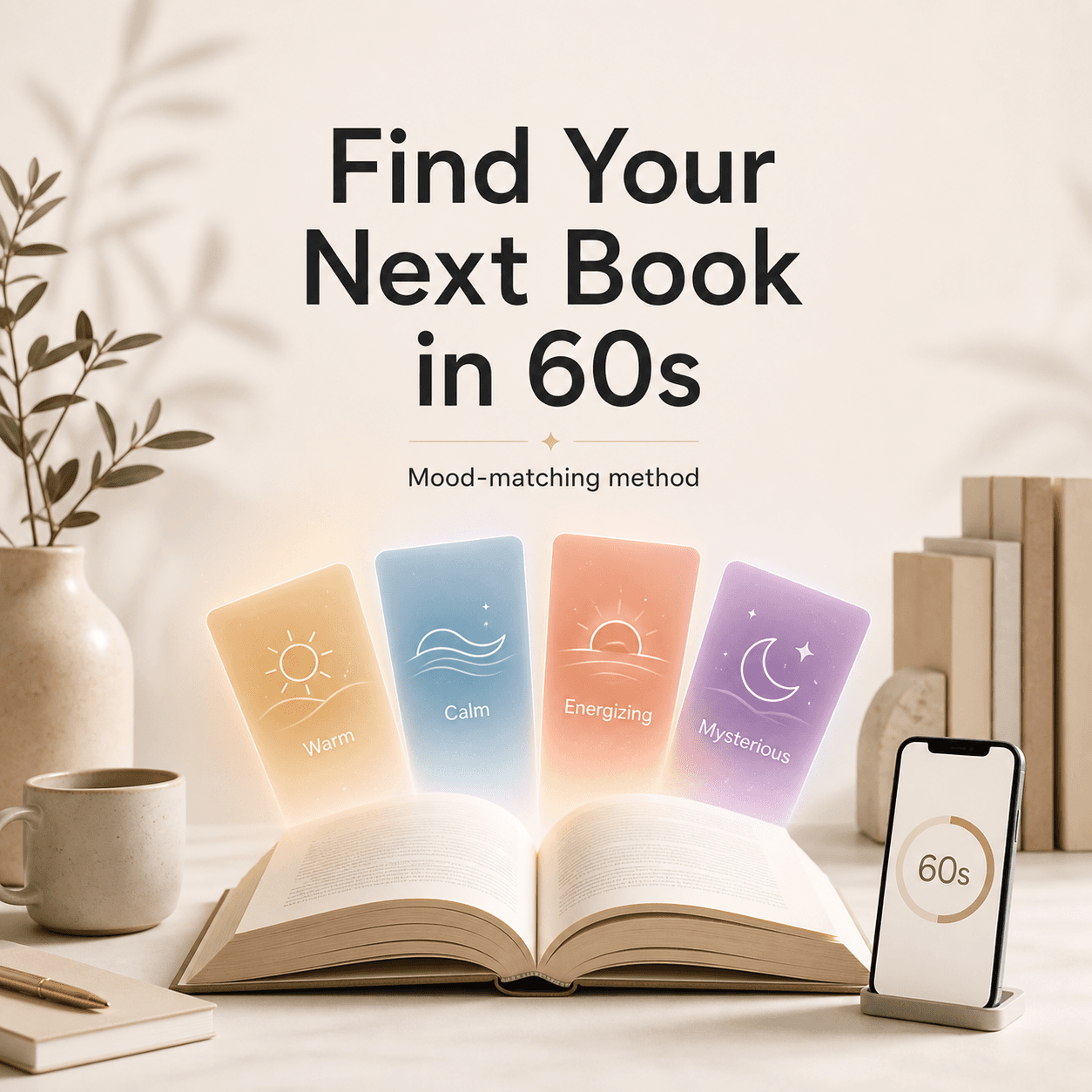
I call it the 60 second mood matching method because that’s honestly how long it takes once you get the hang of it.
And if you like reading as a kind of self care, reflection, or quiet reset, it fits right in with what we do over at GlimmerReads. The whole point is not just finishing books. It’s noticing what they shift in you.
The problem with “What should I read next?” is that it’s too big
Most recommendation systems assume one thing:
You are a stable person with a stable life and a stable brain.
Meanwhile you might be:
- running on three hours of sleep
- emotionally tender for no clear reason
- burned out but restless
- lonely in a way you cannot quite name
- craving beauty but also craving plot
And then someone recommends a 900 page epic with twelve POVs and you just stare at it like. okay. sure. in a different universe.
So instead of asking “What should I read next?” try asking:
“What mood am I in, and what mood do I want to be in 30 pages from now?”
That’s the key. Not just current mood. Desired shift.
The 60 second method (the whole thing)
Here it is. It’s four steps. You can do it in your head. You can also write it down in a reading journal if that’s your thing.
Step 1 (15 seconds): Name your reading energy
Not your emotion. Your energy.
Pick one:
- Fried (tired, overstimulated, blunt)
- Buzzing (restless, scattered, need a channel)
- Tender (raw, soft, easily pierced)
- Flat (numb, bored, foggy)
- Hungry (curious, ready, “feed me something good”)
If you don’t know, ask: Do I want something easier, or something that grips me?
That usually tells you.
Step 2 (15 seconds): Choose your “book job”
A book can do a job. Give it one.
Pick one:
- Soothe (calm me down, lower the volume)
- Spark (make me feel something, wake me up)
- Steady (ground me, give me structure)
- Vanish (pure escape, get me out of my head)
- See me (mirror, validation, “oh it’s not just me”)
One job. Not five. If you ask a book to fix your whole life it will simply sit there, innocent, while you resent it.
Step 3 (15 seconds): Set your “texture”
This is the part people skip, and it’s why they keep picking the wrong thing.
Texture is how the book feels on the page.
Choose two sliders:
Pace
- slow, medium, fast
Density
- light, medium, dense
Then one vibe word:
- cozy, sharp, dreamy, gritty, witty, lyrical, eerie, wholesome, romantic, thorny
That’s enough.
Step 4 (15 seconds): Match to a shelf, not a title
Instead of “I need the perfect book,” think “I need the right shelf.”
A shelf is a category you can keep returning to.
Examples:
- cozy mystery shelf
- lyrical literary shelf
- compulsive thriller shelf
- gentle memoir shelf
- short story shelf
- romantasy shelf
- nonfiction that reads like a story shelf
- reread shelf (very valid)
Once you know your shelf, picking a title is easy.
A quick visual cheat sheet (save this)
Here’s the simplest way to map it:
- Fried + Soothe + light/medium + cozy
= comfort reads, cozy mysteries, warm romance, found family, gentle memoir - Buzzing + Vanish + fast + plotty
= thrillers, heists, page turners, adventure, high concept sci fi - Tender + See me + medium pace + intimate
= character driven lit fic, reflective memoir, quiet romance, grief books (carefully) - Flat + Spark + fast/medium + vivid
= short stories, romance with banter, horror, sharp essays, “one sitting” books - Hungry + Steady + medium/dense + thoughtful
= big fantasy, historical fiction, rich nonfiction, layered classics
You’ll notice this is not about genre as much as effect.
Mood Matching in real life (5 tiny scenarios)
Sometimes it clicks more when you see it in motion.
1) “My brain is fried but I want to read something”
Energy: Fried
Book job: Soothe
Texture: light, medium pace, cozy
Shelf: comfort shelf
This is when you stop forcing yourself into “serious” books.
Try:
- cozy mystery
- feel good romance
- a reread you already trust
- short chapters, familiar tropes
You want a book that asks very little of you, and gives back anyway.
Journal prompt (optional):
What would feel like a soft place to land tonight?
2) “I’m restless and I keep checking my phone”
Energy: Buzzing
Book job: Vanish
Texture: fast pace, light/medium density, high momentum
Shelf: page turners
You need narrative speed. Cliffhangers. Clean stakes.
Try:
- thrillers
- mystery with short chapters
- adventure fantasy
- romcom with sharp dialogue
Micro trick: pick something with naturally short scenes. Your brain gets the dopamine loop without the phone.
3) “I’m tender and everything feels personal”
Energy: Tender
Book job: Steady or See me
Texture: medium pace, intimate voice, not too bleak
Shelf: character centered books
This is where people accidentally pick “sad but beautiful” books and then wonder why they’re crying into their cereal.
You can do tender books without doing emotional harm.
Try:
- gentle memoir
- quiet literary fiction with warmth
- reflective essays
- romance that feels safe, not chaotic
Rule of thumb: if you are tender, choose books with some kind of handrail. Humor, hope, community, a sense of being held.
4) “I feel flat and bored and I miss feeling alive”
Energy: Flat
Book job: Spark
Texture: vivid, surprising, medium to fast
Shelf: novelty shelf
This is when you need voice. Weirdness. Sensory detail. Bite.
Try:
- short stories
- horror (seriously, it wakes you up)
- romcoms with banter
- essays that argue
- books with a strong narrator
Sometimes the fix is not “a better book.” It’s a book with more electricity.
5) “I’m fine, I’m ready, I want to go deep”
Energy: Hungry
Book job: Steady
Texture: medium pace, dense or layered
Shelf: rich books
This is the moment for:
- bigger fantasy worlds
- historical fiction epics
- ambitious literary novels
- nonfiction that teaches and narrates
This is also when you might actually enjoy that book you’ve been “saving.”
The secret ingredient: your “nope list”
Mood matching gets easier when you know what never works for you in certain states.
Make a tiny “nope list” like:
- when I’m fried, I cannot do: multiple POVs, dense worldbuilding, heavy trauma
- when I’m tender, I cannot do: cruelty, humiliation plots, bleak endings
- when I’m buzzing, I cannot do: slow descriptions, long chapter blocks
- when I’m flat, I cannot do: subtle quiet books with low stakes
This is not you being picky. This is you being accurate.
Accuracy is kindness.
Build your personal mood shelves (so you stop starting books you don’t finish)
If you want this to work long term, you don’t want a single perfect list.
You want five mood shelves you can return to.
Here’s a starter template. You can literally copy this into your notes app.
- Soothe Shelf:
(comfort reads, cozy, low stakes, warm endings) - Vanish Shelf:
(page turners, fast plot, “one more chapter”) - Spark Shelf:
(bold voice, humor, surprise, vividness) - See Me Shelf:
(validation, emotional truth, “this gets it”) - Steady Shelf:
(structured, thoughtful, rich, grounding)
If you want to make it even more GlimmerReads style, add a line under each shelf:
“This shelf is for when I feel…”
That one sentence helps more than you’d think.
Use this on GlimmerReads (a gentle call to action, but also true)
If you’re building mood shelves and you want help filling them, that’s basically what the Reading Room on GlimmerReads is for. Book lists, reflective essays, and recommendations that are less “top 10 bestsellers” and more “here’s a story that might meet you where you are.”
And if you want a steady drip of this kind of support, The Weekly Chapter newsletter is organized around monthly themes. Which means you can actually choose a theme based on what you need right now. Calm. Resilience. New beginnings. That kind of thing.
Not urgent. Just there when you want it: https://glimmerreads.com
A simple one page journaling exercise (for after you pick your book)
This is optional but honestly, it makes the whole method stick.
After you choose your next read, answer these in 2 minutes:
- My current mood is:
- I want this book to: (soothe, spark, steady, vanish, see me)
- I chose it because:
- If this book works, I’ll feel:
- If it doesn’t, I’ll switch to this shelf instead:
That last one is magic. It gives you an exit plan. No guilt spiral.
Images to include (so this post feels cozy and real)
Add these throughout the post in WordPress. You can use your own photos, or free stock with proper licensing.
Image 1 (near the intro): a cozy reading setup, mug, blanket, open book
Image 2 (near “The 60 second method”): a notebook with a pen, journaling vibe

Image 3 (near “Build your personal mood shelves”): bookshelf close up

Image 4 (near the end): someone reading by a window, soft light

Common mistakes (so you can skip the frustration part)
Mistake 1: Picking for your fantasy self
You know. The version of you who wakes up early, drinks water, and reads Russian classics before sunrise.
Pick for the you that exists today.
Mistake 2: Confusing “challenge” with “punishment”
A challenging book can be wonderful. But if you are fried or tender, challenge can turn into avoidance really fast.
Mistake 3: Forcing a book to be a whole personality
Sometimes you just need a fun plot. Sometimes you just need a warm ending. It does not have to be impressive.
Let’s wrap this up (and get you a book)
The 60 second mood matching method is basically this:
- Name your reading energy.
- Give your next book one job.
- Pick the texture (pace, density, vibe).
- Choose from a mood shelf, not a giant chaotic internet list.
It’s simple. But it works because it’s honest.
And if you want to turn this into a deeper practice, not in a serious way, just in a “I want to remember what I’m carrying from this story” way, that’s what GlimmerReads is built for. You can browse the Reading Room, pick up a few journaling prompts, or join The Weekly Chapter when you feel like it.
Now, quick. Do the 60 seconds.
What’s your energy right now? What job do you need a book to do?
Then go pick the shelf. The right book is probably already waiting there.


No responses yet