
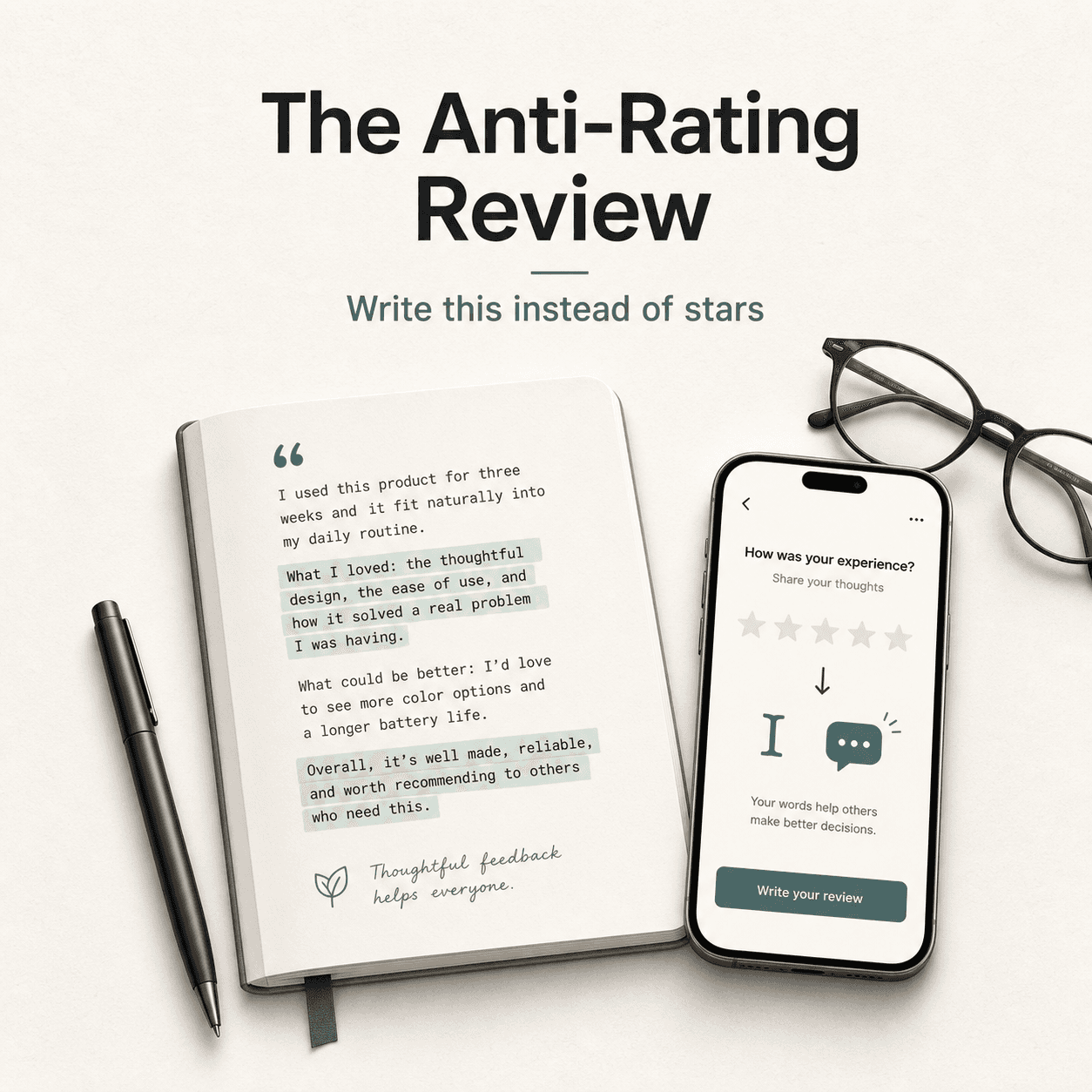
I used to think I was being helpful when I left a star rating.
Like, I’d finish a book, feel something strong (or feel nothing, which is also a feeling, unfortunately), and then I’d click four stars or two stars and move on with my life. Efficient. Clean. A tiny moral judgment dropped into the void.
Except… it didn’t actually capture what happened between me and the book.
Because the truth is, I’ve loved books that I would not recommend to most people. I’ve respected books that bored me. I’ve given three stars to something that cracked me open emotionally because it was “messy” and I didn’t know what to do with that. And sometimes I’ve given five stars to a book that was basically popcorn, and then later I felt weirdly empty about it. Like I’d eaten a whole bag of chips and called it dinner.
Star ratings are quick. They are not, most of the time, honest. Not in the way that helps you remember what mattered.
This is the anti rating review. The one you write instead of stars.
And if you’re the kind of reader who ends a book and wants to keep it close, not just “rate it”… this is going to feel like a relief.
Why star ratings start to feel wrong (at least for some of us)
Let’s be fair. Stars are useful when you need a split second decision.
If I’m scrolling a reading app at 11:47 pm and my brain is mush, yes, a 4.6 average helps. I get it.
But stars also flatten everything.
They turn a complicated reading experience into a single digit. And reading is not a single digit experience. It’s mood and timing and what you’ve been through lately and whether the main character reminded you of your sister and whether you were listening to sad music while you read the ending.
Also. Stars turn personal taste into public verdict.
Two stars can mean:
- “This was harmful or careless.”
- “This was fine but not for me.”
- “I was distracted the entire week I read it.”
- “I hate second chance romance and I forgot that going in.”
- “I wanted dragons and it was actually about taxes.”
And then someone else looks at those two stars and thinks they’re receiving a clear signal.
They’re not.
If you’ve ever felt pressure trying to decide between 3 and 4 stars, you already know this is kind of silly. You’re doing emotional calculus with a broken ruler.
So instead, I want to offer a different kind of review. Not a rating. A record.
A small, readable reflection that says: this is what happened when I met this story.
The Anti Rating Review (the exact format)
Here’s the structure. You can write it in a notes app, a reading journal, a blog post, a Goodreads review, a private doc, whatever.
If you want to keep it simple, copy this and fill it in:
- I picked this up because…
- The reading experience felt like… (a vibe check)
- What it’s really about (to me) is…
- The moment that stayed with me was…
- The kind of reader who will love this is…
- The kind of reader who should skip it is…
- I’m leaving with… (a takeaway, question, or shift)
That’s it. Seven lines. No stars required.
It’s opinionated, but it’s also generous. It makes room for mismatch without turning the book into a “bad book.” And it helps you remember what you actually read, which is weirdly hard once the next book starts.
1. “I picked this up because…”
This is the part stars ignore completely.
Your reason for choosing a book is half the story. Sometimes you pick something up because you’re grieving. Sometimes because it’s summer and you want something fizzy. Sometimes because your friend basically shoved it into your hands and said “trust me.”
Write the real reason. Even if it’s shallow.
- “I picked this up because I wanted a cozy mystery where nothing truly terrible happens.”
- “I picked this up because I needed to feel less alone.”
- “I picked this up because the cover bullied me into it.”
When you come back later, this line explains everything. It also helps you notice patterns in your reading life. Which, honestly, can be more useful than any algorithm.
2. “The reading experience felt like…” (vibe check)
Not a plot summary. Not “the writing was good.” More like… weather.
Try finishing this sentence:
Reading this felt like…
Examples:
- “…a rainy Sunday when you cancel plans and don’t feel guilty about it.”
- “…being gently roasted by someone who loves you.”
- “…a long train ride where the scenery doesn’t change much but you still feel calmer by the end.”
- “…eating a beautiful pastry that tastes like air.”
This is how readers actually talk to other readers in real life. Not “I give it 4.2 stars.” We say, “It felt slow but in a nice way,” or “I inhaled it,” or “I had to force myself through and then cried at the end.”
That’s a review.
3. “What it’s really about (to me) is…”
This is where you name the core of the book, as you experienced it.
Not themes you Googled. Your themes.
Maybe the book is “about” war, but to you it was about loneliness. Maybe it’s “about” romance, but to you it was about self abandonment. Maybe it’s “about” ambition, but to you it was about the cost of needing to be impressive.
Write one sentence. Two max.
- “To me, this was about how hard it is to accept love when you’ve only ever earned it.”
- “To me, this was about friendship as a kind of survival.”
- “To me, this was about choosing a smaller life on purpose and not calling it failure.”
This is also the part that makes your review valuable to other people. It tells them what emotional lane the book is actually in.
4. “The moment that stayed with me was…”
Stars pretend the book is one solid block. But reading is usually made of moments.
This is the line that proves you were there. That you paid attention. And it doesn’t have to be a big twist. It can be a single sentence, a small decision, a quiet scene.
If you want, include a short quote. Or just describe it.
- “The moment she folded the letter and put it back, because she wasn’t ready to be seen.”
- “That tiny scene in the kitchen where nobody says sorry, but they still make tea.”
- “When he realizes the thing he’s chasing won’t fix what’s wrong.”
This one line does more than a star rating ever will. It tells you what hooked into your life.
5. “The kind of reader who will love this is…”
Now we get practical.
Instead of rating the book like a product, you match it to a person. That’s what recommendations actually are. Matching.
Be specific. Not “people who like romance.” More like:
- “If you like slow burn romance where the emotional arc matters more than the plot.”
- “If you want a cozy fantasy with found family, warm food descriptions, and low stakes.”
- “If you love literary fiction that trusts you to sit in ambiguity without being rescued by a neat ending.”
- “If you like thrillers that are more psychological than twisty.”
This is where your review becomes a small act of kindness. You’re saving someone else a mismatch.
6. “The kind of reader who should skip it is…”
This is the part we rarely do because we’re scared it sounds negative.
But it’s not mean. It’s just honest. And it’s genuinely helpful.
- “Skip if you hate present tense or stream of consciousness narration.”
- “Skip if you want fast pacing, because this one lingers and repeats on purpose.”
- “Skip if you’re sensitive to animal harm or addiction themes.”
- “Skip if you need a clearly likable main character.”
Notice how none of this says “this book is bad.” It says: “this is what it is.” That’s respectful.
Also, if you’re journaling privately, this section is where you admit what didn’t work without having to punish the book for it.
7. “I’m leaving with…”
This is the line that makes reading feel like a practice, not just consumption.
What are you taking from the book into your actual life?
It can be a lesson, a question, a new word, a perspective shift, a craving for another type of story.
- “I’m leaving with a reminder that my life doesn’t need to be loud to be meaningful.”
- “I’m leaving with a new compassion for the version of me who used to cope by disappearing.”
- “I’m leaving with the question: what am I postponing until I feel worthy?”
- “I’m leaving with the urge to call my friend and say the thing.”
This is also, quietly, why GlimmerReads exists. Not to speed run reading. To help you carry something back out of the book. Back into your week. Into the messy parts.
A filled in example (so you can see how it reads)
Let’s do a made up example. Same structure, no stars.
I picked this up because… I wanted a gentle book after a heavy week, and the cover looked like it would not yell at me.
The reading experience felt like… sitting by a window while someone talks softly in the next room.
What it’s really about (to me) is… learning to receive care without immediately trying to repay it.
The moment that stayed with me was… the scene where she almost says “I’m fine,” and then she doesn’t.
The kind of reader who will love this is… someone who likes quiet character growth, cozy settings, and emotional resolution more than plot fireworks.
The kind of reader who should skip it is… anyone who needs high stakes or a sharp, twisty storyline.
I’m leaving with… the reminder that rest is not something you earn after you’ve proven you deserve it.
That tells me everything I need. It’s also something I’d actually want to reread later.
What to do if you still want a “score” (without doing stars)
Sometimes you want a shorthand. Fine. Just make it personal.
Try one of these instead:
The Re read test
- Would I reread this? Yes, maybe, no.
That’s more honest than 4 stars.
The Mood match
- Best read when you feel: lonely, restless, hopeful, burnt out, curious, numb, etc.
The Aftertaste
- After finishing, I felt: soothed, wrecked, energized, irritated, thoughtful, hollow.
The Stickiness scale
- How long did it follow me?
An hour, a day, a week, still thinking about it.
These don’t pretend to be objective. They admit the truth. Reading is relational.
Make it even easier: the copy paste template
If you want something you can literally paste into your journal page (or your Notes app), here you go:
Title / Author:
I picked this up because…
Reading this felt like…
What it’s really about (to me) is…
The moment that stayed with me was…
You’ll love this if…
Skip this if…
I’m leaving with…
If you keep a reading journal, you can print this as a recurring page. If you do bookish journaling, it becomes a rhythm. A way to close the loop after finishing.
Images you can add to this post (and where)
Since this is going on WordPress, here are a few simple image placements that fit a cozy book and journaling vibe. Use your own photos if you have them, or grab free stock images from sites like Unsplash or Pexels.
Image 1 (after the intro)
A cozy desk setup: open book, notebook, tea, soft light.
Image 2 (before “The Anti Rating Review” format)
A simple notebook page with handwriting, or someone writing in a journal.

Image 3 (near the template section)
A minimal shot of a to do list style page, or a clean journaling layout.

(If any image link ever breaks, swap it with another Unsplash link. WordPress will take it fine either way.)
How this fits into GlimmerReads (and makes reading feel like a life thing)
If you’re here, on GlimmerReads, you probably already know the difference between finishing a book and actually absorbing it.
This anti rating review is basically a mini version of what we do in the Reading Room. We’re not trying to speed through book lists like errands. We’re trying to notice what stories change in us. And then keep that. Even if the plot details fade, which they will.
If you want more prompts like this, the kind you can return to every week without overthinking it, that’s what The Weekly Chapter newsletter is for. A monthly theme, broken into small weekly pieces. Not overwhelming. Just steady. Like a good reading habit.
You can also take this format into a book club discussion and watch what happens. People stop arguing about whether it was “good.” They start talking about what it did.
The quiet point of all this
A star rating asks: Was this book good?
The anti rating review asks: What did this book do to me? What did I do with it?
And that second question is the one that makes reading feel like it belongs to your life, not just your entertainment.
Next time you finish a book, try it once. Just seven lines.
No stars. No public verdict. Just a little record of contact.
And later, when you’re in a reading slump, or when you can’t remember what you even liked last year, you’ll have something better than a number.
You’ll have yourself, in the margins.


No responses yet