
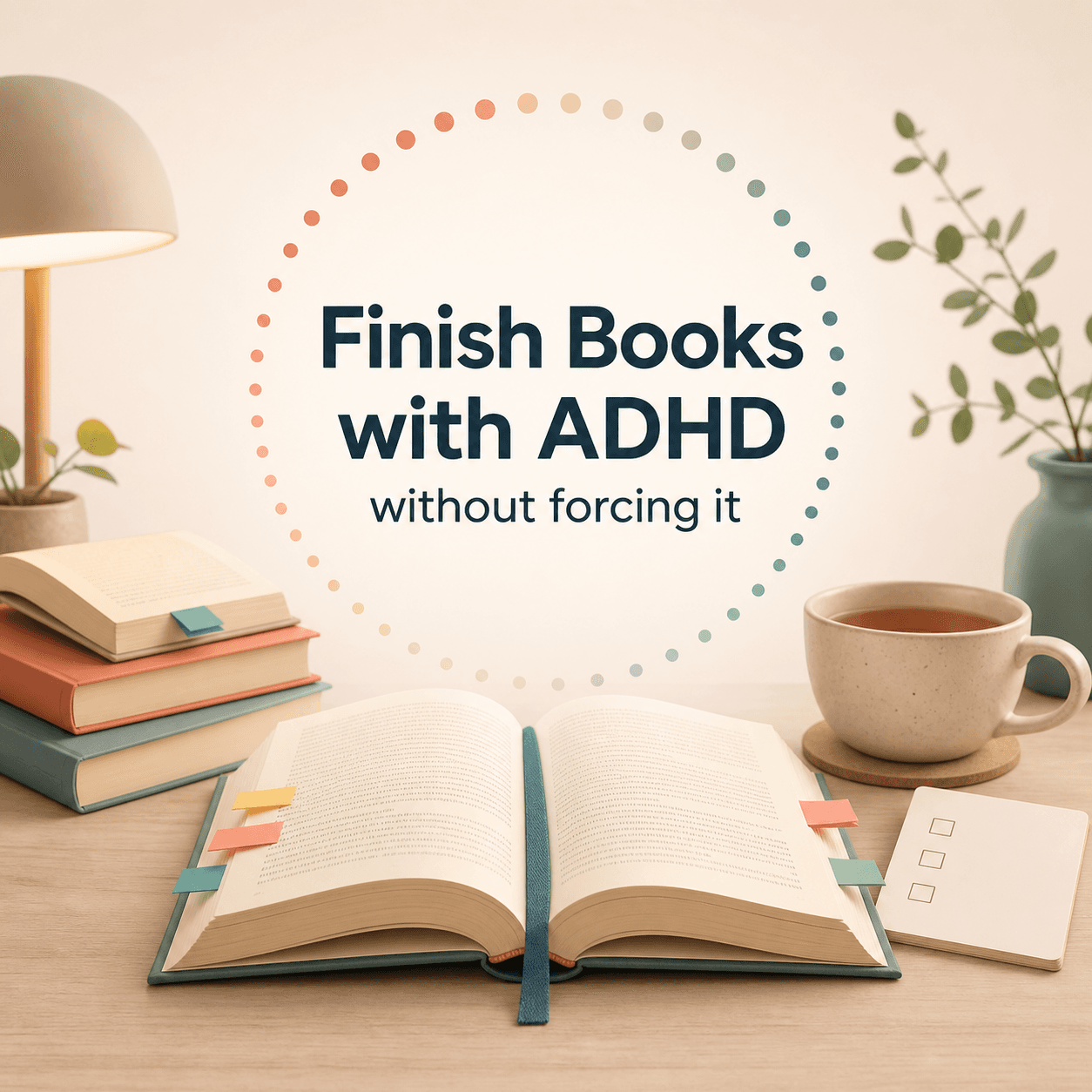
I love the idea of being a person who finishes every book they start.
You know the type. They casually mention they read 60 books last year, they always have a tidy stack on their nightstand, and they never say things like, “I’m 43% in and I just… stopped.”
Meanwhile, if you have ADHD, you might be living in a different reality.
A reality where you buy a book because the first 20 pages made your brain sparkle. Then you put it down for one second. Then it disappears behind a pillow. Then you remember it at 2:11 a.m. and feel weirdly guilty. Then you start something else because you need dopamine and your brain is like, new thing new thing new thing.
And the worst part is not even the unfinished book.
It’s the forcing. The self lectures. The vibe of turning reading into homework. The whole thing gets heavy, and reading is supposed to be… a relief. A place to rest. A place to feel like yourself again.
So this is not a “power through” post.
This is how to finish books with ADHD without forcing it. Which really means, how to finish books in a way that actually works with your brain, not against it.
And yes, we’re going to talk about quitting books too. Because sometimes that is the most ADHD friendly finishing there is.
A quick note before we start
This is personal and practical, not medical advice. ADHD looks different for everyone, and some seasons of life are just not reading seasons. That’s allowed.
Also, you don’t need to become a different person to finish books. You just need a system that respects how your attention works.
Why finishing feels harder with ADHD (and why it’s not a character flaw)
ADHD is not just “can’t focus.” It’s more like… focus behaves like a cat. Sometimes it sits directly on your keyboard for four hours. Sometimes it vanishes when you call it.
A few ADHD specific things that mess with finishing books:
- Novelty wears off. The beginning of a book is shiny. The middle is often not.
- Working memory drops the thread. If you pause for a few days, you might forget names, plot, vibes, why you cared.
- Task resistance kicks in. The moment your brain decides reading is a “should,” it becomes hard to start.
- Time blindness. “I’ll read later” can turn into two weeks without noticing.
- Perfectionism sneaks in. If you missed a few nights, you feel like you failed, so you avoid the book altogether.
So if you’ve been telling yourself you’re lazy or undisciplined, I want you to toss that in the trash. Gently. But firmly.
You’re not bad at reading. You’re just trying to read the way people without your brain wiring read.
Redefine “finish” so your brain stops fighting you
This is the first mental shift that actually changes things.
For ADHD readers, “finish” can mean:
- Finish the story, even if it’s via audiobook for the second half.
- Finish the main idea, even if you skim or jump around.
- Finish your relationship with the book, even if you DNF it on purpose.
- Finish one chapter today. That counts as progress, not “barely anything.”
A lot of the forcing comes from one rigid definition of success.
So here’s your permission slip:
You can finish books in unconventional ways. The point is the experience. The comfort. The meaning. Not the purity test.
The core trick: lower the activation energy
If there’s one concept that helps ADHD reading more than anything, it’s this.
Your brain doesn’t just ask, “Do I want to read?”
It asks, “How hard will it be to start reading?”
Starting is the wall. Not the reading itself.
So we make starting stupidly easy.
Make the book physically easy to pick up
- Keep the current book where you already are, not where you wish you were.
- Couch book. Bed book. Bag book. Bathroom book. One book per location if that helps.
- Remove friction like bookmarks you can’t find. Use a receipt. A sticky note. Whatever.
Make the next step obvious
When you stop reading, don’t just close the book. Leave yourself a breadcrumb.
- Underline the last line you read.
- Write one sentence on a sticky note like: “We just met the sister and she’s lying.”
- If it’s nonfiction: “Next: chapter 4, the habit loop part.”
This helps future you re enter the story without the “wait what was happening” tax.
Use the ADHD friendly format switch (it’s not cheating)
If you tend to stall halfway, the format switch is magic.
You start the book in print or ebook. When you hit the slump, you switch to audio. Or the other way around.
This does a few things:
- Brings novelty back.
- Lets you “read” while moving, cleaning, commuting.
- Removes the pressure of sitting still.
- Keeps the story alive in your head.
If you want a simple rule: Print for focus, audio for momentum.
And yes, it counts. You still absorbed the book. You still lived inside it.
The “two bookmarks” method for when you get bored easily
This one is weirdly effective.
Put two bookmarks in your book:
- One where you’re actually reading.
- One at a “high interest point” you peek ahead to find. A chapter title that looks juicy. A scene that starts with dialogue. A section with bullet points.
When your brain refuses to continue at Bookmark 1, you give yourself permission to jump to Bookmark 2 for a few pages.
Often, that re sparks motivation. Then you slide back.
Is it linear? Not always. Does it work? Honestly, yes.
Stop trying to read every day (aim for a rhythm instead)
Daily habits are great for some people.
For others, “every day” becomes a trap. Miss one day, shame spiral, the habit breaks, you stop reading for a month.
Instead, try a rhythm:
- 3 days a week
- Weekends only
- Every other day
- One long session on Sunday
Pick something that feels forgiving.
Then build a tiny ritual around it. Light a candle. Make tea. Put on the same playlist. Not because you have to be aesthetic. But because your brain starts to associate the cue with reading.
Less decision making. More autopilot.
Make it a “pairing” activity (body busy, mind calmer)
A lot of ADHD brains read better when the body is doing something small.
Try reading while:
- Walking slowly on a treadmill (even 1.5 speed).
- Sitting outside.
- Rocking in a chair.
- Using a fidget.
- Taking a bath.
- Eating a snack (carefully, but still).
The goal is not to multitask in a chaotic way.
It’s to give the restless part of your brain something to do so the reading part can stay.
The 10 page promise (and why it works)
Make a deal with yourself:
“I will read 10 pages. Then I can stop without guilt.”
Most of the time, once you start, you’ll keep going. Not always. But often.
And if you stop at 10 pages, you still kept the relationship alive.
This is how you finish books without forcing. You keep showing up in a way that feels safe.
If 10 pages is too much, make it 2 pages. One scene. Five minutes.
The number is not the point. The non threatening start is.
Mid book slump rescue plan (when you hit the mushy middle)
The middle of books is where ADHD readers go to die.
So here’s a rescue plan you can use the moment you notice yourself stalling.
Step 1: Name the reason
Ask:
- Am I bored, or just overwhelmed?
- Did I forget what’s happening?
- Is this book too slow right now?
- Am I tired, stressed, depressed, burned out?
Sometimes the solution is not a new strategy. Sometimes it’s sleep.
Step 2: Re enter with help
- Read a 1 star review that summarizes the plot (weird but effective).
- Skim the last 3 pages you read.
- Look up a character list.
- If it’s nonfiction, reread the headings and bold text.
You are allowed to rebuild context.
Step 3: Change the conditions
- New location.
- New format (audio).
- Shorter sessions.
- Read at a different time of day.
ADHD attention is state dependent. If the state changes, the focus can come back.
Quit faster. Seriously. It protects your reading life.
If you want to finish more books, you might need to DNF more books.
Because half finished books that you drag around out of guilt are like open tabs in your brain. They drain you.
Here’s a clean way to quit:
The 50 page honesty check
At 50 pages (or 15% in), ask:
- Would I recommend this to someone like me?
- Am I curious what happens next?
- Do I feel pulled forward, even a little?
- If this was a library book due tomorrow, would I rush to finish it?
If the answer is mostly no, you can stop. No dramatic speeches required.
DNF is not failure. It is curation.
And curating your reading life is kind of the whole point of a cozy reading practice anyway.
Use a “currently reading” cap (so you stop abandoning books)
If you’re always halfway through five books, you’re not broken.
You’re just over open.
Try this: No more than 2 active books at a time.
- 1 fiction
- 1 nonfiction
That’s it. Everything else goes on a list called “Later, not now.”
A cap reduces the constant dopamine chasing. It also makes it easier for your brain to remember what’s happening, because you’re not juggling seven worlds.
Make finishing feel immediate (ADHD brains need a reward)
Neurotypical advice often assumes the reward is “I finished a book.”
ADHD brains sometimes need something more immediate than that. Something you can feel today.
Try attaching a small reward to finishing milestones:
- After each chapter, you get to write one sentence in your reading journal.
- After 50 pages, you can message a friend a hot take.
- After finishing, you get to pick the next book from your TBR jar.
- After finishing, you add one quote to your “favorite lines” note.
If you’re into journaling, this is where GlimmerReads style prompts really shine. Not in a “do homework” way. In a, “I want to remember what this made me feel” way.
ADHD friendly book journaling (the simplest version)
You do not need a fancy spread. You do not need to write a full review.
Try this tiny template on a sticky note or Notes app:
- What just happened? (one sentence)
- What do I feel right now? (one word is fine)
- What do I want to remember? (one line)
That’s it.
This keeps the thread alive between sessions, which makes returning to the book so much easier.
If you want more prompts like this, GlimmerReads has a bunch of cozy, low pressure journaling ideas in the Reading Room and in the newsletter The Weekly Chapter over at https://glimmerreads.com. It’s very much built for readers who want meaning without the pressure.
Pick books that are easier to finish (this is a skill, not a personality test)
Some books are just harder to finish with ADHD. Long chapters. Dense prose. Slow build. Tiny font. No dialogue for 40 pages.
You can still read those books. Just maybe not when you’re fragile. Or busy. Or stressed.
If you’re trying to rebuild your finishing muscle, choose books with:
- Short chapters
- Clear stakes
- Strong voice
- Fast scene changes
- Dialogue
- A “just one more chapter” pull
Also, re reading is valid. Comfort reads are valid. Series are valid. Graphic novels are valid. Audiobooks are valid.
You’re not trying to prove you can read the hardest thing. You’re trying to keep reading a place you want to return to.
A few images to break things up (and give you a visual reset)
Cozy reading setup idea

Reading while moving (ADHD friendly)
Simple journaling moment
A realistic „finish the book“ plan you can try this week
If you want something concrete, here’s a plan that doesn’t require a new personality.
Day 1: Set the book up for success
- Put it where you will actually see it.
- Add a sticky note: „What’s happening right now?“
- Choose your reading rhythm (3x this week is fine).
Day 2: Read for 10 minutes
- Stop on purpose, mid scene if you can.
- Leave a breadcrumb note for future you.
Day 3: Format switch if needed
- If you stalled, try audio for the next chapter.
- Or read the next chapter in a new location.
Day 4: Do the 50 page honesty check
- If it’s a no, DNF cleanly.
- If it’s a yes, keep going with small sessions.
Day 5: Finish with a reward
When you finish, write three lines: your favorite moment, a line you want to keep, and who you’d recommend it to.
That’s finishing. That counts. And it doesn’t involve forcing.
Let’s wrap this up (without the guilt)
Finishing books with ADHD is not about pushing harder.
It’s about building a reading life that stays soft. Flexible. Kind of forgiving, honestly.
Try the things that reduce friction:
- Make starting easier than procrastinating.
- Switch formats when you stall.
- Use breadcrumbs so you can re-enter fast.
- Read in rhythms, not rigid streaks.
- Quit books that drain you.
- Give your brain small rewards and quick meaning.
And if you want a cozy place to keep that meaning, to actually remember what a story changed in you, come hang out at GlimmerReads. Start with the Reading Room on https://glimmerreads.com, or join The Weekly Chapter if you want gentle structure delivered to you week by week.
You don’t need to force yourself through books.
You just need a way back in.


No responses yet