I used to be the kind of reader who could finish a book, close the cover, feel that warm little buzz of having lived somewhere else for a while…
…and then, two weeks later, someone would ask me what it was about and I’d say something horrifying like:
“It was really good. Um. There was a house. And like, feelings.”
Not ideal.
The problem was never that I wasn’t paying attention. I was. I was underlining. I was dog-earing pages. I even tried writing full summaries like I was back in school, which, honestly, made me want to read less.
What finally worked was almost annoyingly simple.
One quote.
Not a page of notes. Not a color coded system. Not a 12 step reading workflow.
Just one quote per book that becomes the anchor. The hook. The little thread you can tug later that pulls the whole story back into your hands.
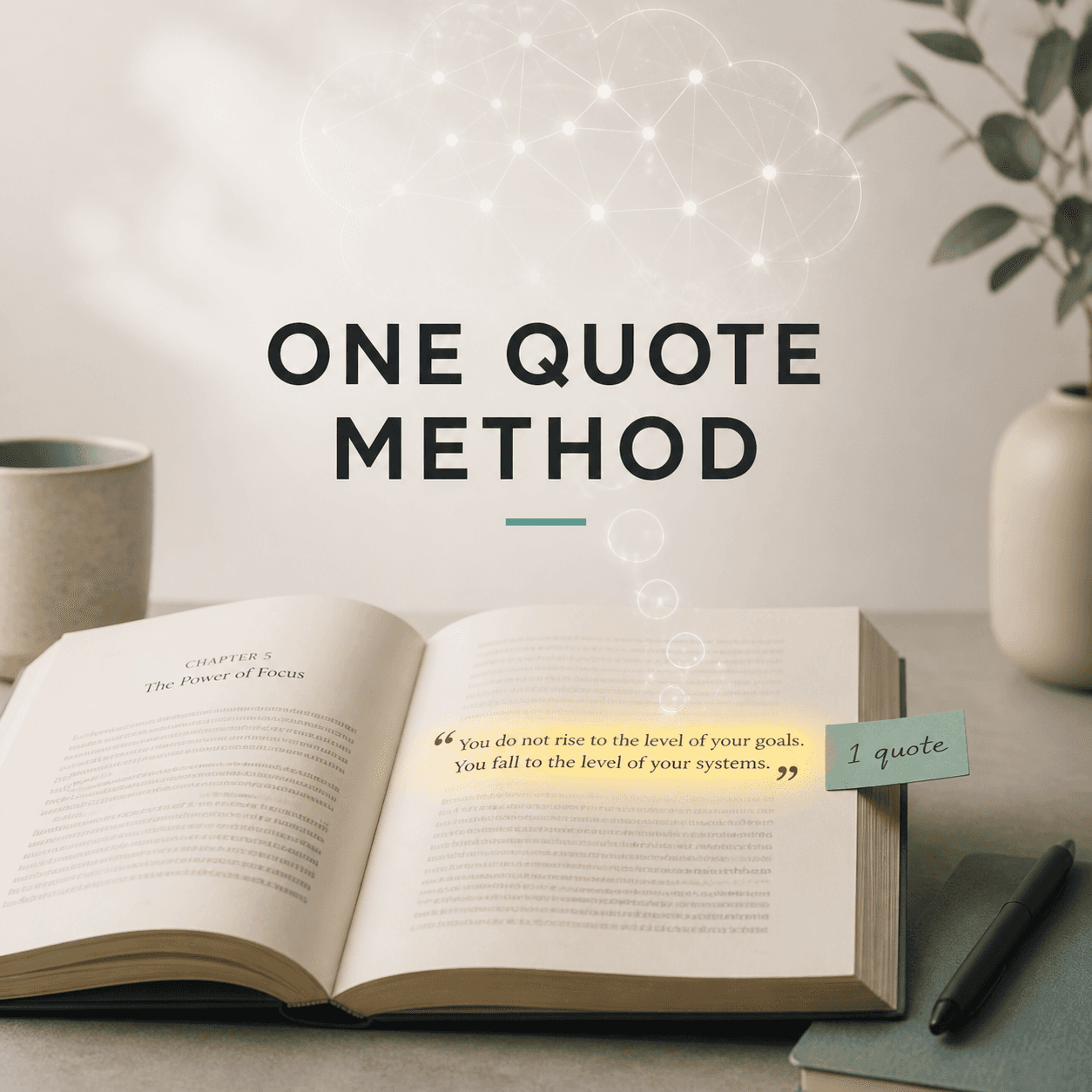
That’s what I call the One Quote Method. And if you’re the kind of reader who wants books to stick, like actually stick, this is such a gentle way to do it.
Why we forget books even when we love them
A quick reality check. Forgetting is normal.
Your brain is not a bookshelf. It’s more like… a cozy living room where only a few things are left out on the coffee table. Everything else gets put away unless you keep using it.
When we finish a book, we usually do one of two things:
- We move on immediately to the next one.
- We tell ourselves we’ll remember it because it mattered.
And then life does life.
The details fade first. Then the characters blur. Then even the main idea gets mushy. All you’re left with is a vibe. Which is sweet, but not very useful if you actually wanted to carry something forward.
The One Quote Method works because it gives your brain a single, specific, sensory handle.
A quote is language. Rhythm. Tone. It’s compact. It has edges. It’s easier to retrieve than a whole plotline.
And once you retrieve the quote, the rest tends to follow.
The One Quote Method (in plain English)
Here’s the entire method:
Pick one quote from the book that feels like the book. Copy it somewhere you trust. Add one short note about why you chose it.
That’s it.
But the magic is in how you choose the quote and how you store it so it becomes a retrieval cue later.
So let’s break it down, without making it weirdly complicated.
Step 1: Choose a quote that can carry the whole book on its back
Not every quote is a good anchor.
Some quotes are pretty, but forgettable. Some are clever, but don’t connect to anything else. Some are basically just plot facts, which won’t help you remember the emotional core.
You want a quote that does at least one of these things:
1) It states the book’s central truth
This is common in nonfiction and memoir.
A line that feels like: “Oh. That’s what this whole thing is about.”
2) It captures the emotional temperature
Fiction especially. A quote that sounds like the book feels.
Not necessarily the most famous quote. Just the one that makes you go quiet for a second.
3) It changed something in you, even a little
Sometimes the best quote isn’t the “best written.” It’s the one that met you at the right time.
The line that made you text a friend. Or put the book down and stare at the wall. Or whisper, okay… yeah.
4) It names a problem you’ve been living with
These are the quotes you remember in the shower three months later. The ones that feel personal. Keep those.
A quick gut-check question (my favorite)
When you find a quote that might be the one, ask:
If I only kept this one sentence from the whole book, would I still be able to remember why I loved it?
If yes, that’s your anchor.
If no, keep looking.
Step 2: Capture it in a way that your future self will actually find
This is the part most people mess up.
They underline the quote in the book. Which is nice. But then the book goes back on the shelf. Or into a stack. Or into the bottomless pit known as “I’ll organize this later.”
You need a single place where your quotes live.
Not ten places. Not sometimes Notes app, sometimes Goodreads, sometimes margins, sometimes a random sticky note that migrates into another dimension.
One place.
Here are a few options that work well:
- A dedicated “Quotes” section in your reading journal
- A single running note on your phone titled “Book Quotes I’m Keeping”
- A spreadsheet if you’re that kind of person (respect)
- A Notion page with book title + quote + one line reflection
If you’re already into bookish journaling, this fits perfectly with the kind of reflective reading we talk about in the Reading Room over at GlimmerReads. The goal is not to document everything. It’s to keep what matters.
Step 3: Add one short note. One. Not a paragraph.
Under the quote, add a tiny note. This is what locks it in.
Think of it like labeling a file so you can find it later.
Here are a few easy formats:
- “This is the moment the book turned.”
- “This is what I needed to hear this month.”
- “Theme: forgiveness, but the messy kind.”
- “This line explains the main character’s whole problem.”
- “I want to remember this when I’m anxious.”
Keep it short. You’re not writing an essay. You’re leaving breadcrumbs.
What this looks like (examples)
Let’s make it concrete. Here are some example entries, the way you’d actually write them.
Fiction example
“It is not enough to be loved. One must be loved well.”
Note: The whole book is about the difference between attention and care.
Nonfiction example
“You do not rise to the level of your goals. You fall to the level of your systems.”
Note: I keep trying to “motivate” myself instead of designing my life.
Memoir example
“I thought healing meant feeling better. It meant feeling everything.”
Note: I’ve been trying to skip the middle part.
Even if you can’t recall the plot later, these notes bring you back to the why.
Add images (so this post feels like a cozy how-to, not a lecture)
Here are a few images that fit naturally inside this article on WordPress. You can use your own photos, or pull royalty free ones from places like Unsplash or Pexels.
Image idea 1: A reading journal open to a quote page
Image idea 2: Annotated book pages with sticky notes

Image idea 3: Notes app style quote capture vibe

(If you prefer, you can swap these out later for GlimmerReads original photography. Same placements work.)
Why one quote is better than ten highlights
This is going to sound a little counterintuitive, but.
If you highlight everything, you highlight nothing.
When you come back later, a page full of neon lines is not a memory. It’s a blur. Your brain doesn’t know what to grab.
But choosing one quote forces a decision:
What mattered most?
And that decision is a form of processing. Processing is what creates retention.
Also, there’s something emotionally satisfying about finishing a book and extracting one distilled line, like a little vial of meaning you can keep.
The “One Quote” method for different kinds of readers
Not everyone reads the same way, so here are a few variations that still keep the method simple.
If you’re a mood reader
Pick the quote that matches the feeling you want to remember.
Not the plot. Not the lesson. The feeling.
Then your note can be:
“This was my winter book.”
or
“This felt like starting over.”
If you’re a fast reader who forgets details
Pick a quote that names the central conflict or question.
Then add a note:
“Main tension: freedom vs belonging.”
Now you’ve built yourself a quick mental map.
If you read for personal growth
Pick a quote that you can apply to your life.
Your note becomes:
“Practice: call my friend instead of spiraling.”
or
“Reminder: rest is not a reward.”
If you’re in a book club
Pick a quote that sparks discussion.
Your note can be:
“Ask: was this character brave or just reckless?”
Then bring it to the meeting. Instant conversation starter.
(Also, if you want a place where this kind of reflection is the whole point, GlimmerReads’ community book club is basically built for it. Reading together, but gently. Not performative.)
The sneaky psychology behind why this works
You don’t need to know the science for the method to work, but it helps to understand why it’s so effective.
A quote does three things:
- It compresses the book into a cue.
- It creates a vivid “retrieval trigger.”
- It encourages elaboration, even in one sentence.
That last one matters.
When you add your one line note, you’re telling your brain: This isn’t just text. This is connected to me.
And your brain is much better at remembering things that touch identity, emotion, timing, personal relevance.
That’s why you can remember a random sentence someone said to you in 2017, but not the entire plot of a novel you read last month.
How to choose the quote while you’re reading (without breaking the flow)
Some people get stuck here. They think they have to be on high alert the whole time, hunting for the perfect sentence.
Please don’t do that. It ruins the reading.
Instead, try this:
The “Soft Mark” approach
While reading, when a line makes you pause, just do something tiny:
- fold the corner (if you don’t mind)
- add a small sticky tab
- underline lightly
- or snap a quick photo of the page
No pressure. You’re just collecting candidates.
Then, when you finish the book, you go back and pick the one.
This is important. The best quote often reveals itself in hindsight, once you know what the book was really doing.
The 5 minute end-of-book ritual (this is where the memory forms)
When you finish a book, do this before you start the next one.
Set a timer for 5 minutes.
- Flip through your soft marks.
- Choose the one quote.
- Copy it into your quote home (journal, notes, whatever).
- Add your one line note.
- Optional: rate the book in one word. Just one.
Examples of one-word ratings:
- “bruising”
- “gentle”
- “electric”
- “necessary”
- “odd”
- “comforting”
That’s it.
This little pause is the difference between books that wash over you and books that stay.
What if you can’t find a quote you love?
This happens. Especially with books that are more plot driven, or books that are good but not quote-y.
Two options.
Option 1: Use a “made quote” (your own sentence)
Write one sentence that summarizes what you’re taking from the book.
Like:
“I can’t outrun my own patterns, but I can name them.”
Note: This was the real arc, not the romance plot.
You’re still doing the same thing. One anchor sentence. One note.
Option 2: Use a micro scene instead of a quote
Describe a tiny moment in the book in one or two lines.
“The scene where she stands in the kitchen at 2 a.m. and decides to leave.”
Note: That quiet decision hit harder than the big arguments.
Sometimes scenes are more memorable than sentences. Use what works.
How to revisit your quotes so they actually… do something
A quote collection is only powerful if you look at it again.
Not constantly. Just enough to bring the books back into your life.
Here are three low effort ways:
1) The Monthly Flip
Once a month, scroll or flip through your quotes and pick one to sit with for the day.
If you get The Weekly Chapter newsletter from GlimmerReads, this pairs beautifully with the monthly theme. One quote from a past book, one theme for the month, and suddenly your reading life feels… connected.
2) The “Before I Buy Another Book” rule
Before you start a new purchase or library haul, read your last 5 saved quotes.
It’s grounding. It reminds you what you’re actually drawn to.
3) The “Send it to a friend” move
Every so often, send one quote to someone who’d get it.
You’ll remember the book instantly, and you’ll also build a kind of shared reading thread with people you love. Which is the best part, honestly.
A simple template you can copy into your journal (or Notes app)
Here’s a clean structure you can paste and reuse:
Book:
Author:
One Quote:
Why I’m keeping it (1 line):
One word for how it felt:
Date finished:
If you want something even more minimal:
Book + Quote + Note.
Done.
One last thing (because this is the whole point)
The One Quote Method is not about proving you read something.
It’s not about building a perfect archive.
It’s about honoring the fact that stories change us in small ways, and we deserve to keep the parts that helped.
Even if it’s just one line.
If you try this and you want a cozy place to keep going, come wander through the Reading Room on GlimmerReads. There are journaling prompts, reflective book lists, and that gentle nudge to read like you mean it, but without turning it into homework.
Because reading is already enough.
We’re just learning how to carry it with us.


No responses yet