Burnout does this annoying thing where it makes everything feel too loud. Even the stuff you normally love.
You sit down with a book you were genuinely excited about. The one you saved. The one you bought because you were “going to get back into reading.” And then your brain just… slides off the page. You reread the same paragraph four times. You start doing math about how many pages are left. You check your phone. You get weirdly angry at the book for existing.
It’s not that you don’t like reading anymore. It’s that your system is overloaded. And reading, which usually feels like comfort, suddenly feels like work.
So this is not a post about reading more. Or reading better. Or optimizing your TBR.
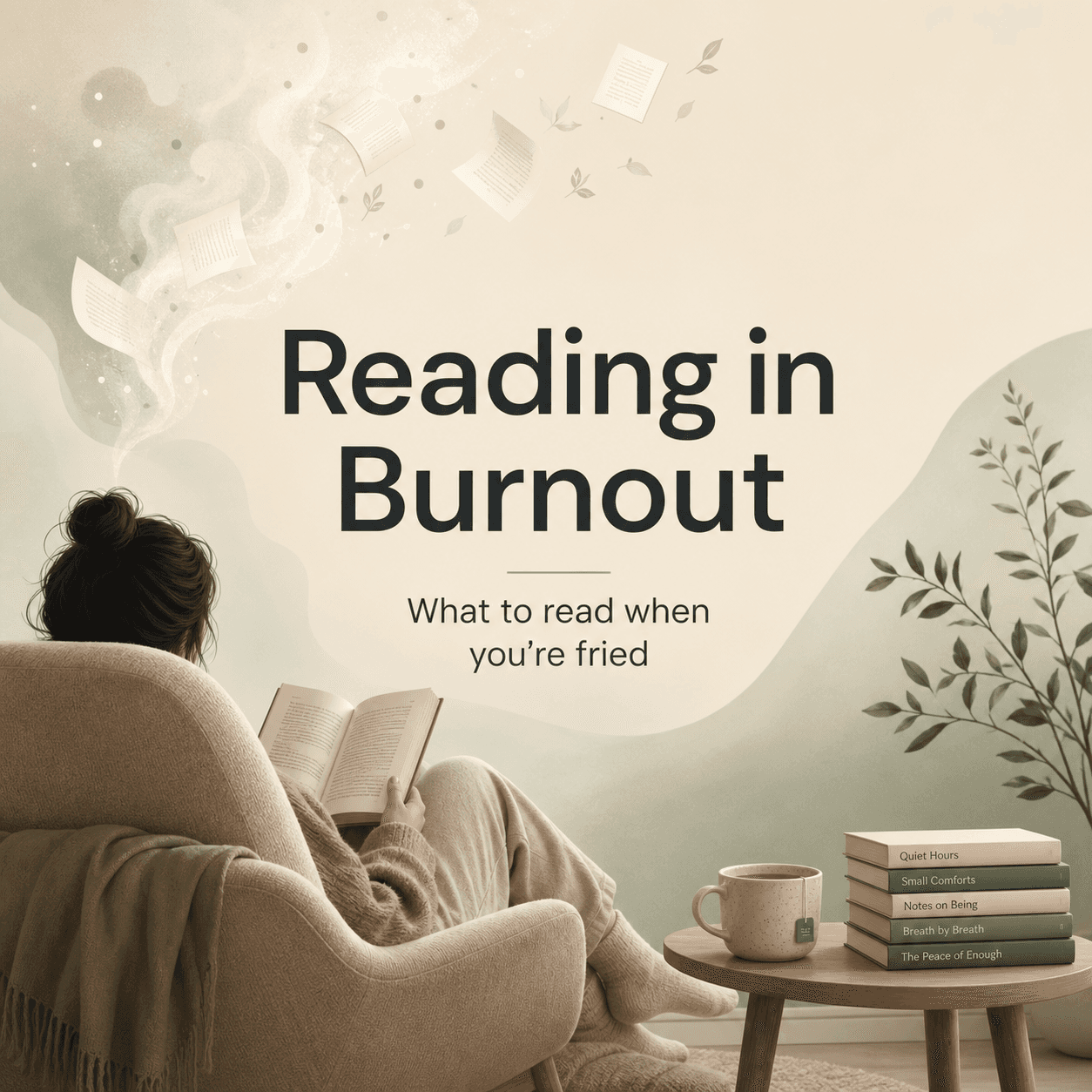
This is about reading in burnout. Reading when you’re fried. Reading when you want something gentle, and you also want to feel like yourself again.
And yeah, some of the time the answer is “don’t read.” We’ll get to that.
But if you want a book shaped life raft, here are a bunch of options. Low demand. High comfort. Minimal emotional admin.

First, a small permission slip
Burnout reading is different reading.
You are allowed to:
- quit books halfway through
- reread the same comfort novel for the fifth time
- switch formats mid book (print to audio, audio to ebook)
- read children’s books or YA even if you’re 43
- read one poem and call it a day
- read nothing for a week and still call yourself a reader
You don’t have to earn reading. You don’t have to “deserve” easy books. If your brain is asking for simple and soft, that’s not you failing. That’s your brain trying to survive.
Sometimes the most restorative thing you can do is stop forcing yourself to consume “important” stories and just let a small, kind one sit next to you.
The burnout test: what kind of fried are you?
This helps, because different kinds of burnout need different kinds of books.
1) You’re mentally foggy
You can’t hold plot threads. Names slide right out of your head.
You probably want: short chapters, simple language, minimal characters, straightforward stakes.
2) You’re emotionally crispy
Everything makes you tear up, even a dog food commercial.
You probably want: warm, safe books. Or funny books. Or books where the feelings are contained and don’t spill all over your day.
3) You’re physically exhausted
Your eyes won’t focus. Holding a book feels like lifting a brick.
You probably want: audiobooks, novellas, graphic novels, large print, anything that reduces friction.
4) You’re existentially done
You’re not just tired. You’re tired of being a person. The world feels heavy.
You probably want: meaning without heaviness. Hope that isn’t corny. Quiet companionship. Something that says, yes, it’s a lot. And also, you’re still here.
Keep that in mind as you pick from the categories below. You don’t need the “best book.” You need the right book for today.
What to read when you can’t focus (but you want pages)
These are books that don’t punish you for drifting. They’re built for interrupted attention. You can pick them up, put them down, and still feel oriented.
Short story collections
Short stories are underrated burnout medicine. You get closure. You get a full arc. You don’t have to remember what happened 140 pages ago.
Try:
- “I’ve Been Thinking” by Maria Shriver (not fiction, but short reflective pieces, very readable when foggy)
- “Uncommon Type” by Tom Hanks (gentle, surprisingly cozy stories)
- “Interpreter of Maladies” by Jhumpa Lahiri (emotionally rich, but contained. Read slowly)
Essays that feel like someone talking softly
The best essays in burnout feel like sitting on the kitchen floor with a friend while the kettle boils.
Try:
- “Bird by Bird” by Anne Lamott (about writing, yes, but mostly about being human)
- “The Anthropocene Reviewed” by John Green (short chapters, tender and funny, easy to pause)
Micro books and tiny memoirs
You want something you can finish in one sitting and feel a little spark of accomplishment.
Try:
- “Small Things Like These” by Claire Keegan (quiet, short, devastating in a controlled way)
- “The Housekeeper and the Professor” by Yoko Ogawa (soft, calm, math-y in a soothing way)
What to read when you need comfort (like actual comfort)
Comfort reads are not “junk.” They are regulation tools. Like soup. Like a warm shower. Like putting on the same show you’ve seen twelve times.
Here are a few flavors of comfort, because comfort isn’t one thing.
Low-stakes cozy fiction
You want a world where the problems are solvable. Where the worst thing that happens is maybe a misunderstanding and a missing pie.
Try:
- “The House in the Cerulean Sea” by TJ Klune (bighearted, safe, gently funny)
- “Legends & Lattes” by Travis Baldree (coffee, friendship, low conflict, very soothing)
- “The Very Secret Society of Irregular Witches” by Sangu Mandanna (found family, warm tone, not too sharp)
Cozy mysteries (mystery without terror)
Your brain gets a puzzle. But your nervous system doesn’t get attacked.
Try:
- “The Thursday Murder Club” by Richard Osman (charming, witty, surprisingly tender)
- Agatha Christie (especially Miss Marple when you want calm intelligence and tidy endings)
Romance that doesn’t demand emotional acrobatics
Romance can be a safety net because it promises resolution. In burnout, the promise matters.
Try:
- “The Flatshare” by Beth O’Leary (gentle, funny, warm)
- “Book Lovers” by Emily Henry (smart, comforting, but still propulsive)
A note, because this matters: if romance makes you feel lonelier right now, skip it. That’s not you being broken. That’s just information. Pick a different comfort flavor.
What to read when everything feels pointless (but you’re still trying)
This is the hardest burnout to read through, honestly. Because you’re not just tired. You’re disconnected. Books can help, but they have to be the right kind of help.
You want books that are hopeful without being preachy. Books that hold darkness but don’t abandon you there.
Try:
- “A Man Called Ove” by Fredrik Backman (grief, crankiness, community. It lands.)
- “Remarkably Bright Creatures” by Shelby Van Pelt (yes, there’s an octopus. yes, it works. it’s tender.)
- “The Boy, the Mole, the Fox and the Horse” by Charlie Mackesy (illustrated, bite sized, gentle wisdom)
- “Man’s Search for Meaning” by Viktor E. Frankl (only if you have capacity. it’s powerful, but not “light”)
If you’re in the “I can’t handle heavy content” zone, go with Mackesy. One page at a time. That’s enough.
What to read when you’re too tired to read (but you want stories)
This is where format saves you.
Audiobooks
Audiobooks count. They are books. Full stop.
A few audiobook friendly picks:
- “Project Hail Mary” by Andy Weir (if you want momentum and distraction. very listenable)
- Any David Sedaris collection (laughing helps. it just does.)
- “The Harry Potter” series (if it’s your comfort and you already know it, even better. rereads are easier in burnout)
Pro tip: set playback to 1.15x if your brain needs a little more stimulation, or 0.95x if your nervous system needs slower.
Graphic novels
The art does some of the cognitive work for you. Less effort, more immersion.
Try:
- “Heartstopper” by Alice Oseman (sweet, low threat, emotionally kind)
- “The Tea Dragon Society” by Kay O’Neill (soft, cozy, like a blanket in panel form)
- “Persepolis” by Marjane Satrapi (more intense, but gripping and accessible)
Poetry (the kind that doesn’t make you feel dumb)
You don’t need “analysis” right now. You need language that meets you where you are.
Try:
- Mary Oliver (clear, grounding, nature as nervous system support)
- Ada Limón (warm, alive, human)
- Ross Gay (joy that feels earned)

What to reread in burnout (yes, reread)
Rereading is basically a burnout superpower. Your brain already knows the path. There are fewer surprises. Less vigilance. More safety.
If you don’t know what to reread, ask yourself:
- What book felt like being understood?
- What book did I read during a safe season of life?
- What fictional place do I want to “visit” again?
- What book did I love before I got tired?
Some common reread categories that work:
- childhood favorites (even picture books, honestly)
- series you know by heart
- “competence comfort” stories where someone is quietly good at something
- books with strong setting, because setting can do the soothing
You don’t need novelty right now. You need steadiness.
What not to read (for now)
This part is gentle, not bossy. You can read anything you want. But if you’re deeply fried, some books will feel like throwing a backpack full of rocks on an already sore back.
Maybe avoid, temporarily:
- sprawling epics with 38 characters and invented words
- bleak books with no relief or humor
- books everyone says you “should” read
- intense self help that feels like homework
- anything that makes you feel guilty for not healing fast enough
You can come back to them later. Books are patient.
A simple burnout reading plan (for the next 7 days)
If decision fatigue is part of your burnout, here’s a plan you can borrow. Adjust it. Make it smaller. Make it weirder. It’s fine.
Day 1: Choose one “easy win”
Pick something you can finish quickly. A short story. A poem. A graphic chapter. You’re reminding your brain that reading still works.
Day 2: Pick a comfort reread
Ten pages. Or twenty minutes of audio. Stop before you’re tired. Leave it with a little sweetness still in the tank.
Day 3: Read something that makes you laugh
Even if it’s one essay. Even if it’s a comic strip collection. Your nervous system likes laughter.
Day 4: Read something with beauty
Nature writing. Poetry. A book with lovely sentences. Beauty counts as fuel.
Day 5: Try a cozy page turner
A gentle mystery. A low-stakes fantasy. Something that pulls you forward without yanking.
Day 6: Switch format
If you’ve been trying print, do audio. If you’ve been doing audio, try a graphic novel. Novelty, but the easy kind.
Day 7: Journal one tiny reflection
Not a book report. Just a small note: “This line felt like a hand on my shoulder.” Or, “I liked that the ending was tidy.” That’s enough.
If you want prompts like that regularly, that’s basically what we do at GlimmerReads, especially inside the Reading Room posts and in The Weekly Chapter newsletter. Not in an intense way. More like… quiet companionship and a nudge to notice what your reading is giving you.
Bookish journaling prompts for burned out readers
These are meant to be low effort. One sentence answers are welcome. Scribbles welcome.
- What do I want a book to do for me right now? (distract, comfort, energize, make me feel less alone)
- What’s one emotion I cannot handle in a story today? (and what emotion feels safe?)
- What kind of ending do I need? (happy, resolved, open, hopeful, doesn’t matter)
- Do I want a plot, or do I want vibes?
- What is the gentlest scene I can remember from any book?
- What’s a “five page book” for me? (a book I can read in five page sips)
- After reading, do I feel more tense or more settled? (use this as your compass)
If you want, copy these into your reading journal. Or start a note on your phone called “Burnout Reading Map.” Because honestly, future you will forget. Burnout steals memory like that.
A quick recommendation list, by burnout mood
No long explanations. Just a grab and go.
If you want cozy + kind
- The House in the Cerulean Sea (Klune)
- Legends & Lattes (Baldree)
- The Tea Dragon Society (O’Neill)
If you want funny
- Me Talk Pretty One Day (Sedaris)
- Bossypants (Tina Fey)
- The Thursday Murder Club (Osman)
If you want short + beautiful
- Small Things Like These (Keegan)
- The Anthropocene Reviewed (Green)
- Mary Oliver poetry
If you want hopeful but not cheesy
- A Man Called Ove (Backman)
- Remarkably Bright Creatures (Van Pelt)
- The Boy, the Mole, the Fox and the Horse (Mackesy)
If you want “I can’t read, help”
- Audiobook of a comfort reread
- Heartstopper (Oseman)
- Any essay collection with short chapters
A gentle ending (because you might be tired)
Reading in burnout is not about being impressive. It’s not about goals. It’s about finding a door that opens without you having to shove it.
Some days, that door is one paragraph. Some days, it’s an audiobook while you fold laundry. Some days, it’s nothing at all. A nap. A walk. Silence.
But if you do want to come back to books, come back softly.
Pick the book that asks the least of you. The one that gives more than it takes.
And if you want more lists like this, plus journaling prompts that aren’t intense or performative, you can wander over to GlimmerReads and settle into the Reading Room. Or subscribe to The Weekly Chapter if you want a small, steady reading rhythm delivered to you instead of you having to go find it.
That’s kind of the point, right. Less searching. More shelter.


No responses yet