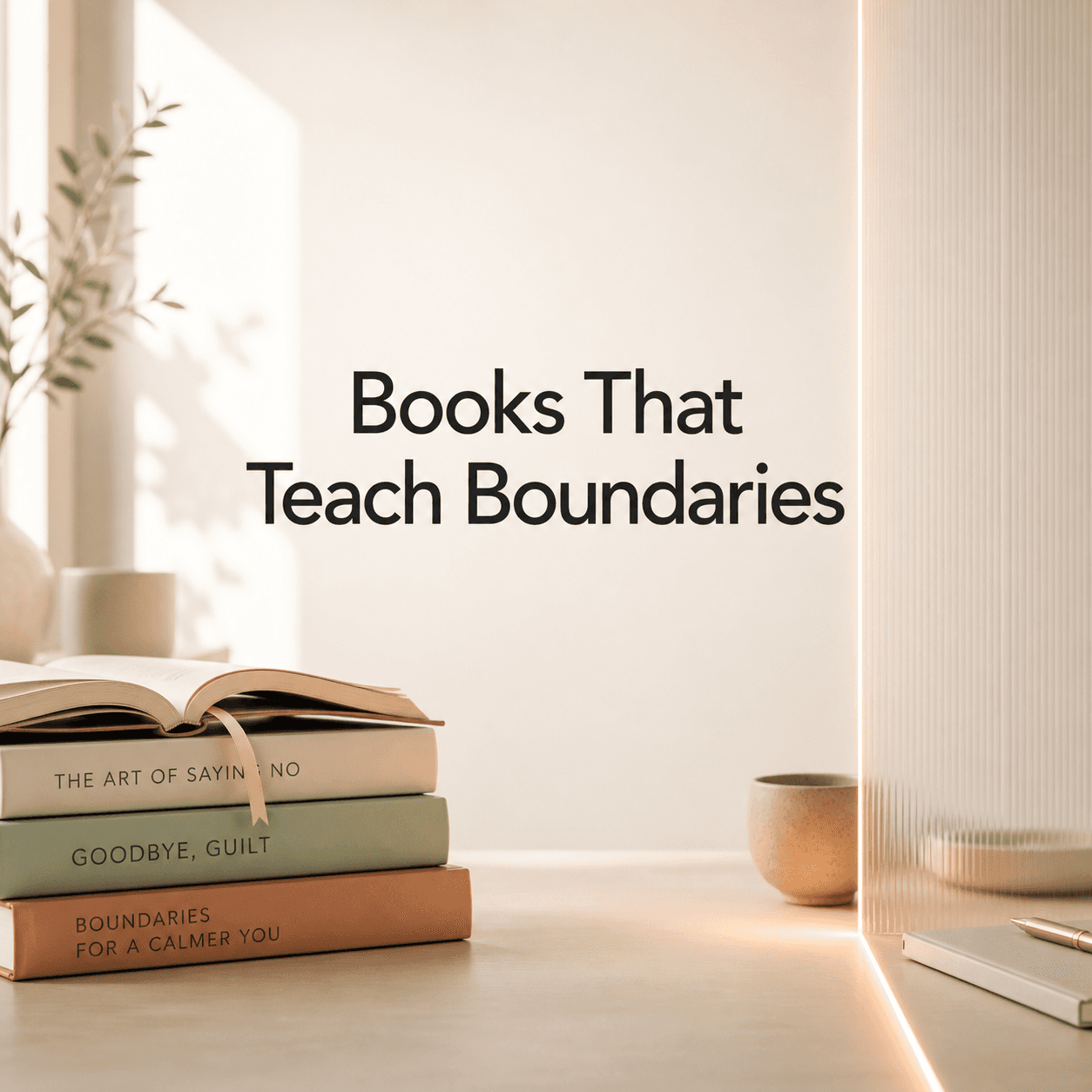
There’s a certain kind of “boundaries book” that feels like it’s wagging a finger at you.
Like. Please stop. I already know I should say no more often. I’m just tired. And sometimes I don’t want another checklist that makes me feel like I’m failing at self respect.
So this list is for the rest of us.
Books that teach boundaries sideways. Through story. Through a messy character you recognize. Through an essay that feels like a friend telling you the truth without trying to “fix” you. They’re not perfect books, and honestly, that’s part of why they work.
A quick note before we start. Boundaries are not about being cold, or turning into a fortress, or cutting everyone off. They’re about clarity. About choosing. About knowing where you end and other people begin. And learning how to live inside that line without apologizing for existing.
If you like this kind of reading, this is basically what we do at GlimmerReads. Cozy recommendations, journaling prompts, and that gentle nudge to carry the good parts of a book into real life.
What “non preachy boundaries” actually looks like in a book
Not a TED Talk in disguise.
More like:
- A character finally stops over explaining themselves, and nothing explodes.
- Someone disappoints people on purpose, and they survive it.
- A woman chooses quiet over being “nice.”
- A memoir where the author admits they backslid, got messy, tried again.
Boundaries are learned in moments, not mottos. These books get that.

1. Set Boundaries, Find Peace by Nedra Glover Tawwab (Nonfiction)
This is the rare boundaries book that’s actually… practical without being harsh.
Nedra’s tone is direct, but not scolding. It’s more like, “Here’s what a boundary is. Here are the words. Try this. Adjust it. You’re allowed.” Which is what most of us need. Permission. Language.
What it teaches, quietly:
- You don’t need a dramatic reason to set a boundary.
- The pushback doesn’t mean you’re wrong.
- A boundary is not a debate invitation.
If you’ve ever frozen in the moment and thought, what do I even say, this book helps with that part.
Best for: people who want scripts, examples, and clarity without the shame flavor.
2. Adult Children of Emotionally Immature Parents by Lindsay C. Gibson (Nonfiction)
Okay, I know. This one can sound intense. But it’s not preachy. It’s… illuminating.
It explains dynamics that a lot of us have normalized for years. The guilt, the obligation, the weird emotional caretaking you didn’t realize you were doing. And it gives you a framework for stepping back without turning your life into a war.
What it teaches, gently but firmly:
- You can love someone and still limit access to you.
- You are not responsible for another adult’s emotional regulation.
- Distance can be an act of sanity, not cruelty.
This book is more like a light clicking on in a room you’ve been bumping around in.
Best for: anyone who keeps feeling like the “bad guy” for wanting space.
3. The Gift of Fear by Gavin de Becker (Nonfiction)
This isn’t marketed as a boundaries book. Which is one reason it hits so hard.
It’s about intuition, safety, and the social conditioning that trains us to ignore our own discomfort. Especially to be polite. Especially to not make a scene. Especially to doubt ourselves.
And that’s boundaries. That’s the root.
What it teaches:
- Discomfort is data.
- “No” is a complete sentence, yes, but also. You don’t owe closeness to someone who scares you.
- Being nice is not the same as being safe.
It’s not cozy, but it’s empowering. The boundary lesson is basically: trust yourself sooner.
Best for: people who second guess their instincts, especially around pushy behavior.
4. Eleanor Oliphant Is Completely Fine by Gail Honeyman (Fiction)
Eleanor is blunt. Rigid. Lonely. And totally unprepared for the ways relationships can blur into obligation.
Watching her slowly learn connection without losing herself is the whole point. It’s not a tidy self help arc. It’s messy. It’s human.
Boundary lessons you absorb while reading:
- Isolation is not the same as having boundaries.
- Opening up does not require self abandonment.
- Healing often starts with one safe person, not a full personality overhaul.
This is one of those novels that makes you feel protective of the main character. And then, awkwardly, you realize you might need to be protective of yourself too.
Best for: readers who want story first, growth second.

5. Such a Fun Age by Kiley Reid (Fiction)
This book is about race, power, performative allyship, and the strange negotiations people make when they want to be seen as “good.”
And boundaries are all over it.
There’s the boundary between employer and babysitter that keeps getting blurred. The boundary between friendship and control. The boundary between “help” and manipulation.
It teaches:
- Someone can be “nice” and still be crossing lines.
- Charm can be a strategy.
- You don’t need to justify your discomfort to someone committed to misunderstanding you.
Also it’s very readable. Like. You’ll look up and it’s 1 a.m.
Best for: anyone who has dealt with workplace dynamics that feel personal when they shouldn’t.
6. Convenience Store Woman by Sayaka Murata (Fiction)
This one is short, sharp, and weirdly comforting.
Keiko doesn’t fit the “normal” life script, and people keep trying to fix that for her. She’s pressured to want different things, to explain herself, to perform a socially acceptable version of adulthood.
Her boundaries aren’t loud. They’re just… uninterested. And watching that is freeing.
What it teaches:
- You don’t owe people a life that makes sense to them.
- You can opt out of roles you never agreed to.
- Being content is not something you have to defend.
This book is like a cool cloth on the forehead if you’ve been exhausted by expectations.
Best for: people who feel constantly evaluated.
7. The Bluest Eye by Toni Morrison (Fiction)
Not an easy read. Not a boundaries primer. But it teaches something essential.
It shows what happens when a child has no protection. When the world keeps stepping over the line, again and again, and there is no one to say stop. It’s devastating. But it clarifies why boundaries matter. Why protection matters. Why community responsibility matters.
What it teaches, painfully:
- A boundary isn’t only personal. It’s cultural. Familial. Structural.
- The absence of boundaries is not “freedom.” It can be harm.
- People learn what they deserve based on what is defended around them.
This book doesn’t lecture. It reveals. And you don’t forget it.
Best for: readers ready for heavy, important work.
8. Untamed by Glennon Doyle (Memoir)
This book is polarizing. Some people adore it, some people roll their eyes. But even if you don’t vibe with every page, the boundaries piece is strong.
Glennon writes about the moment you realize you’ve been living for approval. For being “good.” For being digestible.
And the shift into, I’m going to listen to myself now.
What it teaches:
- Disappointing people is survivable.
- You’re allowed to change your mind.
- A boundary can be choosing your own life, not the one that earns applause.
It’s not subtle. But it’s not preachy either, because it’s mostly confession.
Best for: people who feel like they’ve been performing their personality.
9. Maybe You Should Talk to Someone by Lori Gottlieb (Memoir)
Therapy, but as a story. Which makes the lessons land without that “do this, don’t do that” tone.
You get clients with different boundary problems. Overgiving. Avoiding. People pleasing. Control. You also get the therapist herself, very much not immune to the same stuff.
What it teaches:
- Insight doesn’t instantly change your habits, and that’s normal.
- Boundaries show up in patterns, not just one conversation.
- Compassion and limits can live in the same body.
It’s funny, too. In that real, slightly painful way.
Best for: anyone who wants emotional depth without a clinical vibe.
10. Big Friendship by Aminatou Sow and Ann Friedman (Nonfiction)
This is one of my favorite “boundaries without saying boundaries” books.
It’s about long term friendship. The kind that matters. The kind that changes. The kind that requires honesty and repair and sometimes distance.
And that’s where boundaries live. In adult friendship, especially, because there’s no script. No rules. Just two humans trying.
What it teaches:
- You can ask for what you need in a friendship.
- Resentment is often an unspoken boundary.
- A good friendship can hold hard conversations, and not collapse.
It’s warm. It’s grounded. It doesn’t shame you for not being perfect at relationships.
Best for: people who want healthier friendships without cutting everyone off.
11. Kim Jiyoung, Born 1982 by Cho Nam Joo (Fiction)
Quietly enraging. Simple prose. It reads fast. And it will probably sit in your chest.
This novel shows the everyday erosion of boundaries for women. The constant small demands. The entitlement. The way society treats women’s time and body and ambition like public property.
What it teaches:
- Sometimes your “boundary issues” are actually a system issue.
- Naming what’s happening is part of protecting yourself.
- You’re not imagining it.
Not preachy. Just precise.
Best for: anyone who has ever felt worn down by “small” things.
12. The Diary of a Bookseller by Shaun Bythell (Memoir)
This is a left field pick, but hear me out.
This book is basically one long exercise in low tolerance for nonsense. A bookseller dealing with customers, staff, daily annoyances. The tone is dry, sometimes grumpy, often funny.
And the boundary lesson is subtle but real:
- You’re allowed to protect your energy.
- You don’t have to perform cheerfulness to be a decent person.
- You can be kind and still be firm.
Also, it’s comforting in a cozy curmudgeon way.
Best for: people who are burned out and want permission to stop overextending.
If you want the quickest match:
- You want scripts and clarity: Set Boundaries, Find Peace
- Family dynamics are the sticking point: Adult Children of Emotionally Immature Parents
- You keep ignoring your gut: The Gift of Fear
- You want fiction that changes you quietly: Eleanor Oliphant, Convenience Store Woman
- Friendship boundaries: Big Friendship
- You want the bigger cultural picture: Kim Jiyoung, Born 1982, Such a Fun Age
And if you’re the kind of reader who likes to anchor a book into real life, keep going.
Bookish journaling prompts (to actually practice boundaries)
This is the part where the reading turns into something you can use on a random Tuesday.
Try one or two. Don’t do all of them. You’re not assigned homework.
- Where did I feel relief while reading?
What moment made me breathe out, and why. - Which character (or author) modeled a boundary I secretly want?
What did they do, specifically. What did it cost them. What did it give them. - What do I keep explaining that I could simply decide?
Write the decision without the explanation. - What’s one relationship where I’m overfunctioning?
What am I doing that the other person could do themselves. - What would “less access to me” look like, in a small way?
Not a breakup. Not a confrontation. Just a tweak.
If you like prompts like this, GlimmerReads has a whole section of reading and journaling ideas in the Reading Room, plus our newsletter The Weekly Chapter where we follow a monthly theme in gentle weekly steps. You can find it at glimmerreads.com.

Boundaries don’t have to come from a book that sounds like a lecture.
Sometimes the best boundary teacher is a novel that makes you whisper, oh. I do that too. Or a memoir that admits, I tried to be nice and it wrecked me. Or a nonfiction book that hands you one clean sentence you can finally say out loud.
If you pick one from this list, pick the one that feels like relief. That’s usually your nervous system telling the truth.
And if you want more cozy, meaningful recommendations like this, come hang out at GlimmerReads. Bring a pen. Bring your slightly messy feelings. That’s kind of the point.


No responses yet