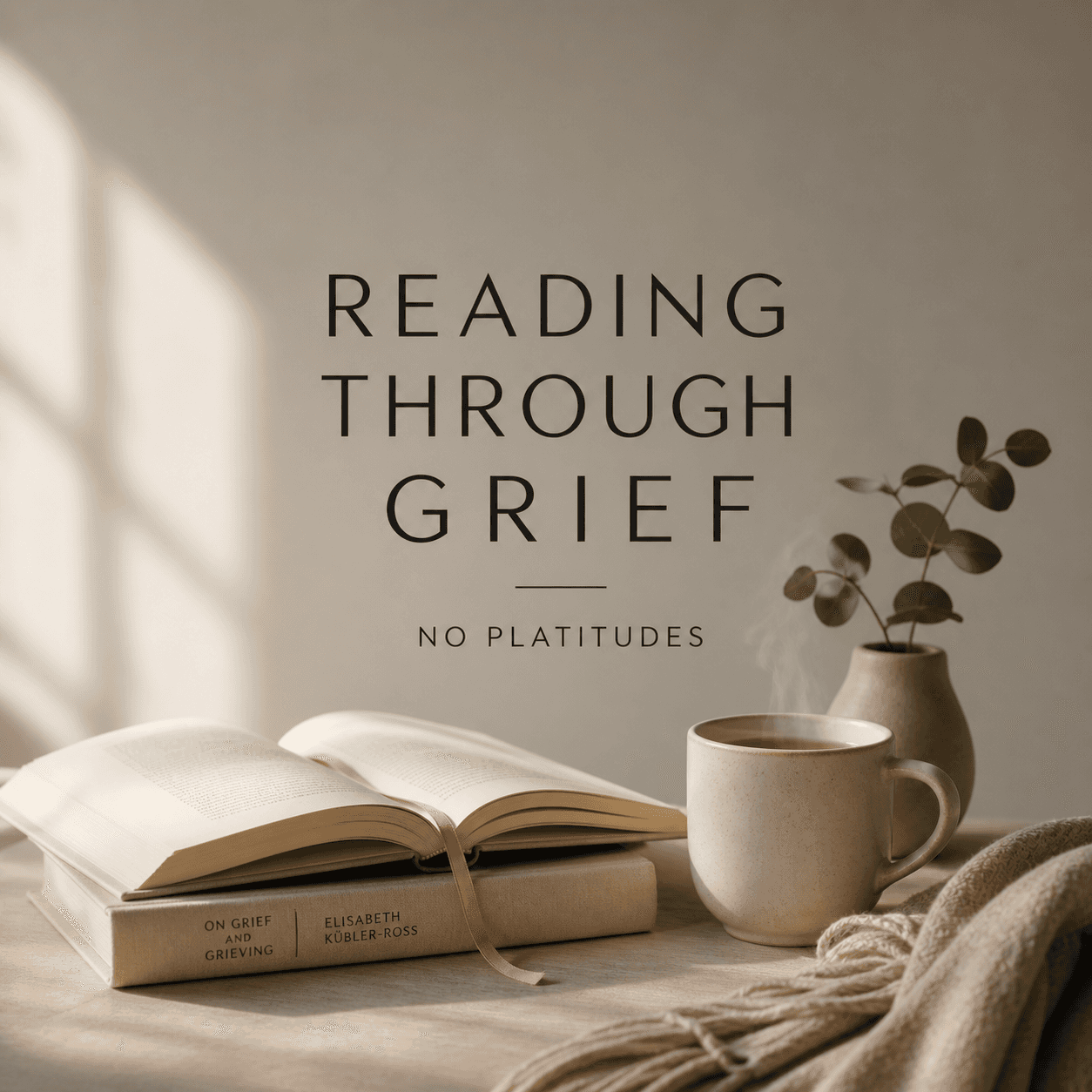
Grief makes you allergic to certain sentences.
You know the ones.
“Everything happens for a reason.”
“They’re in a better place.”
“Time heals all wounds.”
Even when someone means well, it can land like sandpaper. And books can do the same thing. The wrong “comforting” book at the wrong time feels like being cornered by optimism.
So this is not a list of “grief books that will fix you.”
This is a list of books that sit beside you. Books that don’t rush. Books that are honest about how weird grief is, how physical it is, how it shows up as laundry you can’t fold or a song you can’t hear anymore.
Some of these are memoir. Some are fiction. Some are quiet. Some are jagged. All of them, in one way or another, refuse platitudes.
And if you’re reading this in the early days, when your brain won’t hold a paragraph. I see you. I’ll mark a few options that work even when your attention is in shards.
(Also, if you like to process what you read in small, doable ways, GlimmerReads has a bunch of bookish journaling prompts and gentle reading reflections in the Reading Room at https://glimmerreads.com. Not homework. More like a lantern.)
First, a small permission slip (because grief makes reading hard)
Before the list, three things that might help you choose without pressure.
1) You’re allowed to reread
Rereading is not “stuck.” It’s regulation. Familiar pages don’t demand as much from you.
2) You’re allowed to quit a book mid chapter
If a book feels preachy, spiritually pushy, or like it’s trying to sell you a lesson. Stop. You’re not being picky. You’re protecting yourself.
3) Your grief has a reading level, and it changes daily
Some days you can do a whole memoir. Some days you can do two pages and a cup of tea and that’s it.
How I picked these (so you can trust the vibe)
Every book here does at least one of these things well:
- It tells the truth without trying to make grief “beautiful.”
- It lets anger, numbness, confusion, and dark humor exist.
- It doesn’t force a timeline.
- It offers companionship more than answers.
The list (with notes, so you don’t walk in blind)
1) H Is for Hawk by Helen Macdonald
A grief book that doesn’t act like grief is polite.
Macdonald loses her father and, in the shock of it, decides to train a goshawk. The book is part nature writing, part memoir, part spiral. In the best way. It captures that grief thing where you become obsessed with something because your brain needs a rail to hold onto.
Read this if: you want something immersive, smart, and unafraid of intensity.
Skip for now if: you’re very tender around parent loss and you need lighter language.

2) The Year of Magical Thinking by Joan Didion
This is the classic, yes. But it earns its reputation.
Didion writes about losing her husband suddenly, while her daughter is critically ill. The “magical thinking” is the irrational part of grief, the part that believes if you do the right thing, the loss will reverse itself. The book doesn’t make that sound foolish. It makes it sound human.
Read this if: you want crisp sentences that still feel like they’re shaking.
Grief-friendly note: the chapters are short, which helps when focus comes and goes.
3) A Grief Observed by C.S. Lewis
This one is raw. Messier than people expect from Lewis.
It’s basically his journal after his wife died. There’s anger in it. There’s spiritual doubt. There’s that awful whiplash of feeling fine for ten minutes and then not fine at all.
Read this if: you want someone to say the unsayable without polishing it.
Skip for now if: religious language feels loaded for you right now.
4) When Breath Becomes Air by Paul Kalanithi
Not a “you can beat cancer with positivity” book. Not that.
Kalanithi was a neurosurgeon diagnosed with terminal cancer in his 30s. He writes about identity, meaning, ambition, and the strange paperwork of dying. It’s beautiful, yes, but not in a tidy way.
Read this if: you want something that honors mortality without motivational speeches.
Note: there’s love here, but it doesn’t erase the devastation.
5) The Spare Room by Helen Garner
This one is sharp edged. It’s about caring for someone who is dying, and the complicated mix of devotion, irritation, helplessness, and guilt.
It’s also short. And it refuses to pretend that caregiving makes you saintly.
Read this if: you’re grieving someone you cared for, or you’re grieving the version of yourself you were during that time.
Expect: moral discomfort. That’s part of why it’s honest.
6) Crying in H Mart by Michelle Zauner
A daughter grieving her mother, told through food, memory, and identity.
Zauner doesn’t dress things up. The grief is in hospital rooms, in arguments, in the panic of time running out. And also in grocery aisles. Which is real. Grief loves a random aisle.
Read this if: you want a book that shows love and grief tangled together.
Note: you will probably get hungry. Or nauseous. Maybe both.
7) Wave by Sonali Deraniyagala
A devastating memoir of surviving the 2004 tsunami, in which Deraniyagala lost her parents, husband, and two children.
I’m putting this here with a gentle warning: it’s not a book you “recommend” casually. But for some people, reading someone else’s catastrophic grief can feel… oddly stabilizing. Like, okay, my horror is not too much for language.
Read this if: you need a witness to the unimaginable.
Skip for now if: your nervous system is already in free fall.
Fiction that holds grief without preaching at you
Sometimes memoir is too direct. Fiction can come in sideways. It can let you feel things without making you name them.
8) Hamnet by Maggie O’Farrell
A novel imagining the death of Shakespeare’s son and the ripple effects through a family.
It’s tender, sensory, and deeply focused on the lived reality of loss. Not inspirational. More like… grief as weather inside the house.
Read this if: you want gorgeous writing and emotional truth.
Note: it’s about a child’s death, so choose accordingly.

9) Lincoln in the Bardo by George Saunders
This is an unusual one. A chorus of voices in a cemetery, hovering between life and death, while Abraham Lincoln grieves his young son.
It’s strange, funny in places, and genuinely moving. And because it’s written in fragments and dialogue, it can be easier to read when your brain can’t do long smooth paragraphs.
Read this if: you want something formally inventive, not syrupy, and oddly comforting.
Grief-friendly note: the fragmented style can match a fragmented mind.
10) A Man Called Ove by Fredrik Backman
Yes, it’s popular. Yes, it can be cozy. But it’s also a grief book about how someone keeps living when they didn’t plan to.
Ove is prickly. He’s not here for your platitudes either.
Read this if: you want warmth with teeth.
Note: there’s humor, but it doesn’t mock pain.
11) The Friend by Sigrid Nunez
A woman loses a close friend and ends up caring for his dog. That premise sounds simple. The book is not.
It’s meditative, literary, and full of thoughts you might recognize: the weirdness of being alive when someone else isn’t, the social awkwardness, the small betrayals of language.
Read this if: you want quiet companionship and a dog-shaped ache.
12) Never Let Me Go by Kazuo Ishiguro
Not marketed as a grief book, but it’s drenched in anticipatory grief and the melancholy of limited time.
It’s restrained, which can be a relief. No melodrama. Just the slow realization of what can’t be changed.
Read this if: you want to feel deeply without being shouted at.
Poetry and small books (for when concentration is gone)
If you can’t read a “real book” right now, you can. You still can read. It just might look like two pages of poetry and then staring at the wall.
13) Devotions by Mary Oliver
Oliver isn’t for everyone, and sometimes her brightness can be too much. But this collection has plenty of poems that don’t feel like cheerleading. They feel like attention. Like being taught to look at the world again, slowly.
Read this if: you need gentle language and permission to notice small things.
14) The Dark Between Stars by Atticus
Simple, short poems. Some people find them too Instagram-y, others find them exactly right when their brain can’t handle complexity.
I’m including it because grief is not a literature class. If short lines get you through a night, they count.
Read this if: you want very quick hits of feeling.
15) How to Live by Sarah Bakewell (a weird but useful option)
This is not a grief memoir. It’s about Montaigne, essays, and the mess of being human.
But here’s why it can work: it keeps you company without demanding that you “process.” It reminds you that people have always been frightened of loss and time and the body.
Read this if: you want a brain book that doesn’t pretend you’re fine.

If your grief is specific (and it often is)
Grief is not one size fits all. Sometimes you want a book that matches the shape of what happened.
If you lost a parent
- Crying in H Mart by Michelle Zauner
- H Is for Hawk by Helen Macdonald
- The Year of Magical Thinking by Joan Didion (especially if it’s also about the whole world changing overnight)
If you lost a partner
- The Year of Magical Thinking by Joan Didion
- A Grief Observed by C.S. Lewis
- The Friend by Sigrid Nunez (for companionship, not fixes)
If you lost a child (or you’re close to that grief)
- Hamnet by Maggie O’Farrell (fiction, but it goes there)
- Lincoln in the Bardo by George Saunders (oddly tender)
(And also, be gentle with yourself. Truly.)
If you’re grieving someone complicated
Not every relationship was pure sunshine. Some losses come with relief, anger, guilt, regret. That does not make your grief fake.
- The Spare Room by Helen Garner
- A Grief Observed by C.S. Lewis (for the anger and confusion)
- The Friend by Sigrid Nunez (for the social and emotional mess)
What to avoid (unless you know you want it)
This is not me banning books. It’s just a heads up, because grief makes you tender and some genres can feel like being mishandled.
1) “Grief as a lesson” books
If the thesis is “this happened so you could grow,” it might make you want to throw the book. Understandable.
2) Anything that insists on stages
Some stage models help people. Others make you feel like you’re failing at grief. If you notice yourself reading and thinking, wait am I doing it wrong, put it down.
3) Books that treat spiritual certainty like a bandage
Maybe that’s comforting for you. Maybe it’s infuriating. It depends on the day.
A simple way to choose your next book (when decision making is wrecked)
Pick the sentence that fits today:
- I need someone to be honest with me.
Try A Grief Observed or The Year of Magical Thinking. - I can’t handle direct grief, but I need a story that gets it.
Try The Friend or Never Let Me Go. - I want language that feels beautiful, but not fake.
Try Hamnet or When Breath Becomes Air. - My brain is mush.
Try poetry, short chapters, or fragmented fiction like Lincoln in the Bardo.
Tiny journaling prompts (optional, truly)
If you want to hold onto what a book gives you, without turning it into a project, here are a few prompts. These are the kind of prompts we do regularly at GlimmerReads, because sometimes reading is the only place your feelings can safely land.
- What line did I underline, even if I don’t fully know why yet?
- What did this book allow me to feel for 30 seconds?
- What do I want someone to understand about my grief that they keep missing?
- What is one ordinary object that has become loaded with memory?
- What kind of comfort actually helps me. Not what should help. What helps.
If you want more of these, the Reading Room and The Weekly Chapter newsletter are built for exactly this kind of slow reflection. You can start here: https://glimmerreads.com
One last thing
You don’t have to read “the right book” to grieve correctly. There’s no correct.
But there are books that won’t insult your pain. Books that won’t hustle you toward closure. Books that can sit with you in the long middle, where nothing is resolved and you are just trying to get through Tuesday.
If you pick one from this list, and it helps even a little. That counts.
And if all you can do right now is reread a childhood favorite, or scroll poems at 2 a.m., or hold a book without opening it. That counts too.


No responses yet