
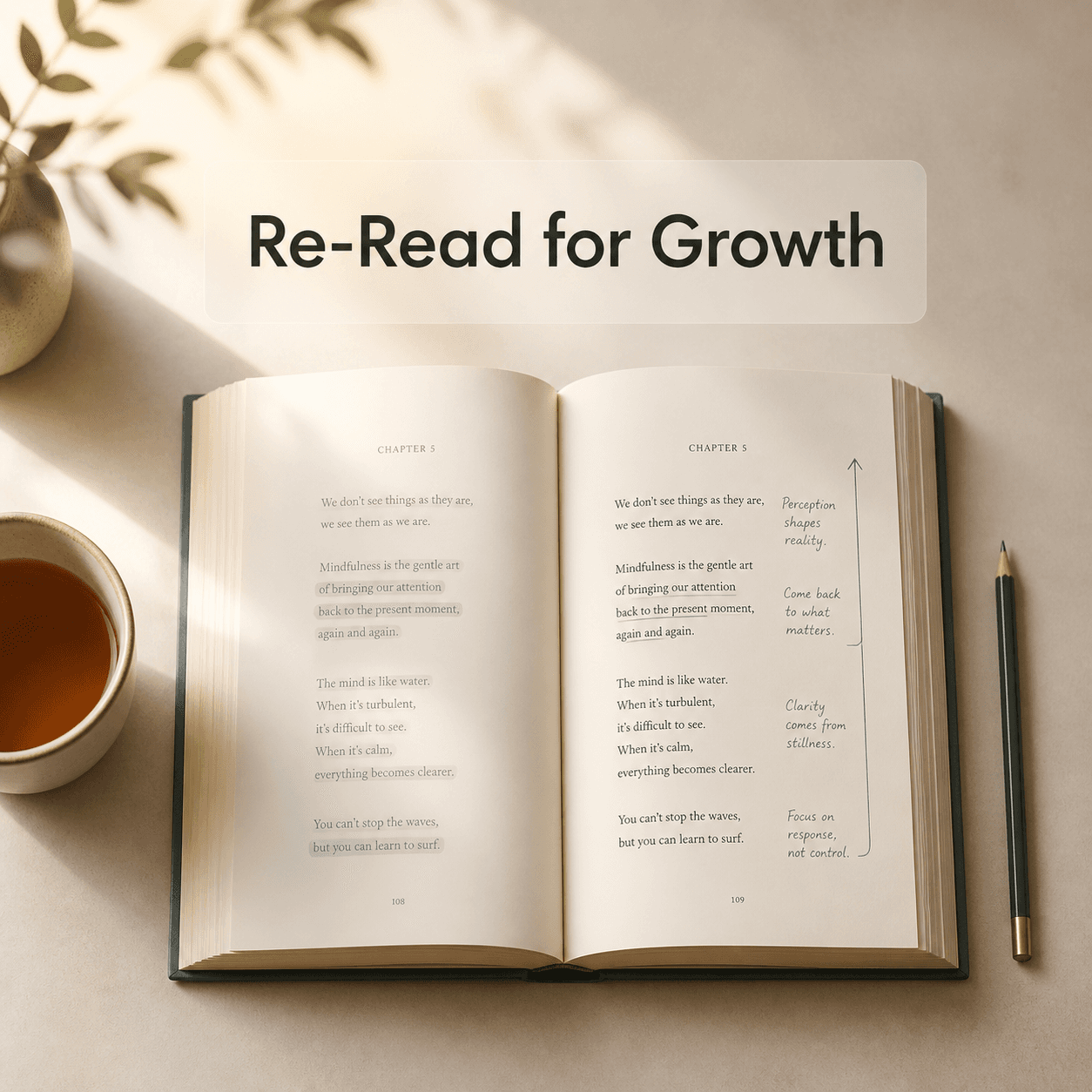
There is a kind of rereading that feels like opening a drawer you have not touched in years.
You know what is inside. You even know the smell of the paper. The first line lands and suddenly you are sixteen again, or twenty three, or that winter when you could not sleep and you read until the sky turned light.
That kind of rereading is sweet. Comforting. And honestly, I am not here to take it away from you.
But if you have ever finished a reread and thought, okay… so why do I feel exactly the same, you are not alone. Nostalgia rereads can be like scrolling old photos. You feel something, then you move on.
A growth reread is different. It is not about going back to who you were.
It is about noticing who you are now.
And using the book as a mirror. Sometimes a flashlight. Sometimes a gentle nudge.
This is a practical guide to rereading on purpose. Not in a rigid, homework way. More like, I want to come out of this with something I can actually carry into my real life.

The difference between a comfort reread and a growth reread
A comfort reread says:
I want to feel safe. I want to be in familiar hands. I do not want surprises right now.
A growth reread says:
I want to see what I missed. I want to test my current beliefs against this story. I want to leave with a sentence that changes how I speak to myself tomorrow morning.
Neither is better. They just have different goals.
And the goal matters because it changes how you show up on the page.
If you open a book only to relive a mood, your mind will skim toward the scenes you already love. The lines that once saved you. The parts that feel like home.
If you open a book to grow, you read slower in weird places. You pause at moments you used to ignore. You interrogate characters you previously excused. You start asking, wait… why did this hit me so hard back then.
That is the doorway.
Step 1. Pick the right book to reread (not the one you feel you “should”)
The best growth rereads are not always the “best books.”
They are the books with friction. The ones that left you with a lingering ache. Or a strange calm. Or a question you never resolved.
Here are a few solid categories to choose from:
1. The book you loved during a hard season
Not because you want to time travel. Because you want to meet that version of you with adult eyes.
Ask: what did I need then that I did not know how to name.
2. The book you disliked but keep thinking about
Sometimes dislike is a clue. Maybe it challenged you. Maybe it mirrored something you were not ready to see.
3. The book you read “too early”
You were young, distracted, busy, heartbroken, new to reading. Whatever. The book went through you, not into you.
Now you can give it a fair shot.
4. The book with a character you secretly envy
Envy is information. It points to unlived life. Unclaimed traits.
If you are not sure what to reread next, you can always browse the Reading Room on GlimmerReads and pick something that matches what you are working through lately. Not your ideal self. Your actual self.

Step 2. Set an intention that is small and specific
If your intention is “grow,” your brain will go blank. It is too vague.
Try something like:
- I want to learn how to handle conflict without shutting down.
- I want to understand why I keep over explaining myself.
- I want to practice noticing when I abandon my own needs.
- I want to find language for grief that does not scare me.
Write one sentence before you start. Just one.
This matters because your mind starts scanning the text differently when it knows what it is looking for. Like when you buy a new coat and suddenly everyone on the street is wearing that same coat.
Your intention becomes your filter.
Step 3. Choose a rereading method that matches your energy
Not every reread needs color coded tabs and a 12 page reading journal.
Sometimes you are tired. Sometimes you are dealing with life.
Here are three ways to reread for growth, from low effort to deep dive.
Method A. The “slow scenes” reread (low effort, high return)
You reread normally, but you slow down only when you feel a tug.
A tug can look like:
- you reread the same paragraph twice without meaning to
- your chest tightens, or you suddenly feel defensive
- you underline something and do not know why
- you get the urge to text someone about it
When that happens, stop. Ask one question:
What is this bringing up in me.
Write a two line answer in the margin or in your notes app. That is enough.
Method B. The “theme pass” reread (focused and tidy)
Choose one theme and track it.
Examples:
- boundaries
- belonging
- self trust
- power and control
- shame
- friendship repairs
- ambition
- rest
Every time the theme shows up, mark it. Not every occurrence. Just the ones that feel real.
At the end, you will have a map of the book through that lens.
Method C. The “mirror reread” (deep, reflective, a little intense)
This is where growth happens fast, but it can be emotionally loud.
You read with prompts. You pause often. You journal. You let yourself be changed.
This is best for books that already feel personal.
Step 4. Read with “growth questions” instead of plot questions
On a first read, you ask plot questions.
What happens. Who did it. Are they going to make it. Will they kiss.
On a growth reread, you ask different questions. Quiet ones.
Here are some to keep in your back pocket. You do not need all of them. Pick three.
Questions that reveal your patterns
- Where do I see myself in this character’s coping?
- What does this character avoid, and what do I avoid in the same way?
- What is the character’s “protective story” about themselves. And what is mine.
Questions that build self trust
- When does the character ignore their own knowing.
- What does the character do when they finally listen to themselves.
- What is the cost of not listening.
Questions that clarify boundaries
- What is this character responsible for, and what are they not responsible for.
- Who benefits when the character stays small.
- Where does the character confuse love with self abandonment.
Questions that shift your inner voice
- What does the character say to themselves at their lowest point.
- If I spoke to myself that way, how would my life feel.
- What would a kinder voice sound like, without being fake.
If you want, you can copy these into a page in your reading journal. Or grab a few of the bookish journaling prompts on GlimmerReads and use them as your reread companion.

Step 5. Mark the book like you are leaving yourself breadcrumbs
I used to avoid writing in books because it felt wrong. Like I was ruining something sacred.
But here is what I eventually realized.
A reread is a conversation between two versions of you.
Past you highlighted a line because they needed it. Current you can respond. Argue. Expand. Correct.
So mark the book. Lightly. Messily.
Try simple systems:
- Underline lines that feel like truth.
- Circle lines that feel like a lie you once believed.
- Put a question mark next to anything that makes you uncomfortable.
- Write a tiny note: “I do this.” “This is my mom.” “This is avoidance.”
If you do not want to write in the book, use sticky tabs or a separate notebook. But do something physical. Something that leaves evidence you were awake while reading.
Step 6. Do the “two timelines” exercise (this is where it gets good)
This is my favorite rereading trick because it makes the shift visible.
After every few chapters, or at the end of the book, make two short lists.
Timeline A. Who I was when I first read this
- What was my life like.
- What did I believe about love, work, myself.
- What did I need.
- What was I afraid of.
Timeline B. Who I am now reading it again
- What has changed.
- What hurts less.
- What hurts more, but in a clearer way.
- What do I understand now that I could not understand then.
You start noticing something almost spooky.
The book did not change. The sentences are the same.
You changed. So the meaning changes.
That is growth.
Step 7. Track what you resist, not just what you love
This is the part people skip because it is not cozy.
When you feel resistance, pay attention. Resistance is a flare.
Moments to watch for:
- you roll your eyes at a character and feel superior
- you think “that would never be me” a little too fast
- you feel bored exactly when emotions get close
- you want to skim the apology scene, the grief scene, the confrontation
Instead of forcing yourself to push through, pause and ask:
What am I protecting myself from feeling here.
Sometimes the answer is simple. You are tired. You have no bandwidth.
But sometimes… it is a pattern. One you bring into real relationships.
This is what makes rereading useful beyond books.

Step 8. Pull out “carry lines” and actually carry them
A carry line is a sentence you can take into Tuesday.
Not an aesthetic quote for social media. Something you might need when you are about to spiral, people please, overwork, or disappear.
While rereading, collect 5 to 10 carry lines. Write them down in one place.
Then do one more step that feels almost silly but works.
Next to each line, write:
When I need this:
Examples:
- “You do not have to earn rest.”
When I start treating exhaustion like a badge. - “Avoiding the truth is still a choice.”
When I am pretending a situation will fix itself. - “Love without honesty is just performance.”
When I am being agreeable instead of real.
If you want a place to keep these, this is basically what The Weekly Chapter on GlimmerReads is for. A small weekly nudge, plus prompts, so your reading does not just evaporate after you close the cover.
Step 9. Try a “character study” instead of a full reread (when you are busy)
If the idea of rereading an entire book makes you sigh, do this.
Pick one character. Preferably one you judge. Or one you adore.
Now reread only their scenes.
Track:
- what they want
- what they fear
- what they do when they do not get what they want
- what they call love
- how they respond to accountability
Then ask:
Where do I do this, even in a smaller way.
You can get a shocking amount of insight without rereading 400 pages.
Step 10. Close the reread with one concrete action
Growth does not mean „I realized something.“
Growth means you live differently for five minutes.
At the end of the reread, choose one small action. Something borderline too easy.
Examples:
- Write the text you have been avoiding. Keep it short.
- Set one boundary this week. Tiny. Real.
- Stop explaining yourself to someone committed to misunderstanding you.
- Schedule rest like it matters, because it does.
- Apologize without defending yourself.
- Put your phone in another room for one hour and let silence happen.
One action. That is the bridge from story to life.

A simple reread ritual you can steal (15 minutes, no perfection)
If you want a repeatable routine, here is one that works even when you are not feeling „productive.“
- Make tea or whatever makes your body unclench.
- Read 10 pages.
- Mark one line that hits.
- Answer this prompt in 3 sentences: What is this showing me about how I handle life.
- Stop. Do not force more.
That is it.
Over a few weeks, those tiny notes pile up into a portrait of you. Not the curated version. The real one.
Common rereading traps (and how to dodge them)
Trap 1. You treat the book like scripture
A book can be wise and still be wrong for you.
If a “lesson” makes you smaller, question it.
Trap 2. You reread to punish yourself
Some people reread self improvement books like penance.
If you feel worse every time, pause. Growth should feel like more honesty, not more self hatred.
Trap 3. You only reread what confirms you
It is tempting to reread the same five comfort books forever.
No shame. But if you want growth, occasionally reread something that challenges you. Something that makes you argue back.
Trap 4. You confuse insight with change
A highlighted quote is not a boundary. A journal entry is not a conversation.
Use the reread to pick one real world move.
If you want to make rereading a real practice, not a one off
The easiest way to keep this going is to tie it to a theme.
One month, one focus.
Like:
- January: self trust
- February: love and attachment
- March: rest and burnout
- April: friendship and repair
Then choose rereads, new reads, and prompts that support that theme.
This is basically the structure behind GlimmerReads and the newsletter, The Weekly Chapter. Cozy, yes. But also quietly intentional. The kind of reading life that leaves you with something.
Wrap up
Rereading for nostalgia is a warm bath.
Rereading for growth is a mirror you can hold at a kinder angle.
You do not need to overanalyze every chapter. You do not need to turn reading into a productivity project. You just need one honest intention, a few good questions, and the willingness to notice what your past self clung to.
Because the real magic of rereading is not that you return to an old story.
It is that you see the distance you have traveled since the last time you were there.
If you want a gentle framework to do this more often, browse the Reading Room and journaling prompts on GlimmerReads, or join The Weekly Chapter so you have a theme to reread with, week by week.


No responses yet