
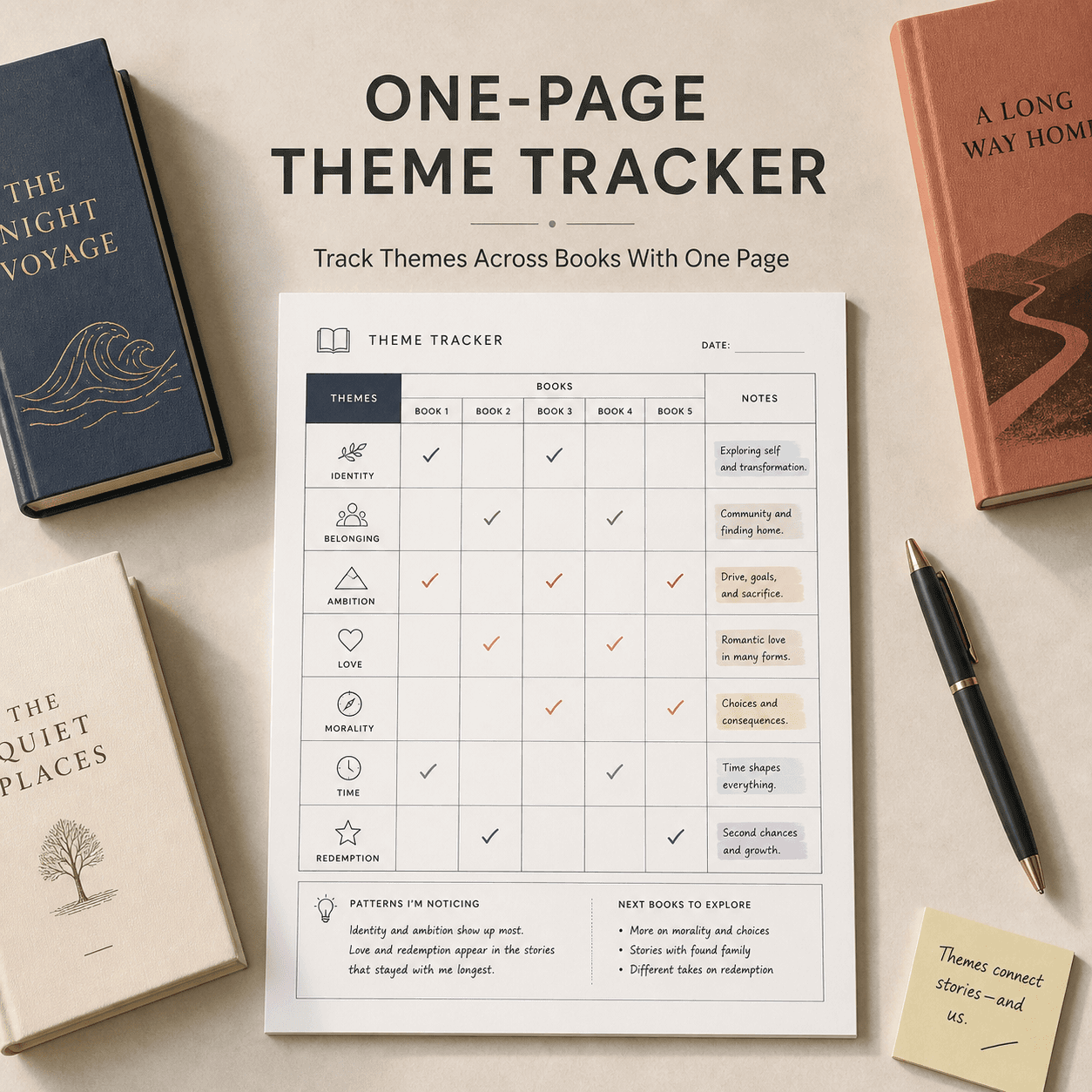
I used to think I was a “themes person.”
Like, I could tell you the theme of a novel right after finishing it. Grief. Power. Freedom. Identity. Easy.
And then three months later I’d pick up another book, feel that same little tug in my chest, and realize I had no way to connect it to anything I’d already read. The books were changing me, sure, but in this scattered, untraceable way. Like trying to remember dreams.
What finally worked for me was weirdly simple.
One page. One page that stays the same across every book.
Not a giant reading journal system. Not a spreadsheet. Not a color coded Notion database with seventeen properties that I abandon in two weeks.
Just one page that helps you track themes across books in a way that makes patterns show up, quietly, over time.
This is that page. And how to use it.
Why themes feel slippery in the first place
A theme isn’t a quote you underline. It’s not a moral.
It’s more like. A pressure. A question the book keeps circling. The thing that repeats, but not always in the same words.
And when you read a lot, themes blur together because:
- you’re moving too fast from book to book
- you remember plot, but not the emotional argument underneath it
- you have highlights everywhere but no container for meaning
- you don’t have a consistent way to name what the book was really doing
The trick is consistency. Not intensity.
Same prompts. Same layout. Every time.
That’s what makes the connections happen.
The One Page Theme Tracker (the actual page)
Here’s the one page. Copy it into a notebook, print it, paste it into your reading journal. Doesn’t matter.
Just keep it consistent.
ONE PAGE: Theme Tracker
Book: Author: Date finished:
1) The book’s central question (one sentence)
“What is this book quietly asking?”
2) 3 theme words (not phrases)
Pick three. Force yourself to keep them single words. Examples: belonging, ambition, forgiveness, control, faith, inheritance, silence
3) The theme that hit me (circle one)
Choose one from your three words. The one that felt personal.
4) Theme evidence (three moments, not quotes)
- Moment 1:
- Moment 2:
- Moment 3:
5) What the book seems to believe about that theme
One to three sentences. Start with:
“This book suggests that…”
6) A pairing note (connect it forward or backward)
Finish one of these:
- “This reminded me of…”
- “This disagreed with…”
- “This deepened what I felt in…”
7) My life hook (one honest line)
“In my life, this shows up when…”
8) A single symbol or image (optional but powerful)
A door. A river. A dinner table. A locked phone. A train. Something that repeats or lingers.
That’s the whole thing.
One page per book.
And yes, the magic is in the constraints. Especially the “one sentence” parts. Especially choosing one theme to circle.
Because if you don’t choose, you’ll write paragraphs and nothing will stick.
How to fill it out without turning it into homework
Step 1: Wait 10 minutes after finishing
Not always possible, but it helps.
Themes get clearer when the plot dust settles. I’ll usually make tea, stare at the wall a bit, then do the page. If I do it immediately, I just recap the ending.
If you’re reading on a commute, do a rough version on your phone. Then rewrite it later.
Step 2: Start with the central question, not the theme words
This is backwards from how most people do it.
But if you start with “themes,” you tend to pick vague stuff. Love. Loss. Society. Time. The usual.
If you start with the question, you get something sharper, like:
- “What do we owe the people who raised us?”
- “Can you become someone new without betraying who you were?”
- “Is power ever clean?”
- “What does it cost to be seen?”
Then the theme words almost choose themselves.
Step 3: Use “moments,” not quotes, for evidence
Quotes are tempting. They feel official.
But they can also become a way to avoid thinking. You copy the line, you move on, you feel productive.
Moments force interpretation. They force you to recall what actually happened and why it mattered.
A “moment” can be tiny, too. A character refusing to answer. A repeated habit. A setting detail.
Step 4: The “what the book believes” line is the hinge
This is where the theme becomes trackable across books.
Two books can be about grief and feel totally different because they “believe” different things about grief.
Examples:
- “This book suggests grief is a private language that isolates you.”
- “This book suggests grief is a bridge, if you let other people cross it with you.”
- “This book suggests grief is inheritance. You don’t choose it, you carry it.”
Now you’re not just labeling. You’re tracking arguments.
How themes start connecting across books (the simple method)
Once you have 5 to 10 of these pages, do this.
Make a “Theme Index” on one spread or one doc
It’s just a list of theme words you’ve used, and the books attached to them.
Like:
belonging
- The Namesake
- Eleanor Oliphant Is Completely Fine
- Pachinko
control
- Never Let Me Go
- The Handmaid’s Tale
forgiveness
- A Man Called Ove
- Beloved
You can do this in the back of your notebook. Or a single note on your phone. Keep it low friction.
Then add one extra mark: “agree / disagree / complicate”
This is optional but it’s where the fun starts.
When you list a book under a theme, add a tiny tag:
- (A) agree
- (D) disagree
- (C) complicate
Agree with what?
With your own evolving belief about the theme.
So for “ambition,” you might notice:
- one book frames ambition as hunger that ruins relationships
- another frames it as survival
- another frames it as inherited expectation you didn’t ask for
Now your reading life starts behaving like a conversation, not a stack.
A filled example (so you can see how it actually looks)
Let’s do a quick demo with a made up example. Same structure you’ll use.
Book: The Remains of the Day
Author: Kazuo Ishiguro
Date finished: (whatever)
1) Central question
“What happens to a life when you confuse duty with meaning?”
2) 3 theme words
duty, regret, dignity
3) The theme that hit me
(regret)
4) Theme evidence (moments)
- He keeps reframing personal sacrifice as professionalism.
- The missed opportunities with Miss Kenton show up like tiny hauntings.
- The final acceptance lands quietly, not dramatically.
5) What the book believes
“This book suggests regret isn’t loud. It’s built from small choices you defend as necessary, until the defense becomes your personality.”
6) Pairing note
“This reminded me of Stoner, but with less warmth and more self deception.”
7) My life hook
“In my life, this shows up when I over explain why I’m too busy, instead of admitting what I’m avoiding.”
8) Symbol/image
A perfectly set table.
That’s one page. Done.
Now later, when you read another book about regret, you’ll see whether it treats regret as fate, as choice, as punishment, as clarity.
Different shape. Same theme.
The part most people skip (and it’s the whole point)
The “My life hook” line.
This is where the theme moves from academic to personal.
If you leave that part out, theme tracking becomes… kind of sterile. Like you’re collecting labels.
But if you write one honest line about where it hits your life, your theme index becomes a map of you. Over time, you’ll notice which themes keep returning. Which ones you keep reaching for. Which ones you avoid.
That’s not just “tracking themes.”
That’s tracking the stories you carry. Which is basically the heart of what we do at GlimmerReads anyway.
If you want a gentler version of this with weekly prompts, that’s exactly what The Weekly Chapter newsletter is built around. One monthly theme, four weekly installments, and prompts that don’t feel like homework. You can find it at: https://glimmerreads.com
Common mistakes that make the one page stop working
1) Picking theme phrases instead of words
“Finding yourself” is a vibe, but it’s hard to track.
If you force yourself into single words, you get cleaner indexing later.
Instead of “finding yourself,” pick: identity. autonomy. becoming.
2) Trying to capture everything
This is the big one.
The page is not a book report. It’s a theme capture device.
If the book had ten themes, fine. Choose the one that grabbed your throat. Circle it. Move on.
3) Writing what you think the theme should be
Sometimes the theme is not the noble one.
Sometimes the theme that hit you is envy. Or resentment. Or loneliness. Or shame.
Track the real one. It’s your page.
4) Only doing this for “serious” books
Genre books are theme machines. Romance, fantasy, mystery, thrillers. They’re full of repeating thematic structures.
Some of the clearest “what the book believes” lines I’ve written came from books people dismiss.
If you want to go one notch deeper (still one page)
After you’ve done this for a month or two, you can add a tiny sidebar to the page:
Theme temperature (circle one)
- tender
- angry
- bleak
- hopeful
- unresolved
Because themes aren’t just ideas. They have emotional weather.
Two books about “family” can feel completely different depending on whether the family is portrayed as shelter, trap, obligation, legacy.
Temperature makes that visible.
The easiest way to keep it going
Here’s what kept me consistent:
- I print 10 copies of the page at a time and tuck them into my current book.
- Or I keep it as a single note template on my phone and duplicate it.
- I don’t force it for every book. I aim for most books. That’s enough.
- I do the page even if I didn’t love the book. Sometimes especially then.
Because the goal isn’t to prove you read. It’s to remember what moved.
Wrap up (and your next tiny step)
If you want to track themes across books without building a whole system, use one page per book, always the same prompts.
Central question. Three theme words. Circle one. Evidence moments. What the book believes. A pairing note. One life hook line.
That’s it.
And if you try it, you’ll start noticing something kind of surprising. Your reading life will start to knit together. Books will talk to each other across months, sometimes years. You’ll build a personal archive of themes that keeps getting more honest.
If you want a place to continue that kind of reflective reading, the Reading Room on GlimmerReads has more prompts and theme based essays, plus the newsletter if you like a monthly structure.
FAQs (Frequently Asked Questions)
What is the One Page Theme Tracker and how does it help in understanding book themes?
The One Page Theme Tracker is a simple, consistent template to track themes across books. It includes prompts like the book’s central question, three theme words, personal resonance with a theme, moments evidencing the theme, and what the book suggests about that theme. This method helps readers recognize patterns and deeper emotional arguments in books over time.
Why do themes in books often feel slippery or hard to pin down?
Themes feel slippery because they aren’t just quotes or morals but pressures or questions a book circles repeatedly. When reading many books quickly, it’s easy to remember plots but not the underlying emotional arguments. Without consistent naming or containers for meaning, themes blur together and become hard to track.
How should I start filling out the One Page Theme Tracker after finishing a book?
Wait about 10 minutes after finishing to let plot dust settle. Begin by writing the book’s central question—what it quietly asks—before choosing theme words. This approach leads to sharper insights rather than vague themes like ‚love‘ or ‚loss.‘ Then pick three single-word themes that emerge naturally from that question.
Why does the tracker emphasize using moments instead of quotes as evidence for themes?
Using moments rather than quotes forces active interpretation and recall of why specific events mattered. Quotes can feel official but risk becoming mere copying without engagement. Moments can be subtle details like habits or settings that reveal how a theme plays out in the story.
What is the significance of articulating ‚what the book seems to believe‘ about a theme?
This line acts as a hinge for tracking themes across different books by capturing each book’s unique argument about a theme. For example, two books on grief might differ because one sees grief as isolating while another views it as a bridge. This nuanced belief lets you compare and connect thematic ideas more meaningfully.
How can I connect themes across multiple books using this method?
After completing several One Page Theme Trackers, create a Theme Index listing all your theme words alongside their respective books. This low-friction list helps you see which themes recur and how different books handle them. Adding marks or notes can deepen these connections and reveal evolving patterns over time.


No responses yet