
There’s this weird little gap that happens after you finish a book.
You close it. You sit there for a second. Maybe you even feel something. Relief, grief, a quiet buzz, whatever. And then life walks in and starts talking over it. Notifications, dinner, laundry, the next book, the next thing.
And later when someone asks, “So what was it about?”
You say… the plot. Or the vibe. Or you go blank. Which is annoying, because you know something happened in you while you were reading.
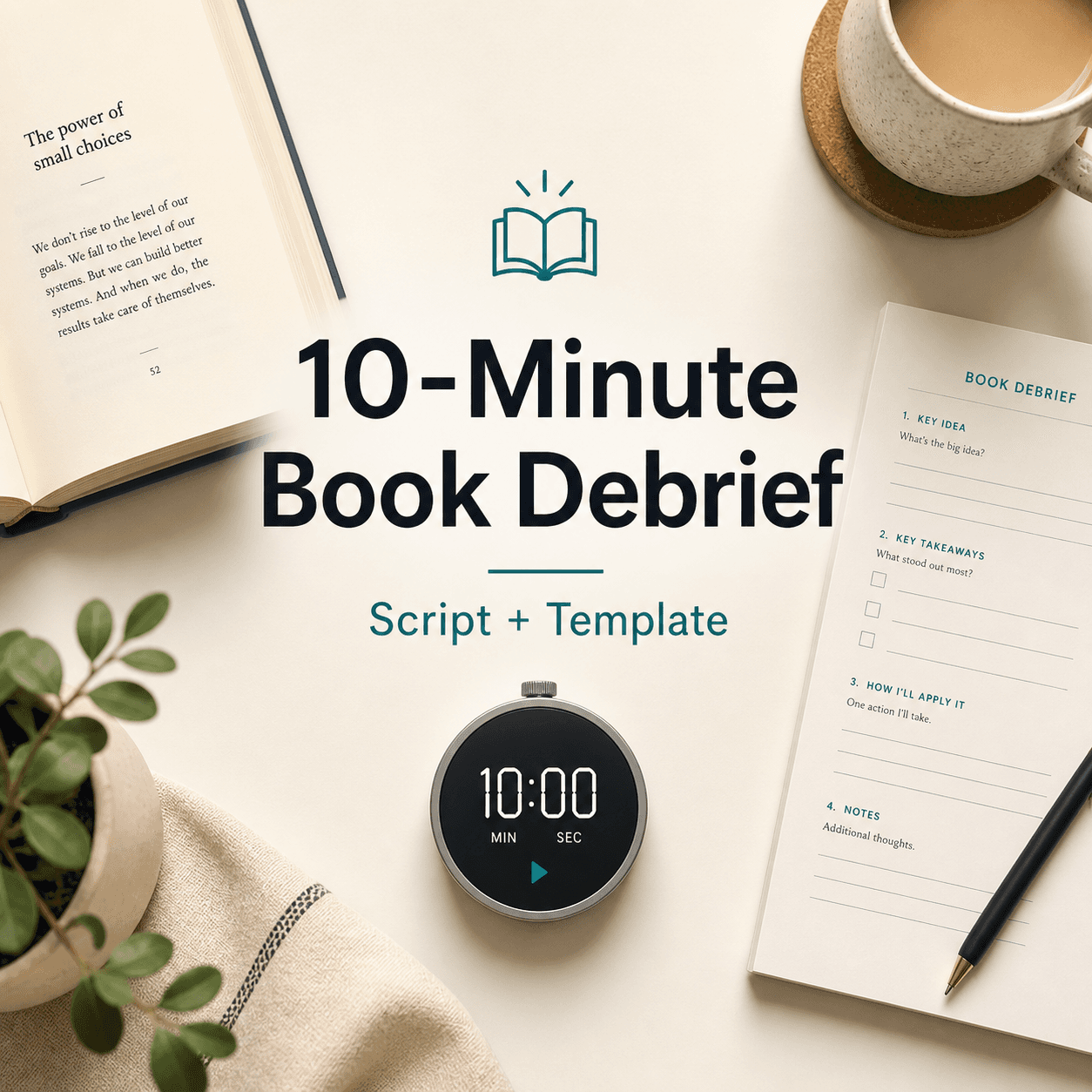
This is what the 10-minute book debrief is for.
Not a full review. Not an essay. Not a thousand highlighted quotes you never revisit. Just a fast, repeatable ritual to help you keep what matters.
You can do it in a notebook, Notes app, Notion, Google Doc, the back of a receipt. Doesn’t matter.
What matters is you do it while the book is still warm.
What this debrief actually does (and why it works)
A good debrief has three jobs:
- Catch the thread before it slips away. The one line you’d want to remember.
- Name the change. Even a small one. Even if it’s just, “I felt seen.”
- Turn it into something usable. A question, a habit, a next step.
That’s it.
And the time limit matters. Ten minutes keeps you honest. It forces clarity. It stops you from turning reflection into homework.
The 10-minute timer setup
Before we get into the script, do this:
- Set a timer for 10 minutes.
- Don’t try to make it pretty.
- Write like you’re sending a slightly chaotic voice note to yourself. Short lines are fine. Fragments are fine.
- If you miss a question, skip it. Keep moving.
If you want a gentle structure for this kind of reflective reading long term, that’s basically the heart of what we do at GlimmerReads too. Less “rate it out of five” and more “what did it leave in me.”
Subtle plug, yes. But also true.
The 10-Minute Book Debrief Script (do this right after finishing)
Minute 0 to 1: The snapshot
Prompt: What just happened in me?
Write 3 quick lines:
- My mood right now is:
- The strongest feeling I have is:
- If this book was a weather report, it would be:
Don’t overthink the weather one. “Foggy but bright.” “Thunderstorm with a clear ending.” “Dry heat.” Whatever fits.
Minute 1 to 3: The spine of the book
Prompt: What was this really about?
Fill in these blanks:
- On the surface, it’s about:
- Underneath, it’s about:
- The question it kept asking was:
- The answer it hinted at was:
If you can’t find the answer, that’s fine. Write: “I don’t know yet.” That counts. Sometimes that’s the point.
Minute 3 to 5: The mirror moment
Prompt: Where did it touch my life?
Choose one:
- The line or scene I keep replaying is:
- I felt called out when:
- I felt comforted when:
- I saw myself in:
Then add one sentence:
- This matters because:
This is the pivot. The part most people skip because it feels “too personal.” Which is exactly why it’s the part worth doing.
Minute 5 to 7: The takeaway in one sentence
Prompt: If I only keep one thing, what is it?
Write:
- My one-sentence takeaway:
Examples, just so you get the vibe:
- “I can be responsible without being rigid.”
- “Love doesn’t erase loneliness, it sits beside it.”
- “I don’t have to earn rest by suffering first.”
If your sentence feels too big or too neat, make it smaller. Make it truer.
Minute 7 to 9: The tiny action
Prompt: What do I do with this?
Pick one small next step. Not a life overhaul. A pebble, not a boulder.
- This week I will try:
- I will stop:
- I will start:
- I will ask someone:
If the book gave you language, use it. If it gave you courage, aim it somewhere.
Minute 9 to 10: The memory anchor
Prompt: How will I remember this book six months from now?
Write one:
- A quote (max 2 lines):
- A single image from the book:
- A song it reminds you of:
- A person you want to recommend it to (and why):
Then done. Timer ends. You’re free.
Relevant images you can add to this post (with placements)
You said this is going on WordPress, so here are simple image suggestions that fit the vibe and break up the page. You can use your own photos, Canva, or free stock images.
Image 1 (near the top): “Reading journal + tea”
Alt text: Open journal beside a book and warm drink
Suggestion: A cozy desk scene, soft light, handwritten notes.
Image 2 (before the script): “10-minute timer”
Alt text: Phone timer set to ten minutes next to a paperback
Suggestion: Simple, minimal. Emphasize the ritual.
Image 3 (before the template section): “Template screenshot”
Alt text: Book debrief template layout on a notebook page
Suggestion: Create a clean graphic of the template prompts.
Image 4 (near the end): “Stack of books with sticky notes”
Alt text: Books with tabs and sticky notes ready for reflection
Suggestion: A visual cue for returning to what you read.
If you want, you can also turn the template below into a one-page printable and offer it as a download. That tends to work well on literary newsletters.
The Copy and Paste Template (fast version)
Use this when you’re in a hurry. Save it somewhere you’ll actually open.
10-Minute Book Debrief
Book:
Author:
Date finished:
Format (audio/ebook/print):
1) Snapshot (right now)
- Mood:
- Strongest feeling:
- Weather report:
2) The spine
- On the surface, it’s about:
- Underneath, it’s about:
- The question it kept asking:
- The answer it hinted at:
3) The mirror moment
- The scene/line I keep replaying:
- I felt called out when:
- I felt comforted when:
- I saw myself in:
- This matters because:
4) One-sentence takeaway
- My one-sentence takeaway:
5) Tiny action (this week)
- I will try:
- I will stop:
- I will start:
- I will ask someone:
6) Memory anchor
- Quote (max 2 lines) / image / song / who to recommend to:
That’s the whole thing.
But if you want it even simpler, like aggressively simple…
The Ultra Simple 4-Line Debrief (when you’re tired)
Some days you finish a book at 1:14 a.m. and your brain is soup. Use this version.
- It was about:
- It was really about:
- It left me with:
- This week I will:
Still counts. Still works.
A filled example (so you can see what “good” looks like)
People get stuck because they think their reflection has to sound smart. It doesn’t.
Here’s what a real one might look like, messy and human.
Book: The Remains of the Day (example)
Snapshot: Mood: quiet, heavy. Strongest feeling: regret, but also tenderness. Weather: pale winter sun.
The spine:
On the surface, it’s about a butler remembering his career.
Underneath, it’s about what happens when you confuse duty with safety.
The question: what did I give up to be “professional”?
The answer: you don’t get time back, but you can still tell the truth about it.
Mirror moment:
I felt called out when he kept rationalizing his choices.
This matters because I do that. I intellectualize my way out of feeling.
One sentence takeaway:
If I keep postponing my real life, I will eventually become good at postponing, and nothing else.
Tiny action:
Have the conversation I’ve been delaying. Not perfectly. Just honestly.
Memory anchor:
Image: the empty evening road, him driving with all that unsaid.
That’s it. No thesis statement. No book report voice.
How to make this a habit (without turning it into another “productivity system”)
A few ways to keep this easy:
- Do it immediately. Same day if you can. Next morning at latest.
- Keep one place for it. One notebook. One Notes folder. One Notion page. Don’t scatter.
- Don’t force completion. Half a debrief is better than none.
- Revisit monthly. Read your last 4 debriefs in one sitting. You’ll start noticing patterns in what you’re drawn to. That’s the good stuff.
This is also where a themed rhythm helps. At GlimmerReads, our email series The Weekly Chapter is built around a monthly theme in four weekly installments. Which means you’re not reflecting in a vacuum. You’re collecting a trail. A tiny record of what your reading life is doing to you.
If that’s your vibe, you can start at: https://glimmerreads.com
Common sticking points (quick fixes)
“I don’t remember enough details.”
Good. You’re not doing trivia. You’re doing impact.
Write what you remember emotionally. The brain keeps what matters.
“I didn’t like the book.”
Even better, honestly.
Debrief it anyway:
- What annoyed you?
- What expectation did it break?
- What does your reaction reveal about you?
Sometimes dislike is a clearer mirror than love.
“This feels self-indulgent.”
It might be. And also, it might be the point.
Reading already changes you. Debriefing just stops the change from evaporating.
Wrap up (and a gentle next step)
If you try this once, you’ll feel the difference. Not in a dramatic way. More like… you can actually hold the book after it ends.
So do it with your next finish.
Set ten minutes. Answer the prompts. Keep the one sentence. Take the tiny action.
And if you want a place that leans into this kind of reflective reading, come hang out in the Reading Room at GlimmerReads. The site is built for the stories we carry, not just the ones we consume.
FAQs (Frequently Asked Questions)
What is the 10-minute book debrief and why should I do it?
The 10-minute book debrief is a quick, repeatable ritual designed to help you capture and keep what truly matters from a book right after finishing it. It prevents the insights and feelings you experienced while reading from slipping away amidst daily distractions, ensuring you remember the core change or impact the book had on you.
How does the 10-minute timer setup enhance the book debrief process?
Setting a 10-minute timer keeps your reflection focused and honest. It encourages clarity by preventing overthinking or turning reflection into an overwhelming task. Writing quickly, without worrying about neatness or completeness, helps capture authentic thoughts and emotions while the book is still fresh.
What are the key steps or prompts in the 10-minute book debrief script?
The debrief script guides you through several timed prompts: Minute 0-1: Capture your current mood, strongest feeling, and a weather metaphor for the book; Minute 1-3: Identify what the book was really about on surface and deeper levels; Minute 3-5: Reflect on personal moments where the book touched your life; Minute 5-7: Summarize your one-sentence takeaway; Minute 7-9: Decide on a small actionable step inspired by the book; Minute 9-10: Choose a memory anchor like a quote or image to remember the book by.
Can I use any tool to do this debrief, or does it have to be specific software?
You can use any tool that works for you — whether it’s a physical notebook, Notes app, Notion, Google Docs, or even the back of a receipt. The medium doesn’t matter as much as doing the debrief promptly while the book’s impressions are still warm.
Why is naming a personal change important in reflecting on a book?
Naming even a small change—like feeling seen or comforted—helps solidify how the book impacted you personally. This ‚mirror moment‘ is often skipped because it feels too intimate but is crucial for turning reading into meaningful growth and insight that stays with you.
How can I make my takeaway from a book more authentic and manageable?
Aim for a one-sentence takeaway that feels small, true, and personal rather than grandiose or overly neat. For example, instead of sweeping statements, focus on something like “I can be responsible without being rigid” which captures a genuine insight you can carry forward easily.


No responses yet