
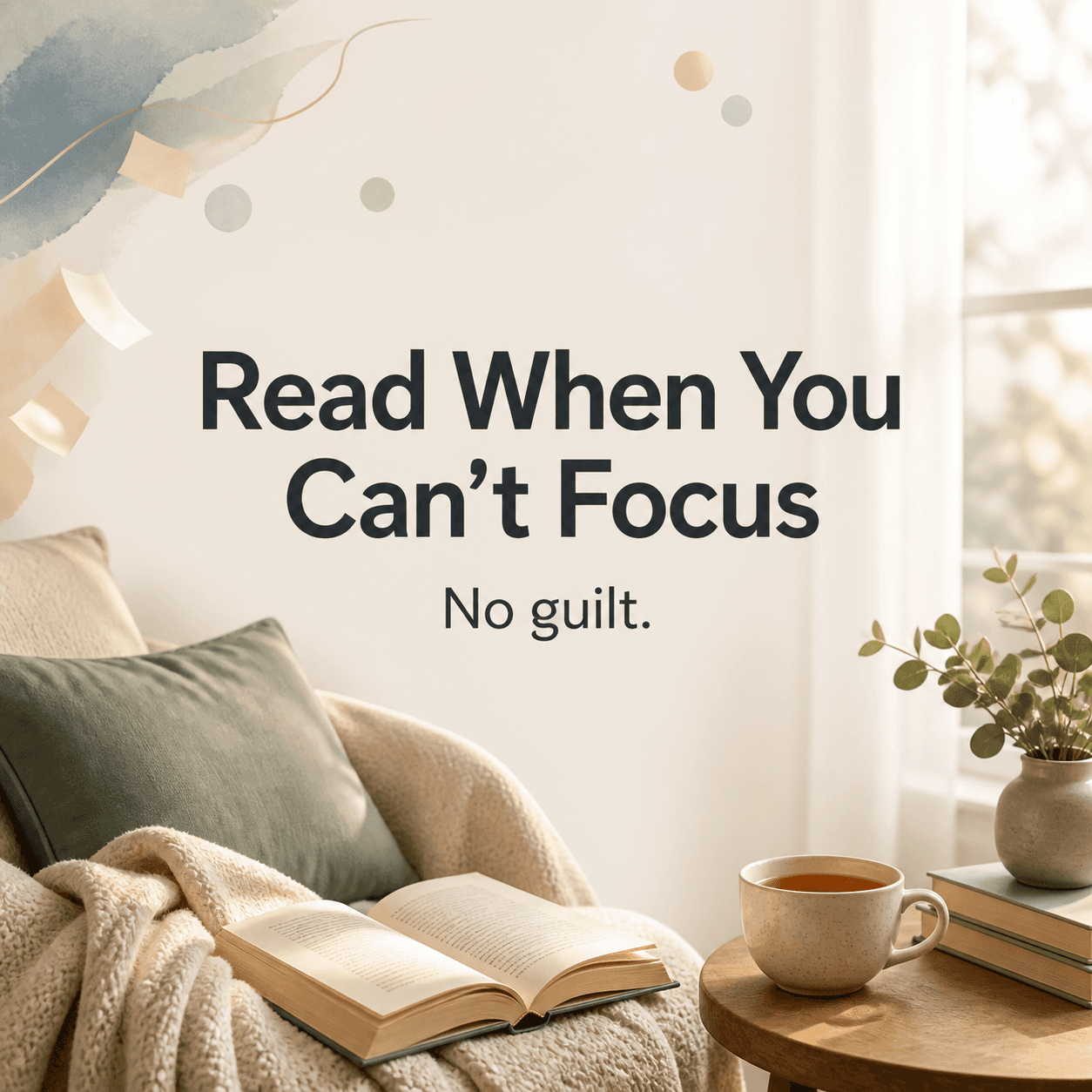
Some days, reading feels like trying to hold water in your hands.
You sit down with a book. You even want to read. But your eyes keep skimming. Your brain keeps hopping. You reread the same sentence four times and still nothing sticks. And then the little shame spiral starts.
“I used to be a reader.” “Why can everyone else focus?” “Maybe I’m just… not disciplined.”
Nope. Not doing that today.
This is a no guilt guide. Not a productivity sermon. Not a list of “wake up at 5am and drink lemon water and you’ll suddenly love Tolstoy.”
Just ways to read again when your attention is thin. When your life is loud. When your brain is tired. And still, you miss stories.
Quick truth: focus is not a personality trait
Focus changes with:
- sleep
- stress
- grief
- hormones
- ADHD (diagnosed or not)
- burnout
- anxiety
- the fact that you’re a human living in 2026 with a phone in your pocket
So if you can’t focus, it doesn’t mean you’re failing at reading.
It means you need a different doorway into it.
Start by changing the goal (this is the whole thing)
If your goal is “read 50 pages,” your brain hears: work.
If your goal is “finish this book this week,” your brain hears: pressure.
Try swapping the goal for something softer and more honest:
- “touch the book today”
- “read until I feel even 2 percent calmer”
- “read one scene”
- “read one paragraph and stop on purpose”
- “find one line worth saving”
This is how you get back into reading without turning it into another arena where you’re “behind.”
Reading is allowed to be small.

The 10 minute rule (but with a twist)
People say “just read 10 minutes.” Great. But if you’re already struggling, 10 minutes can feel like a treadmill.
Here’s the twist.
Set a timer for 6 minutes.
Not 10. Six is weirdly doable. It’s short enough that your brain doesn’t panic. It’s long enough to slip into the page.
When the timer ends, you get to stop. Not “should stop.” You get to stop.
If you want to keep going, sure. But the win is that you kept the promise. You read for six minutes. That counts.
If six is too much, do three. If three is too much, do one page. The point is momentum, not heroics.
Re reading is still reading (and it might be the best kind)
When focus is scattered, new information can feel slippery. But familiar stories? They’re a warm path.
Re read:
- a childhood favorite
- a comfort series
- a book you’ve read so many times you can fall into it anywhere
You’re not “wasting time.” You’re rebuilding your reading nerve endings. You’re letting your brain remember: oh right, this is safe. This is enjoyable.
And honestly, re reading often hits harder. You’re different now. The book is the same. That’s the magic.
Try “low friction” formats (no, audiobooks are not cheating)
If your attention won’t stay on print, don’t make print the only way you’re allowed to read.
Low friction options:
- audiobooks while walking, folding laundry, driving
- ebooks with bigger font and less visual overwhelm
- short stories, essays, poetry
- graphic novels and comics
- narrative nonfiction that reads like a novel
- rereading a single chapter instead of pushing forward
Audiobooks especially. They’re not a lesser version. They are literally how humans got stories for most of history. Spoken. Shared. Remembered.
If it helps you access the story, it’s valid.
Use “anchor reading” when your mind keeps running away
Anchor reading is what I do when my brain won’t stop spinning.
You pick a tiny anchor that keeps you tethered to the text. Something physical or repetitive.
A few anchors that work:
- Finger tracking: run your finger under the line as you read
- Index card: cover the page so you only see one paragraph at a time
- Pen in hand: lightly underline or circle words (not to study, just to stay present)
- Whisper reading: quietly mouth the words
- One sentence summary: after each page, say one sentence out loud like “okay, she’s lying and I don’t know why yet”
This isn’t childish. It’s supportive. Same way a handrail isn’t embarrassing. It’s there because stairs are real.
Make the environment do some of the focusing for you
Sometimes you don’t need more willpower. You need fewer inputs.
A simple setup that helps:
- phone in another room (or at least face down)
- one lamp instead of overhead lights
- one drink you don’t have to keep getting up for
- a blanket, yes, you are allowed
- a boring soundtrack (rain sounds, brown noise, instrumental)
If you keep checking your phone without thinking, try this:
Put it on airplane mode for six minutes. Just six. You’re not committing to a new lifestyle. You’re giving yourself a pocket of quiet.
Read something “too easy” on purpose
If you used to love dense classics and now you can only handle a romance novella or a cozy mystery, read the cozy mystery.
Your brain is not a machine that only deserves “serious” books.
Sometimes you need books that:
- are plotty and obvious
- are funny
- have short chapters
- don’t require you to remember 42 characters
- pull you forward without effort
Easy reading is often the bridge back to deeper reading.
And even if it isn’t. Even if it’s just… what you read now.
That’s still a reading life.
The “open the book” habit (tiny, almost silly, works anyway)
If you’re really stuck, do this for a week:
Every day, open your book.
That’s it. No reading required. Just open it.
You’ll probably read a little. But you don’t have to. The win is building the identity again. The ritual. The relationship.
Because the hardest part isn’t the reading. It’s the beginning.
Stop mid page (yes, mid page)
This one sounds wrong, but it helps.
When focus is shaky, your brain starts to believe reading is endless. Like once you start, you have to keep going or it “doesn’t count.” That pressure makes you avoid it.
So. Stop in the middle of a page.
Leave a bookmark right there, like a little cliffhanger.
Next time you pick it up, you’re already inside the scene. You don’t have to rev the engine from zero. You just continue.
If you can’t focus, reflect smaller
A lot of readers feel extra frustrated because they’re not just reading for plot. They want to remember what it meant. They want that deeper relationship with the book.
But deep reflection can feel like homework when your brain is tired.
So do micro reflection. One prompt. One line.
Here are a few (steal them):
- What line did I like, even if I don’t know why?
- What mood is this book giving me?
- What’s one thing I noticed about myself while reading?
- If this chapter had a title, what would it be?
- What did this remind me of?
If you want a gentle structure for this kind of thing, that’s basically the heart of GlimmerReads. The whole site is built around reflective reading without the pressure to perform it. You can also grab the newsletter, The Weekly Chapter, when you want someone to guide the process in small steps. Not intense. Just steady.
(And if you’re thinking “I can’t even keep up with a newsletter,” you’re fine. It’ll be there when you want it.)
A few “focus friendly” reading strategies that feel normal
1. Read two pages, then switch tasks
This is not quitting. It’s pacing.
Try: two pages, then stand up and stretch. Two pages, then refill water. Two pages, then sit back down.
Your brain starts to trust that reading won’t trap it.
2. Choose books with short chapters
Short chapters are basically built in encouragement.
If you’re picking a book specifically for low focus days, look for:
- 2 to 6 page chapters
- clear scene breaks
- simple language
- strong forward motion
3. Read in public (weirdly helpful)
Coffee shop reading works for some people because you’re less likely to scroll. The environment creates a social container.
Library works too. Quiet pressure. In a good way.
4. Read at the wrong time of day
If you keep trying to read at night and you’re always exhausted, try midday. Or morning. Or during lunch.
A lot of “I can’t focus” is actually “I’m depleted.”
What to do when you reread and still don’t understand
This happens. Especially with stress.
Here’s what helps:
- Slow down and read one paragraph like it’s a poem
- Read it out loud once
- Skip it and keep going (seriously)
- Summarize what you do understand: “Okay, they’re in a kitchen and something tense is happening”
- Switch to audiobook for the next chapter, then come back
You do not need perfect comprehension to enjoy a book.
Sometimes the brain catches up later.
Permission to quit books, too
If a book is making focus worse, if it feels like wading through wet cement, you can stop reading it.
Not forever. Just now.
Put it in a “later” pile, not a “failed” pile.
Your attention is a living thing. Feed it something it can digest.
A simple 7 day reset (gentle, realistic)
If you want a plan that doesn’t make you hate reading, try this.
Day 1: Open the book. Read 1 page. Stop.
Day 2: Read for 3 minutes.
Day 3: Read one chapter or one scene.
Day 4: Re read a favorite chapter from an old book.
Day 5: Audiobook day. 10 minutes while doing something easy.
Day 6: Read in a different place than usual.
Day 7: Write one sentence: “This week, reading felt like ___.”
That’s it. No tracking. No streaks. No gold stars.
Just a reset.
The actual point (so you don’t miss it)
You don’t have to earn reading by being focused.
You don’t have to wait until your brain is perfect, your life is quiet, your stress is gone, and you finally become the kind of person who can sit still for 90 minutes with a hardcover.
You can read like you are. Today.
Messy. Distracted. In little scraps of time. One paragraph. One scene. One line that hits.
And if you want a place to hold onto those little reading moments, that’s what GlimmerReads is for. Not to optimize your reading. Just to help you remember what a story changed in you. Even if you only read six minutes.
Because that still counts.
It really does.
FAQs (Frequently Asked Questions)
Why do I struggle to focus when reading sometimes?
Focus isn’t a fixed personality trait; it changes with factors like sleep, stress, grief, hormones, ADHD (diagnosed or not), burnout, anxiety, and simply living in a noisy world with constant phone distractions. Struggling to focus doesn’t mean you’re failing at reading—it means you might need a different approach to engage with books.
How can I adjust my reading goals to make reading feel easier?
Instead of setting high-pressure goals like „read 50 pages“ or „finish this book this week,“ try softer, more honest goals such as „touch the book today,“ „read until I feel even 2% calmer,“ or „find one line worth saving.“ This shifts reading from a task into a gentle activity, making it easier to reconnect without guilt.
What is the ‚6-minute rule‘ for reading and how does it help?
The ‚6-minute rule‘ suggests setting a timer for six minutes (instead of the usual 10) to read. Six minutes is short enough to avoid panic but long enough to get absorbed. When time’s up, you can stop if you want—no pressure. This builds momentum and makes reading feel doable even on tough days.
Is rereading books beneficial when my focus is scattered?
Absolutely! Rereading familiar stories acts like a warm path for your brain when new information feels slippery. It rebuilds your ‚reading nerve endings,‘ reminding your brain that reading is safe and enjoyable. Plus, rereading often reveals new insights since you’ve changed while the book stays the same.
Are audiobooks and graphic novels valid ways to enjoy stories if I can’t focus on print?
Yes! Low friction formats like audiobooks, ebooks with larger fonts, short stories, poetry, graphic novels, and narrative nonfiction are all valid ways to access stories. Audiobooks especially connect us to how humans have shared stories orally throughout history. If it helps you engage with the story, it’s not cheating—it’s smart reading.
What techniques can help me stay present while reading if my mind keeps wandering?
Try ‚anchor reading‘ techniques such as finger tracking under lines, using an index card to reveal one paragraph at a time, lightly underlining words with a pen (just to stay present), whispering words quietly as you read, or summarizing each page aloud in one sentence. These methods act like supportive handrails to keep your attention tethered to the text.


No responses yet