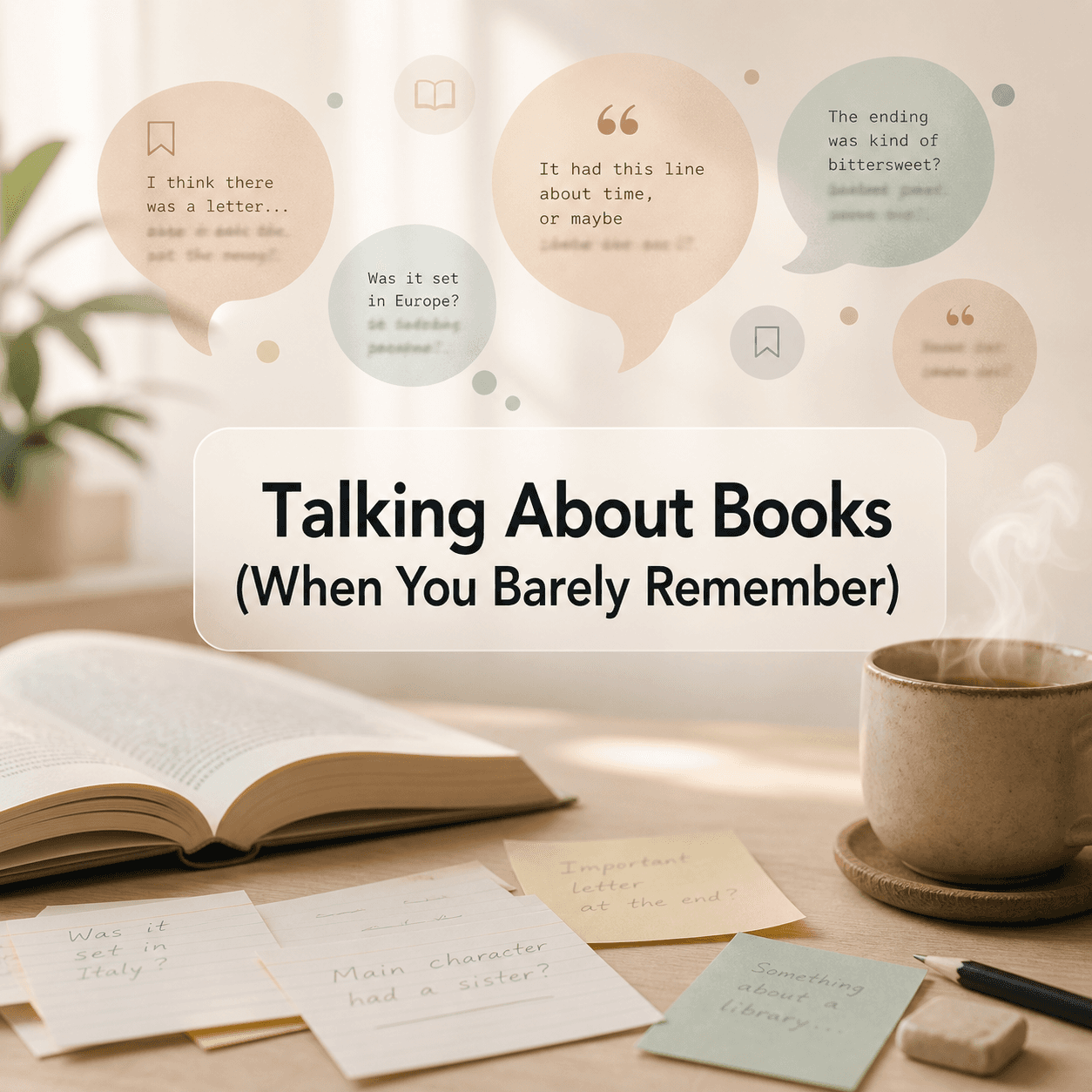
You know that slightly panicky moment.
Someone says, “Oh I loved that book. What did you think?”
And your brain goes… blank. Not even a quote. Not even a character name. Just vibes. Maybe a foggy memory of a train scene. Or was that a different book.
And the worst part is you did read it. You finished it. You even remember feeling something at the end.
But now. Nothing.
If this is you, welcome. You’re not dumb, you’re not a fake reader, and you don’t need to start writing book reports to prove you belong in the conversation.
Talking about books when you don’t remember much is a skill. A normal, very human skill. And honestly it can make you a better reader, because it forces you to name what stuck.
Not what you could recite.

First, a quick reality check: forgetting is normal
Most of us learned to think reading equals retention. Like if you can’t summarize the plot cleanly, you didn’t “get it.”
But books are not exams.
You’re allowed to remember a book the way you remember a year of your life. Some scenes, some feelings, maybe one line that hit too hard at 2 am.
Also, modern reading is… a lot.
We read in fragments. On commutes. Before bed. Between tabs. Sometimes we read five books in a month and then act surprised when our brain stores them in one shared folder labeled “stories I liked, I think.”
So yeah. If you forget details, you’re in the majority.
The goal isn’t to magically remember everything. It’s to learn how to talk about what you do remember in a way that feels real and not embarrassing.
The shift that changes everything: talk about impact, not inventory
When people ask about a book, they’re rarely testing you.
They’re usually trying to do one of these:
- See if you liked it too
- Figure out if they should read it
- Swap feelings about the ending
- Connect with you for a minute
That means you can respond with impact. Not a flawless plot recap.
Try framing your thoughts around:
- How it felt
- What it made you think about
- What kind of reader it might work for
- What you remember most clearly, even if it’s small
- What you wanted more or less of
This is allowed. This is actually what good conversations are made of.
The “3 anchors” method (my favorite simple trick)
When you don’t remember much, grab three anchors. Just three. That’s it.
Anchor #1: a vibe
Examples:
- “It felt quiet and reflective.”
- “It was tense the whole way through.”
- “It had that cozy small town thing going on.”
- “It was kind of bleak, but in a beautiful way.”
Anchor #2: a theme (not a plot)
Themes are easier to remember than sequences of events.
Examples:
- grief and healing
- ambition and burnout
- belonging
- power
- identity
- second chances
- friendship that changes shape over time
Anchor #3: one specific thing
A scene, setting, character type, a twist, the writing style. Just one.
Examples:
- “There’s this dinner party scene I still think about.”
- “The narrator was so unreliable, it messed with me.”
- “It took place on an island and the atmosphere was basically a character.”
- “The ending punched me a little.”
Put them together and you sound grounded. Even if you can’t name the side characters or explain the middle 60%.
A full example:
“I remember it being really tense and kind of claustrophobic, like you’re trapped in the character’s head. The big thing for me was how it explored guilt and self deception. And I can’t recall every detail, but there’s this one scene near the end where everything clicks and it made the whole book feel sharper.”
That is a good answer. That is a real answer.
A few honest phrases that save you (and keep you likable)
You don’t have to pretend. Just don’t over apologize either.
Try these:
- “I read it a bit ago, so the details are fuzzy, but I remember the feeling.”
- “I can’t do a clean plot summary, but I remember what it was about emotionally.”
- “I don’t remember the exact ending, but I remember how I felt after.”
- “It’s funny, I forgot a lot of the specifics, but the writing stuck with me.”
- “I might be mixing up a couple scenes, but the core idea was…”
Notice how none of these say “I’m so stupid.” They’re calm. They assume forgetting is normal. Because it is.
If you need to answer fast, use these 5 conversation templates
Sometimes you don’t have time to think. Someone’s staring at you politely. You need a sentence that works.
Here are a few that rarely fail.
1) The “who is it for” template
“I’d recommend it if you like [tone], and if you’re okay with [pace/structure].”
Example:
“I’d recommend it if you like character driven stories and you don’t mind a slower pace.”
2) The “what it’s similar to” template
“It reminded me of [book/movie/vibe], but with [difference].”
Example:
“It reminded me a little of Gone Girl energy, but less twisty and more psychological.”
3) The “best at / worst at” template
“It’s really strong at [thing], and weaker at [thing].”
Example:
“It’s really strong at atmosphere and inner monologue, but the plot was kind of loose.”
4) The “moment that stayed” template
“The part that stuck with me was [moment], because [reason].”
Example:
“The part that stuck with me was the way the sisters talked to each other. It felt painfully real.”
5) The “it made me think about” template
“It made me think about [topic], especially [angle].”
Example:
“It made me think about ambition and what we trade for it. Like how quietly it can eat your life.”
You can carry these around like emergency snacks.
What if you barely remember anything at all?
Like not even vibes. Just… “I read a book. Once.”
Still workable.
Here’s what to do:
Step 1: name your level of memory without making it a big deal
“I honestly remember almost nothing, which is annoying because I remember I liked it.”
That line is relatable. People usually laugh and agree.
Step 2: ask them a question that gives you something to grab
- “What was your favorite part?”
- “Did you like the ending?”
- “Which character did you love most?”
- “Did it work for you or did it drag?”
Now you’re in a shared conversation, not a performance.
Step 3: reflect back what they say, then add one small thing
Even something tiny.
“Yes, the ending. I remember it being kind of quiet, not explosive. And I liked that it didn’t over explain everything.”
That’s enough.
If you’re in a book club, here’s how to survive (and actually enjoy it)
Book club is where memory anxiety really spikes because it feels like you’re supposed to bring “insights.”
But book club is not a courtroom.
A few strategies that help a lot:
Bring 2 notes, not 20
Before you go, write down:
- One thing you liked (or respected, even if you didn’t like it)
- One thing you questioned, disliked, or felt unsure about
That’s it. Two notes can carry you through an hour.
Talk about patterns, not facts
Instead of “In chapter 14 she said…” try:
- “I noticed the book kept returning to the idea of…”
- “There was a pattern of characters avoiding honesty until…”
- “It kept shifting between tenderness and cruelty and that contrast hit me.”
You sound thoughtful. Because you are being thoughtful.
Give yourself permission to be a “theme reader”
Some readers remember plot like a filing cabinet. Some remember emotions. Some remember sentences. Some remember settings.
All valid.
Book clubs need all of those types, by the way. Plot recap people are helpful. But they’re not the only ones who belong.

The secret weapon: talk about your reading experience, not just the book
This is underrated.
You can talk about:
- where you were when you read it
- what you were going through
- why you picked it up
- whether you binged it or stalled
- whether it pulled you out of a slump
That counts. It adds context. It also makes the conversation more personal, which is usually what people want anyway.
Examples:
- “I read it during a stressful week, so I think I needed something comforting.”
- “I flew through the first half and then slowed down, which tells me the middle sagged a bit.”
- “I kept highlighting lines even when I didn’t fully know where the plot was going.”
That last one especially. Because it signals you were engaged.
A gentle way to rebuild memory, if you want to
You don’t have to change your life. But if you want to remember books a little more, without turning reading into homework, try one of these low effort options.
Option 1: the one sentence recap
When you finish a book, write one sentence:
- “A tender story about ____.”
- “A sharp, unsettling look at ____.”
- “A messy family novel where ____.”
That sentence becomes your future conversation starter.
Option 2: the “3 things” note
Write three bullets:
- A vibe
- A theme
- A moment
Yes, the anchors again. They work.
Option 3: a quote you’d want to keep
Not ten quotes. One.
Even if you forget everything else, that one line can bring the book back.
Option 4: use a reading journal prompt that does the thinking for you
This is basically why we built so much of GlimmerReads around reflection. Not intense analysis. Just simple prompts that catch the meaning before it slips away.
If you want a starting point, try this:
- What did this book shift in me, even slightly?
- What did it make me feel that I didn’t expect?
- What kind of day is this book best read on?
If you like that style, you’ll probably like the prompts in the Reading Room on GlimmerReads, and the newsletter too. The Weekly Chapter is basically a soft landing for readers who want to remember what mattered without turning it into an assignment.
What to do when someone clearly remembers everything (and you don’t)
This happens. They’re like:
“So when he said that line on page 247…”
And you’re standing there with your brain holding a single goldfish.
A couple ways to handle it:
Be curious instead of defensive
“Wait remind me, was that before or after the reveal?”
or
“I love that you remember that. What did you take from it?”
People like talking about what they noticed. You’re giving them space. And you’re quietly rebuilding your own context.
Offer a different kind of insight
You can say:
- “I don’t remember the exact scene, but I remember the book’s view on forgiveness felt complicated.”
- “I can’t quote it, but the overall message felt more bittersweet than hopeful.”
That’s valuable. It’s not lesser. It’s just different.
A mini cheat sheet for common book conversation moments
When someone asks: “So what’s it about?”
Try:
- “It’s about ____ on the surface, but really it’s about ____.”
- “It follows ____ and the main tension is ____.”
- “It’s hard to summarize, but the core is ____.”
When someone asks: “Did you like it?”
Try:
- “Yes, mostly. I had a couple issues, but the mood was worth it.”
- “Not exactly, but I’m glad I read it.”
- “I admired it more than I enjoyed it.”
When someone asks: “Was it slow?”
Try:
- “More character driven than plot driven.”
- “It’s a slow burn. The payoff depends on whether you like atmosphere.”
- “The middle dragged a bit, but the ending helped.”
When someone asks: “Would you recommend it?”
Try:
- “To the right person, absolutely. If you like ____, you’ll probably love it.”
- “I’d recommend it with a warning about ____.”
- “I’m not sure I’d recommend it broadly, but it has a really specific charm.”
You don’t need to be extreme. Books don’t have to be “best thing ever” or “trash.” Real readers live in the middle.

The weird truth: remembering less can make you talk about books better
Because if you can’t hide behind plot, you end up talking about meaning.
About mood. About what a character taught you. About what a story did to your nervous system.
And that’s usually what we’re actually looking for when we talk about books. Not the Wikipedia summary. Not the list of events in order.
So next time you forget, don’t panic. Grab your three anchors. Say what you remember honestly. Ask a question. Let the conversation be a conversation.
And if you want a small ritual that helps you hold onto what matters, not every detail, come hang out at GlimmerReads. Start with a journaling prompt or two. Or subscribe to The Weekly Chapter and let the theme carry your reading for a month.
You don’t need perfect recall to be a real reader.
You just need a relationship with what you read. That’s enough.


No responses yet