
This post is about how to take care of yourself after a book or (heavy) chapter ends. Yes, you deserve aftercare. Anything else is below the minimum. No, we don’t just call it a „reading slump“ and bash on people who feel deeply and need a breather after a very immersive, intense book. Leave. them. alone!
The part no one really talks about — when the story is over, but your nervous system isn’t done with it. You’ll learn why intense books can linger emotionally, and a few gentle ways to help yourself land again, without analyzing the story or fixing yourself.
#Sounds familiar? You close the book, set it down, and for a moment everything feels… off.
The room looks the same. Your phone is still there. The day is still moving forward (or the moon is up now, if you are anything like me). But inside, something hasn’t caught up yet. You might feel heavy, raw, restless, or strangely hollow. Sometimes it’s sadness. Sometimes it’s agitation. Sometimes it’s a quiet, floating what now? that follows you around for hours—or even days.
If you’ve ever finished a book and felt strangely empty afterward, like something meaningful just ended, that’s part of the emotional impact of reading—and you’re not alone.
This reaction doesn’t mean you’re overly sensitive. It doesn’t mean you “took it too seriously.” It means the book reached you. And when something reaches you, it doesn’t disappear the moment you close the cover.
This is where reading aftercare comes in.
Not as therapy.
Not as analysis.
But as a gentle way to help yourself land again after an emotionally intense reading experience.
What Readers Often Feel After Intense Books
People describe this post-book state in remarkably similar ways, even when the stories themselves are completely different.
You might notice:
- a sense of emotional fullness, sometimes numbness, like there’s no space for anything else
- scenes replaying in your mind while you’re trying to do ordinary tasks (you might dream about it as well.. sometimes it is nightmares, or a personal version of a chapter that just lingers)
- irritability, tears, or an unusual quiet
- the urge to talk about the book—and the urge to avoid it at the same time
- a vague unease, even though your real life is safe
- a detached feeling, like you’re slightly outside your own day
- missing the characters in a way that feels surprisingly physical
Sometimes it shows up as insomnia. Sometimes as the need to immediately start another book—not out of excitement, but because silence feels too loud…CAREFUL, there is a difference between wanting more info and finishing a story, and just switching into robot-auto-pilot and zombying through the next chapters.
Once you understand what is going on, it becomes much easier to be kind to yourself while it passes.
Why Emotional Residue Happens After Reading (In Plain Language – let’s break it down)
An intense book isn’t just information. It’s an experience your mind and body participate in, especially if you feel close to any of the characters involved. You like them, you feel for them.
When you read, your brain doesn’t file the story away like a document. It’s more than just ink on a page. You basically dive right in. It builds a world. It imagines faces, voices, danger, tenderness, hope. It tracks emotional stakes and predicts outcomes. Even when you know a story is fictional, your nervous system can still respond as if you were there.
A few reasons the feeling lingers:
Your brain builds real emotional pathways.
Stories ask you to practice empathy. You follow fear, attachment, grief, desire, survival. Your body responds with real chemistry—tension, relief, warmth, loss. Those pathways don’t shut off instantly when the book ends. They fade gradually.
Closure is often incomplete, even with a “good” ending.
Many powerful books end with ambiguity, loss, or bittersweet resolution. Even neat endings can leave emotional momentum behind. Your mind keeps processing because it didn’t get a clean landing.
Identification deepens the impact.
If a character’s situation resembles something you’ve lived, feared, or witnessed, the story can reach deeper than you expect. You may not consciously think of your own life—but your body recognizes familiar themes.
Immersion has a comedown.
Leaving an intense book can feel like leaving a loud concert and stepping into a quiet parking lot. The contrast can be jarring. Your attention was held tightly for hours. When it’s released, you can feel unmoored.
Some stories activate protective instincts.
Books involving danger, injustice, grief, or high emotional stakes can create a low-level stress response. During reading, your focus carries you through. Afterward, your body finally notices what it held.
None of this requires a diagnosis. It’s a human response to meaningful storytelling.
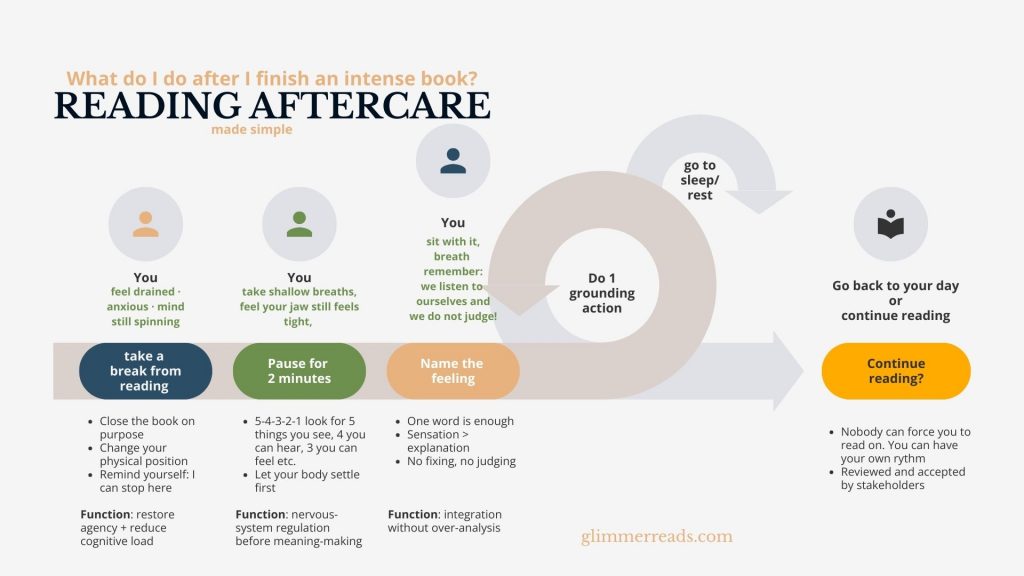
Reading Aftercare: Gentle Ways to Come Back to Yourself
Aftercare is about transition. You’re helping your system move from the emotional reality of the book back into your own life—without forcing it. This process is essential for emotional recovery after intense books, allowing you to gently reintroduce yourself to reality while considering bibliotherapy techniques and other trauma healing tools.
1. Name what’s happening (without making it a problem)
A single sentence can help:
“I’m feeling emotional residue from that book.” You talks like that, right? I get it. You just FEEL so much! And that is a good thing. It makes you YOU. (and it might be a very nice way of learning to let people go? eventually?)
That’s it.
Naming reduces confusion and interrupts the spiral of why am I like this? You’re not broken. You’re processing.
If it helps, you can go one step further:
“I feel ___ because the book left me with ___.”
Grief. Anger. Longing. Unease. Relief. Let the feeling have a hook to hang on.
Additionally, consider incorporating bibliotherapy, trauma recovery workbooks, or psychoeducational tools into your reading aftercare routine. These resources can provide structured support, helping you process emotions more effectively and gain deeper insights into your experiences.
2. Give yourself a real-life cool-down
Athletes cool down after exertion. Readers can too, especially when engaging with trauma literature that may trigger intense emotions.
Choose 10–20 minutes of something low-stimulus and grounding. Not distraction—decompression. This is an essential part of managing triggers and supporting your healing process in relational trauma recovery.
Good options:
- a warm drink, sipped slowly
- washing your face or taking a shower
- tidying one small surface
- stepping outside for a short walk without headphones
These activities help signal to your body: we’re here now. They allow you to reconnect with the present moment and soothe any overwhelming feelings that arise from the material you’ve read.
3. Re-enter through your senses
If you feel floaty or stuck, bring your attention back to the physical world.
Casually notice:
- a few colors you can see
- your feet on the floor
- the temperature of the air
- the farthest sound you can hear
This isn’t about forcing calm. It’s about orientation. Sensory grounding techniques are supported by psychoeducation on how the body processes emotional experiences from various books.
4. Get the story out of your head and into a container
A book loops in your mind because your brain is still holding it. Engaging in bibliotherapy can help you process these thoughts effectively.
You can journal, voice-note, or message someone (a book bestie maybe?)—briefly:
- what scene is stuck
- what emotion it carries
- what it reminded you of (even loosely)
If writing feels like too much, try one sentence:
“The part I can’t stop thinking about is…”
You could add a „why“, but there is no need to overexplain yourself.
You might wanna write a „how I wished it would go“ or „what I would do with the characters if I was the author“, just to change the perspective. That can help!
Stop when you feel even a little lighter. This act of journaling for trauma healing allows you to use writing as an emotional recovery tool after intense books.
5. Let yourself grieve the end of the experience
Missing characters can feel embarrassing—but it makes sense.
For hours, you were in emotional proximity to a coherent world with meaning and direction. Then it ended.
You’re not grieving a person.
You’re grieving an experience.
That distinction often releases the shame—and helps the feeling move.
Consider reading memoirs like The Glass Castle by Jeannette Walls or Educated by Tara Westover, which explore themes of estrangement and family dysfunction. These narratives can validate your feelings of loss after intense reading experiences, as they vividly depict the complexities of familial relationships and the emotional impact of leaving them behind.
6. Choose a bridge activity, not productivity
Jumping straight into demanding tasks can feel awful when you’re still processing. Instead, consider incorporating bridge activities as part of your self-care routine, as recommended in trauma recovery books for emotional recovery after intense experiences.
If you can, choose a gentle bridge:
- light cooking
- stretching
- a familiar show
- simple chores
Notice if you’re tempted to scroll aggressively. Doom-scrolling mimics intensity and can keep your system activated.
7. If you start another book, do it intentionally
Starting a new book right away can be soothing—or avoidant.
A middle ground:
- choose something calmer or familiar
- reread a trusted favorite
- or wait until the next day
- consider lighter genres or curated trauma recovery books if you decide to start another book
Even a small pause helps your mind file the previous story instead of stacking emotions. Pay attention to your personal readiness before diving into a new narrative.
8. Let your body move the feeling through
Emotional residue lives in the body, as noted by Bessel van der Kolk in his book The Body Keeps the Score. He explains how emotions can linger physically, affecting our well-being long after the initial experience.
Match movement to the feeling:
- anxious → brisk walk, shaking out tension
- heavy → stretching, warmth, lying down
- numb → sensory input, music, cooking
By engaging in these movements, you’re giving the emotion a path—not trying to think it away. This process helps to effectively process the emotions tied to your experiences and stories.
Building Your Own Reading Aftercare Rhythm
If you love intense books but dread the emotional hangover, a simple rhythm helps.
It can be as small as:
- close the book
- sit quietly for two minutes
- write three sentences
- do one grounding activity
- rest
Over time, your system learns:
We can go deep—and we can come back.
That trust changes how reading feels.
If you find that emotional residue feels overwhelming or persistent, consider integrating reading aftercare with professional therapy or support groups.
Reading Aftercare FAQ
What is reading aftercare?
Reading aftercare is a set of simple habits that help you transition after finishing an emotionally intense book. It’s about grounding, not fixing. This practice can be particularly beneficial in the context of bibliotherapy, where reading is used as a tool for trauma healing.
Is it normal to feel sad or anxious after a book?
Yes. Many readers experience sadness, restlessness, numbness, or anxiety after emotionally charged stories. If you’re managing triggers related to past trauma, these feelings may be more pronounced.
Why do I miss the characters so much?
Because your brain treated them like meaningful social experiences. Missing them is often grief for the end of that experience. This attachment can be intensified when the story resonates with your own emotional healing journey.
How long does emotional residue last?
It varies. For some, it fades in hours. For others, a few days—especially if the themes felt personal. When engaging with intense narratives as part of bibliotherapy, be mindful that the emotional impact may linger longer depending on your personal history.
Can intense reading be harmful?
Not inherently. But if you notice repeated emotional crashes or sleep disruption, pacing and aftercare can help. If you’re sensitive to certain triggers, consider seeking curated book recommendations that align with your emotional healing process. Guess where to find those 😉


No responses yet