
The audiobook vs reading debate (and why it gets so heated)
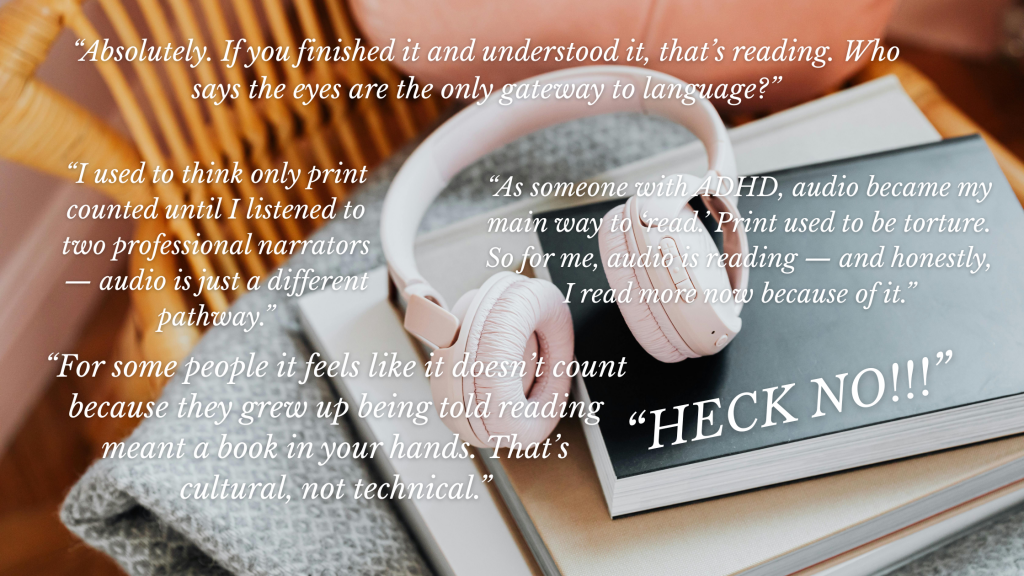
Did you hear about this? Insta and Reddit blew up withing a day…and this argument gets weirdly intense for something that should be… fun. Books. Stories. Learning. And yet, say “I read it on audio” and you can feel the room split.
Quick answer: Yes, audiobooks count as reading in terms of comprehension, learning, and engaging with ideas. While they do not involve visual decoding of text, research suggests that for many adults, listening comprehension can be similar to reading comprehension when attention is maintained. The right format depends on your goal.
I feel like this became an even bigger issue since Booktok started a couple years ago and people talk about popular books a lot more – which boosted the audio book industry. So starting out I hope to find some common ground for everybody: we LOVE stories. Back in the days, written stories were delivered in books and for many, reading is not just an activity. It is tied to tons of feelings, then some added intelligence, effort, morality, even identity.
So when someone says audiobooks count, some people hear: “Effort doesn’t matter.”
And when someone says audiobooks do not count, other people hear: “You don’t belong here.”
Usually the debate falls into two camps:
- Only print counts. If your eyes did not move across the words, you did not read. (A kindle is allowed, but doesn’t fully cound for the hardcore readers!)
- Story is story. If you finished the book and understood it, you read it.
This post is not meant to shame either side or force one definition. It is here to clarify what “counts” can mean depending on the goal: learning, enjoyment, building literacy skills, how the brain processes language, and what you personally need to stay consistent.
And specifically, below you can find a practical guide for ADHD or dyslexic readers, because this topic can hit a nerve. If you have ever felt judged, behind, or unsure whether you are “doing it right,” you are not alone.
What does “reading” actually mean? (Definitions that change the answer)
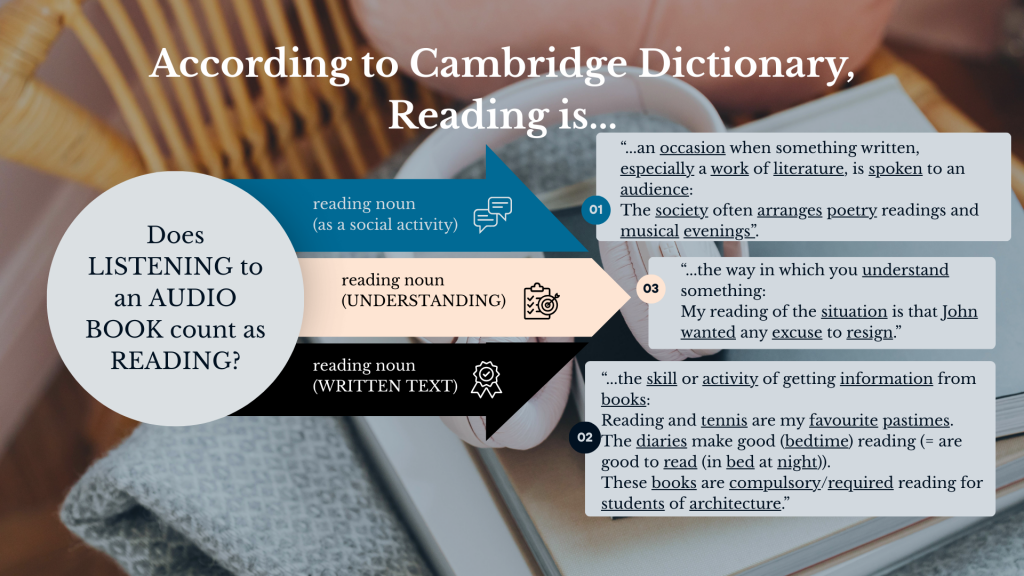
The answer changes depending on what you mean by “reading.” People talk past each other because they are using different definitions without realizing it.
Here are three useful lenses.
1) Mechanical reading (decoding text)
This is the classic, literal definition. Reading as in: visually recognizing written words, decoding letters into sounds, tracking sentences, handling punctuation, scanning, rereading.
Under this lens: audiobooks are not “reading,” because there is no visual decoding happening.
And to be fair, that matters sometimes. If your goal is to build decoding skills, spelling, or comfort with written language, audio is not a full substitute.
2) Comprehension reading (understanding language and ideas)
This is reading as in: understanding the meaning. Following arguments. Tracking plot. Holding concepts in working memory. Making inferences. Learning.
Under this lens: audiobooks absolutely count, because you are still processing language and meaning. You are just receiving it through your ears instead of your eyes.
3) Cultural reading (participating in books and literature)
This is reading as belonging. Being part of “people who read.” Talking about books, learning from them, sharing quotes, getting emotionally moved, building a relationship with authors and ideas.
Under this lens: audiobooks count in the way that matters most socially. You experienced the book. You can discuss it. It shaped your thinking. You are in the conversation.
If you grew up being praised or criticized for reading, this can feel personal. Because it is not really about the medium. It is about what reading represented in your life.
Here is the answer that avoids the purity contest:
Audiobooks do not involve visual decoding, but they absolutely can count as reading for comprehension, learning, and engaging with books.
They also allow ANY person that can hear to experience the story!!! And I think that is the most relevant thing for me.
A simple reframe that helps a lot:
You are still processing language, narrative, and meaning. Just through your ears.
Where audiobooks may not fully substitute for print or ebooks:
- Spelling and orthography (seeing how words look)
- Punctuation awareness (how commas and paragraph breaks shape meaning)
- Skimming and scanning (quickly locating a passage)
- Some study workflows that rely on visual markup, highlighting, and quoting
- Charts, formulas, footnotes, tables (audio can handle these, but it is often clunky)
Have you ever tried to read book 2 in a series, after only listening to the first book? Trust me, it is WEIRD. But…
None of that makes audio “less than.” It just means audio is a different tool with different strengths. Because a dual narrative done by professionals is… a journey, let’s keep it at that :D.
Why this matters for ADHD readers, specifically: reading identity often comes bundled with shame. “I should be able to sit still.” “I used to love books, what happened?” “I never finish.” Redefining success around outcomes (understanding, enjoyment, consistency) instead of format purity usually makes people read more, not less.
Listening vs reading comprehension: what research and real life usually show
In real life, comprehension tends to depend more on:
- attention and distractions
- prior knowledge of the topic
- pacing (too slow can cause drifting, too fast can overwhelm)
- text difficulty and density
- whether you pause and reflect
- whether you take notes when you need to
A common takeaway from research in this area, without pretending it is one simple universal result: for many adults, comprehension from listening and reading can be similar when the listener or reader is focused. Differences often show up when material is complex, when you need to study and reference details, or when mind wandering kicks in.
So instead of asking “Which is better?” it helps to ask “Which one helps me stay engaged with this specific book?”
A few practical examples.
If you are learning concepts
- Audio can be excellent for big picture understanding, especially if the narrator is clear and the book is not overly technical.
- Print can be better for diagrams, definitions, and anything you want to revisit quickly.
A good middle ground: audio first for flow, then skim the ebook for highlights and key sections.
If you are studying for a test
- Print or ebook usually wins because you can annotate, quote, and jump around fast.
- Audio can still help if you treat it like a lecture and pause to capture key points.
If you do use audio for studying, you probably need a capture system. Even a tiny one.
If you are trying to remember details
- Audio works well when you are fully present and the pacing fits your brain.
- If you listen while doing something that competes for attention, details can slide right off.
And this is where ADHD shows up hard. Not because you are not smart. Because attention is a moving target.
ADHD and audiobooks: why this format can be a game-changer (or not)
ADHD affects sustained attention, task initiation, working memory, and distractibility. It is not a character flaw. It is not laziness. It is not lack of intelligence. Still, a lot of ADHD adults have a long history of being treated like it is.
Audiobooks can help ADHD readers because they reduce some of the friction points that make print harder.
Why audiobooks can be great for ADHD
1) Lower initiation energy Starting a print book can feel like a whole event. Lighting, posture, quiet, attention, the first few pages you barely remember. Audio is often easier to start. Press play. Done.
2) Body doubling, but with a narrator A good narrator provides structure. It can feel like someone is carrying you through the book, sentence by sentence, which reduces the effort of self pacing.
3) You can pair it with movement Walking, chores, commuting, stretching. For many ADHD brains, light movement helps attention lock in.
4) Less visual fatigue If you deal with eye strain, headaches, visual stress, or just “my eyes bounce off the page,” audio is relief.
5) Speed and voice sensitivity Many ADHD listeners do better at 1.25x to 1.75x because slow narration gives the mind space to wander. But some people get overstimulated by faster speed or certain voices. It is personal.
Make this identity safe: needing audio is not cheating. It is a strategy. You are not trying to win the Reading Olympics. You are trying to access books.
Also worth saying out loud: a lot of ADHD readers have co existing challenges like dyslexia, auditory processing differences, anxiety, depression, and sleep issues. Formats can be accessibility tools. That is not a lesser path. It is literally the point of accessibility.
When audiobooks might not work for ADHD
- If you zone out and cannot easily find your place again
- If you need visual anchors to remember what you read
- If the book is dense and reference heavy
- If your environment is noisy and headphones are uncomfortable
- If the narrator’s voice irritates you (this matters more than people admit)
If audio does not work for you, that is not a failure either. It just means you need a different tool or a hybrid approach.
The identity piece: “I feel like I’m not a real reader”
This is usually the core of it. Not the definition.
Many ADHD readers carry a history of:
- unfinished books stacked like guilt
- school pressure and timed reading
- being compared to siblings or classmates
- being told “you just need to focus”
- loving stories but struggling with follow through
So when someone says audiobooks do not count, it can hit the oldest bruise. The one that says: you are pretending. You are lazy. You do not get to be part of this.
Here is a healthier definition of reader identity:
A reader is someone who consistently engages with books and ideas. Who collects stories. Who learns. Who returns to language.
Not someone who performs reading in a specific posture, with a specific medium, to satisfy an imaginary judge.
Two lines that help, especially with ADHD:
- Consistency beats purity.
- Access beats aesthetics.
Social stigma is real. Goodreads counts “books read,” not “hours listened.” Book clubs casually ask “how fast did you read it?” People brag about page counts. Even if nobody is trying to be cruel, it can trigger shame fast.
Try personal metrics instead:
- Did this book make me curious?
- Did I finish, or did I intentionally DNF without spiraling?
- Did I learn one useful thing?
- Did I enjoy my time with it?
- Did it give me language for my life?
Those are real outcomes. And they are the reason people read in the first place.
When print or ebook might be the better tool (and how to choose without guilt)
Audio is not always the best tool. Neither is print. You are allowed to choose based on the job.
Print or ebooks can be especially helpful for:
- Visual structure: headings, charts, formulas, code snippets
- Dense nonfiction: where you need to pause, reread, and compare paragraphs
- Classic literature: older syntax can be easier when you can see the sentence
- Quoting and research: grabbing passages quickly
- Note heavy learning: highlighting, annotation, linking ideas
A simple set of “match the format to the moment” examples:
- Commute, chores, walking: audiobook
- Desk study, writing, exams: ebook or print
- Dense classics: hybrid (audio plus text)
- Bedtime wind down: audiobook with a sleep timer, or ebook with low light and large font
Using text sometimes does not invalidate audio other times. You are not picking a team. You are building a system.
Hybrid reading: the simplest way to get the best of both worlds
Hybrid reading is underrated because it sounds like extra effort. In practice, it is often what makes books finally click.
A common method is immersion reading: listening to the audiobook while following along in the text.
This can help with:
- ADHD focus support (two channels of input can reduce drifting)
- pronunciation and name recognition
- faster finishing, because momentum stays high
- tackling dense books without bouncing off
Other easy hybrid options:
- Switch formats by context. Audio while cooking, ebook at night, print on weekends.
- Use bookmarks. Drop a bookmark whenever you feel attention slipping.
- Keep formats synced when possible. Some platforms support sync between audio and ebook for the same title, but even without that, a quick chapter note works.
How to avoid overload: start with a slower speed than you think you need, then adjust. And do not underestimate narrator fit. The wrong narrator can make a great book feel impossible.
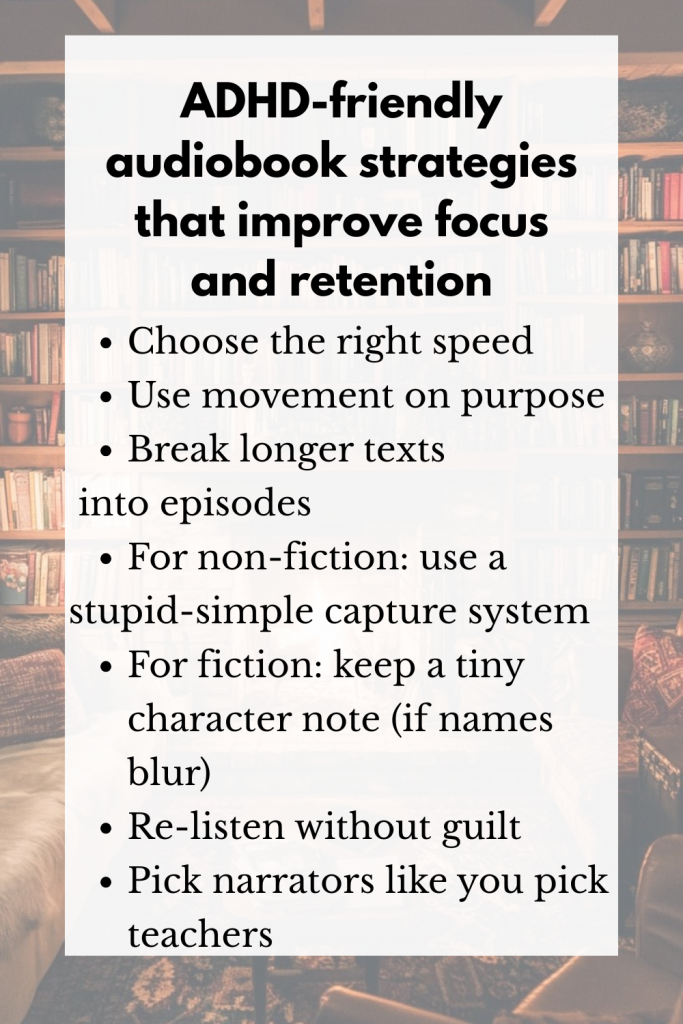
ADHD-friendly audiobook strategies that improve focus and retention
Audiobooks can be effortless. They can also turn into background noise if you are not careful. The goal is not perfection. It is gentle structure.
1) Choose the right speed
A lot of ADHD listeners do best slightly faster than normal because it keeps the mind engaged.
Try this:
- Start at 1.0x
- Move to 1.15x or 1.25x
- Increase until you notice comprehension drop
- Back off one step
Some narrators also sound more natural at 1.1x to 1.3x, which is funny, but true.
2) Use movement on purpose
If you know you focus better while moving, design for it. Do not wait to “earn” audiobooks by sitting still.
Good pairings:
- walking outside
- cleaning a room
- folding laundry
- commuting
- low effort crafts
Be careful with tasks that steal language processing, like writing emails or reading other text.
3) Break long books into episodes
Long books can feel endless in audio because there are no visible page landmarks.
Make chapters your unit of success.
- “One chapter today” is clear.
- “Thirty minutes” is clear.
- “Finish the book” is abstract and heavy.
4) For nonfiction: use a stupid simple capture system
You do not need a full note taking setup. You need something you will actually do.
Try: one note per chapter. That is it.
Format:
- 1 sentence: what this chapter was about
- 1 bullet: one idea I want to remember
- 1 bullet: one action or question
If you are listening in an app that allows bookmarks and clips, even better. But keep it lightweight or you will stop.
5) For fiction: keep a tiny character note (if names blur)
If you lose track of names, it is not because you are “bad at reading.” Audio can make names harder to anchor because you never see spelling.
A note like this helps:
- Mara: the doctor, sister of Jon
- Jon: journalist, owes money
- Eli: neighbor, suspicious
That is enough to stop the mid book confusion spiral.
6) Re-listen without guilt
Rewinding 30 seconds is normal. ADHD brains miss transitions. You are not failing the audiobook by replaying. You are using it correctly.
7) Pick narrators like you pick teachers
Some voices calm you down. Some make you restless. Some make your brain itch.
If you dislike the narrator, switch versions if you can. It can change everything.
What to say when someone insists audiobooks “don’t count”
You do not owe a debate. Especially not if it will mess with your motivation.
But if you want something calm to say, here are a few scripts.
- “It’s how I access the book. Comprehension is the goal for me.”
- “I use audio for stories and print when I need to study. Different tools.”
- “I’m still engaging with the author’s words and ideas, just through listening.”
- “Totally fine if you define reading differently. This works for my brain.”
If you want to redirect without defending:
- “Anyway, isnt the interesting part what the book argues about, which is…”
- “The character arc in chapter six is wild, did you notice…”
Set boundaries if you need to:
- “I’m not really interested in debating formats.”
Protect your reading life. Outside opinions should not decide whether you get to enjoy books.
FAQ
Do audiobooks count as reading for adults?
For comprehension and engaging with the book, yes. For visual decoding skills like spelling and scanning, audiobooks are different.
Do audiobooks count as reading on Goodreads or reading challenges?
Most people count them, and many challenges explicitly allow audiobooks. If a specific challenge does not, that is a rule of that challenge, not a rule of literacy.
Are audiobooks “cheating,” especially for ADHD?
HECK NO. They are an accessibility and consistency tool. If audiobooks help you finish books and understand them, they are doing their job! This counts for school, university and leasure books!
Is listening comprehension the same as reading comprehension?
Often similar for many adults when focused, but it depends on attention, difficulty, and whether you need to study, take notes, or reference details.
What if I zone out during audiobooks?
Try a slightly faster speed, pair listening with light movement, use bookmarks, break the book into short sessions, or switch to hybrid reading with the text.
Should kids use audiobooks instead of print?
It depends on the goal. Audiobooks are great for language exposure and enjoyment, but kids still benefit from practicing visual decoding if they are learning to read. Many families do both.
If audiobooks are the format that makes books possible for you, that is not a technicality. That is the whole point. You are allowed to build a reading life that works with your brain, not against it.
FAQs (Frequently Asked Questions)
Do audiobooks count as reading?
Audiobooks do not involve visual decoding of text, but they absolutely count as reading when it comes to comprehension, learning, and engaging with books. You are still processing language, narrative, and meaning—just through your ears instead of your eyes.
What are the different definitions of reading that affect whether audiobooks count?
Reading can be understood through three lenses: 1) Mechanical reading—visually decoding written words; 2) Comprehension reading—understanding language and ideas; and 3) Cultural reading—participating in the social experience of books. Audiobooks don’t fulfill mechanical reading but fully support comprehension and cultural reading.
Why does the audiobook vs. reading debate get so heated?
The debate often feels intense because ‚reading‘ is tied to personal identity, intelligence, effort, and morality for many people. Some hear audiobooks counting as devaluing effort, while others feel excluding audiobooks means they don’t belong in the reading community. This emotional charge makes the discussion surprisingly heated.
How do audiobooks compare to print books for learning and studying?
Audiobooks are excellent for big-picture understanding and enjoying stories, especially if the narrator is clear. However, print or ebooks are generally better for studying because they allow annotation, quick referencing, skimming, highlighting, and handling complex elements like diagrams or formulas. Combining audio first with a skim of text can be an effective strategy.
What challenges do ADHD readers face regarding the audiobook vs. print debate?
ADHD readers often experience shame or frustration around traditional reading expectations like sitting still or finishing books. Redefining success around outcomes such as understanding, enjoyment, and consistency—rather than format purity—can help ADHD readers engage more with books without feeling judged or behind.
Does research show differences in comprehension between listening to audiobooks and reading print?
Research suggests that for many adults, comprehension from listening and reading can be similar when focused attention is maintained. Differences arise mainly with complex material requiring detailed study or when mind wandering occurs. Therefore, choosing between audio or print depends on which format helps you stay engaged with a specific book.


One response
Great content! Keep up the good work!