
It’s back. Or maybe it never really left, but lately it’s loud again.
Junk journaling on TikTok. Junk journaling on YouTube. Junk journaling kits on Etsy. People saving candy wrappers like they’re museum artifacts. Gluing down receipts from a random Tuesday and treating it like proof that the day happened.
And I get it. It looks comforting. A little messy, a little nostalgic. Like a scrapbook that doesn’t demand perfect lighting or a life milestone to justify its existence.
But the question I keep circling back to is simpler than the aesthetic.
Can junk journaling actually help you remember your life?
Not just remember what you did. But remember what it felt like. What mattered. What changed in you, quietly, while you were busy living.
This is a book and journaling corner of the internet, so of course I’m going to connect it back to reading too. Because for a lot of us, the books we read are part of the “evidence” of a season of life. Sometimes they’re the only evidence.
So let’s talk about it. The real memory stuff. The craft stuff. The brain stuff. The part where it helps, the part where it doesn’t, and the part where it becomes a gentle practice you actually stick with.
What junk journaling even is now (because it has evolved)
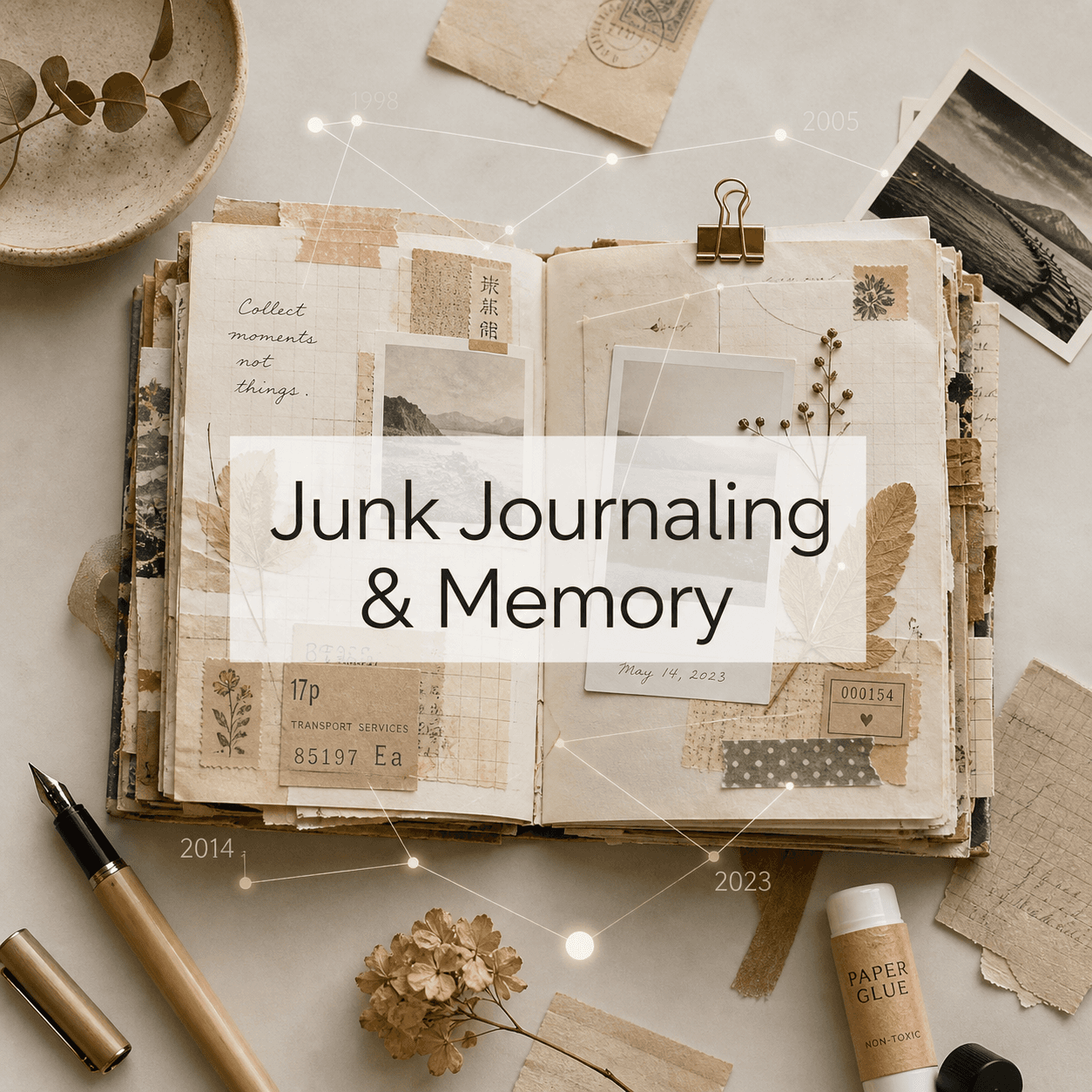
Traditionally, “junk journal” meant a handmade book filled with “junk” materials. Old paper, envelopes, book pages, packaging, bits of lace, whatever. It was craft-forward and very tactile, almost like creating the journal itself was part of the therapy.
Now it’s broader.
For some people, it’s an art journal. For others, it’s a memory keeper. For others, it’s basically a reading journal with pretty ephemera and a quote copied out in nice handwriting.
Most modern junk journaling, from what I’m seeing, is built around three things:
- Artifacts: receipts, tickets, tags, wrappers, flyers, bits of mail, pressed flowers, a napkin from a cafe.
- Texture: layered paper, washi tape, stamps, glued edges, little pockets and folds.
- Tiny narration: a date, a sentence, a list, a quote, a mood.
The vibe is “life, but make it touchable.”
And it’s also, quietly, “life, but make it easier to keep.”
Why it feels so good right now (even if you can’t explain it)
I think junk journaling is having a moment because a lot of people are tired.
Tired of documenting life only through a phone. Tired of infinite photos that never get revisited. Tired of memory feeling slippery.
Also, the world has been… a lot. The last few years have rearranged people. The nervous system stuff is real. A practice that says, sit down, use your hands, make something imperfect, and call it enough, is going to catch on.
But the big reason is this:
Junk journaling feels like it can hold your life for you, when your brain can’t.
That’s the promise, anyway.
Memory is weird, and your brain doesn’t store “days” the way you think it does
If you’re hoping junk journaling will turn you into someone with perfect recall, like you’ll flip to March 12 and suddenly remember everything you said and wore and thought.
No.
That’s not how memory works for most of us. Memory is reconstructive. It’s not a video archive, it’s more like a story you keep rewriting with whatever pieces you still have access to. The emotions, the associations, the sensory cues.
Which is exactly why junk journaling might help.
Because the scraps are cues.
A ticket stub is not just a ticket stub. It’s the smell of popcorn, the person you went with, the way your stomach dropped at that one scene. A hotel key sleeve is not just cardboard. It’s the heavy air in the lobby, the weird loneliness of travel, the sense of starting over for a week.
Your brain loves cues. It needs a handle to grab onto.
And a junk journal is basically a book of handles.
The science-y part, without making it unbearable
Here’s the useful concept: retrieval cues.
Memories are easier to access when something in the present resembles something from the past. Smell is famous for this, but visuals and textures work too. Even the act of writing by hand can deepen encoding for a lot of people, because it forces processing instead of skimming.
Junk journaling stacks cues:
- You see the artifact.
- You touch the texture.
- You remember why you kept it.
- You add context with a sentence or two.
- You revisit it later, which strengthens recall.
So yes, it can help you remember.
But not automatically. Not just because you glued something down.
The remembering part happens when you add meaning. Even a tiny bit.
The trap: when the journal becomes an aesthetic performance
This is where people quietly fall off.
They start a junk journal because it looks relaxing. Then suddenly they’re watching supply hauls and comparing spreads and feeling like their pages look childish. Or too empty. Or not cohesive. Or not “junk journaling enough,” whatever that means.
And now the practice is stressful. Which is kind of the opposite of the point.
Also, if your goal is memory, aesthetics can become a distraction. Not always. Some people genuinely remember more because they love making it beautiful. Beauty can be a cue too. But if you’re curating the page like a brand, you might skip the honest bits.
And the honest bits are what you’ll want later.
The page where you admit you felt left out. The day you finished a book and cried for reasons you didn’t expect. The week you were fine, technically, but also sort of floating.
If you only keep the cute parts, you’re not remembering your life. You’re remembering your highlight reel.
So. Make it messy on purpose sometimes. It helps.

What actually makes junk journaling work for memory (the three ingredient version)
If you want this to help you remember your life, aim for these three ingredients:
1. A real artifact
Something that genuinely came from the day. Not a printed vintage tag you bought (those are fun, but they’re not memory-rich by themselves).
Think: receipt, tea label, bookstore bookmark, library hold slip, a note you found in your pocket, packaging from something you loved.
2. A sensory detail
One detail that anchors the moment.
- “The cafe smelled like cinnamon and wet coats.”
- “My hands were shaking when I bought this.”
- “It was so humid the pages of my book curled.”
If you only write one thing, write that.
3. A meaning sentence
Not a summary. Meaning.
- “I felt brave, even though I didn’t look brave.”
- “This was the day I realized I don’t miss them anymore.”
- “I kept rereading that paragraph because it sounded like me.”
This is the part that turns a scrapbook into a memory practice.
Okay, but what if your life is… ordinary?
Good. Perfect, actually.
Junk journaling shines in the ordinary. That’s the whole point of saving a receipt from a Tuesday. You’re saying, this counts. I count.
And it does.
You don’t need a vacation. You don’t need a wedding. You don’t need a dramatic plotline. Most of life is small. Most of life is the slow shaping of you, and that shaping is worth recording.
The problem is that ordinary days blur together. That’s where junk journaling can act like a little divider tab between “weeks that disappeared.”
If you keep even one page a week, you start to see your life again. The rhythm of it. The seasons. The repeating challenges. The repeating comforts.
And that is memory, too.
How to use junk journaling to remember your reading life (without turning it into homework)
This is where GlimmerReads readers tend to perk up, because reading is already a memory system.
You remember who you were when you read a certain book. Even if you don’t remember the plot perfectly.
So try this: treat your junk journal as a “reading life” journal, not just a life journal.
Here are a few easy artifacts to glue in:
- bookstore receipts
- library checkout slips or hold stickers
- a bookmark from an indie shop
- a tea tag from your reading ritual
- the torn-off flap from a used book bag
- a photocopied line from a book (if it’s your own copy and you’re okay with that)
- a printed photo of the cover (small, like a label)
Then add one tiny anchor:
- “I read this during my insomnia week.”
- “This book made me text my sister.”
- “I didn’t even like the ending, but I loved who I was while reading it.”
- “This character annoyed me because she was too close to home.”
That’s it. That’s the magic.
If you want prompts like this consistently, this is basically what we do in The Weekly Chapter newsletter on GlimmerReads. A monthly theme, then small weekly reflections you can actually finish. Not journaling prompts that feel like a school assignment. You can browse the Reading Room too if you want more bookish journaling ideas that don’t require perfection.
A realistic junk journaling routine (so it doesn’t die in a drawer)
Most people quit because the routine is too big.
So make it small on purpose.
Here’s a routine that’s almost annoyingly doable:
The „10 minute closeout“ once a week
Pick one day. Sunday night, Friday morning, whatever.
- Grab 3 to 5 scraps from the week
- Glue or tape them on one spread
- Write the date range
- Write one sensory detail
- Write one meaning sentence
- Optionally, add one book quote or title
Done.
It will look sparse sometimes. Let it.
Sparse is still a record. Sparse is still a cue.
The „pocket method“ for people who forget
Keep an envelope, pouch, or zip pocket in your bag.
When you get a receipt or a wrapper you want to keep, throw it in. No decisions. Just collect.
Then on your weekly closeout, you sort the pile and pick a few pieces. The journal becomes the second step, not the first.
What if you don’t remember much even with the scraps?
This happens. Especially if you’re stressed, depressed, grieving, burned out, sleep deprived. Memory gets patchy. It’s not a personal failure, it’s biology.
Junk journaling still helps, but you might need to change your goal.
Instead of „remember everything,“ try one of these goals:
- „Prove I was here“
- „Track what soothed me“
- „Notice what kept repeating“
- „Leave a breadcrumb trail for future me“
Sometimes the journal is not a memory vault. It’s a lighthouse.
A page that says: I drank this tea. I read these pages. I got through the day. That counts as a record.
And later, when life is calmer, you’ll look back and feel something. You’ll understand yourself better. Not because the page is detailed, but because it existed.

The gentle line between documenting and living
One more thing, because it matters.
Any memory practice can tip into over-documenting. Into “if I don’t record it, it didn’t happen.” Into being more focused on capturing than being present.
If you feel that pull, junk journaling can actually be a good antidote, if you use it right. Because it’s slower. It asks you to wait until later. It asks you to choose a few pieces, not everything.
A helpful rule:
Collect during the week. Reflect later.
That way you’re not constantly interrupting your own life to archive it.
A simple starter kit (that doesn’t require buying anything)
You do not need a haul.
Start with what you already have:
- any notebook
- glue stick or tape
- pen
- scissors (optional)
Artifacts you can find today, probably:
- a grocery receipt
- junk mail paper you cut into a label
- a tea bag tag
- a sticky note
- packaging from something you used
- a flyer from a community board
- a random scrap of wrapping paper
If you want it to look nicer, sure, get washi tape. But don’t make supplies the gatekeeper. The journal is the point.
So, can it actually help you remember your life?
Yes.
Not in a flawless, cinematic way.
But in a grounded way.
Junk journaling helps you remember your life because it creates a physical trail of cues and meaning. It slows you down enough to label a moment. It gives future you something to hold. And it turns ordinary days into something you can actually find again.
If you want to try it this week, do one spread. Just one. Pick three scraps, add one sensory detail, add one meaning sentence.
And if you want to bring your reading life into it too, that’s basically what we’re building around here at GlimmerReads anyway. The idea that stories change us, and we deserve a way to notice what changed. Even if it’s just a taped in receipt and one honest line in the margin.
You don’t need to remember everything.
You just need a few true breadcrumbs.
Enough to lead you back to yourself.


No responses yet