
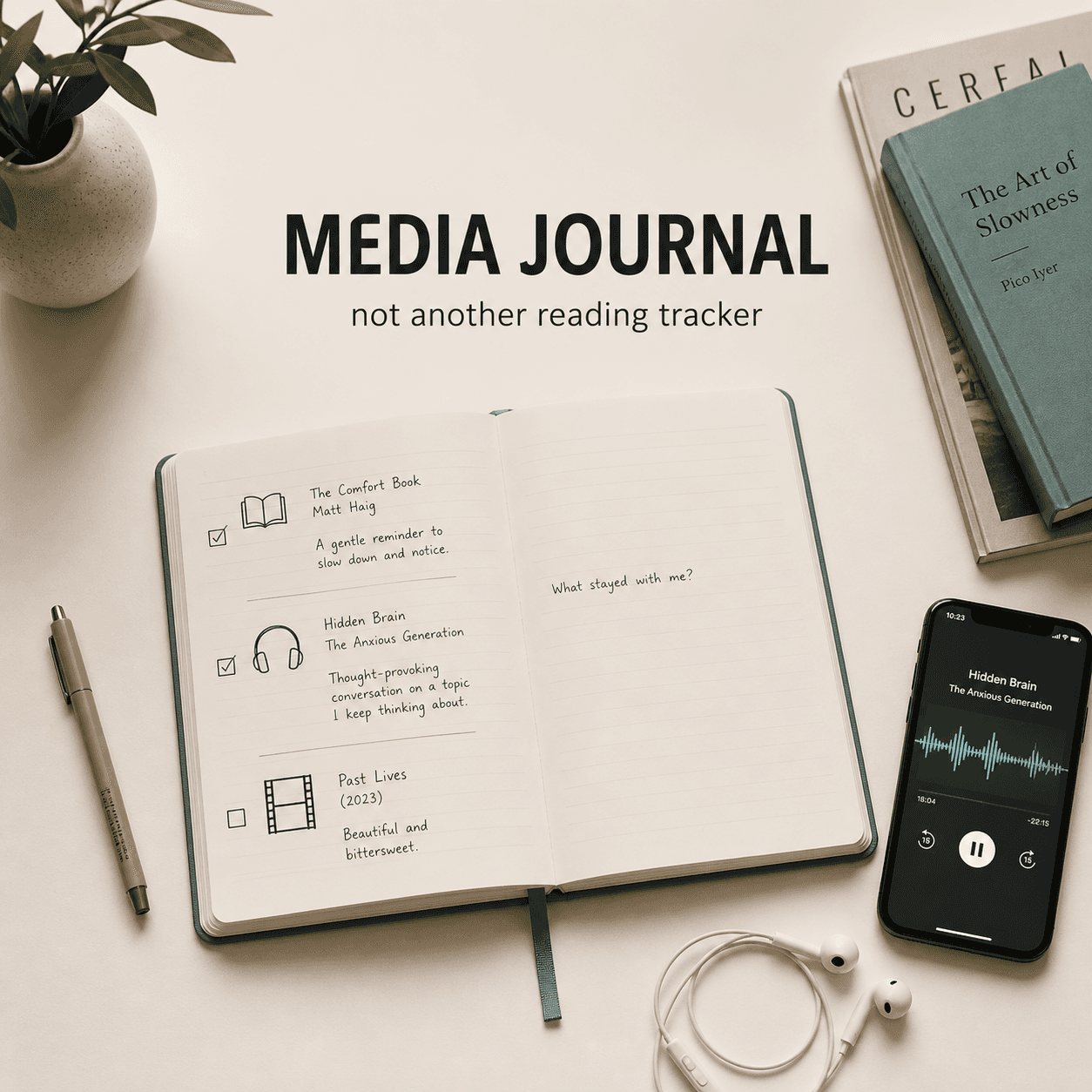
I used to think I was being a Responsible Reader when I logged everything.
Pages. Dates. Ratings. Streaks. Genres. A little pie chart that told me I was, apparently, 18 percent “literary fiction” this quarter.
And it worked, sort of. It made reading feel measurable. Clean. Like I was getting somewhere.
But then I would finish a book that cracked something open in me, you know the kind. And I would stare at the tracker screen and realize there was nowhere to put the actual thing that happened.
Not the plot. Not the star rating.
The moment I underlined a sentence and then sat on the edge of my bed for ten minutes because it hit too close. The weird urge to call my sister afterward. The way a side character’s loneliness felt like a mirror. The fact that I slept differently for two nights.
A tracker can tell you what you consumed.
It usually cannot tell you what stayed.
That’s where a media journal comes in.

The quiet problem with reading trackers
Let me be clear. I’m not here to dunk on reading trackers. They can be genuinely helpful.
They’re great for:
- remembering titles you finished
- building a habit when your brain likes checklists
- tracking formats (ebook vs print vs audio)
- noticing patterns over time
But a lot of us start to bend toward the tracker without noticing. The tool slowly becomes the point.
You start picking shorter books because the streak feels good. You rush the ending so you can log it. You rate a memoir like it’s competing in the same sport as a fast paced thriller. You feel vaguely guilty if a month looks empty, even if that month was… life. Grief. New job. Burnout. A move.
And the weirdest part is you can read a lot and still feel like nothing is landing.
Because logging is not reflecting.
A tracker answers: What did I read? When did I read it?
A media journal asks: What did it do to me? What did it shift? What do I want to remember?
Those are different questions. Different outcomes. Different kind of attention.
What a “media journal” actually is (and what it isn’t)
A media journal is not just a reading journal with a fancier name.
It’s a single place where you keep track of what you are taking in, across formats. Books, yes. But also:
- audiobooks you listened to while walking
- essays you bookmarked and reread
- poems you saved to your notes app
- shows you watched when you were tired
- movies you can’t stop thinking about
- podcasts that changed your mind
- even music, sometimes, if a lyric becomes a little mantra
It’s less like a ledger.
More like a scrapbook for your inner life.
And importantly, it’s not meant to be “complete.” You do not need to catalog every article you skim. That becomes another tracker, just bigger.
A media journal is selective. Personal. A record of impact.
The stuff you want to carry.
Why this matters more than ever (because we are all a little fried)
Most of us are consuming media all day. Not in a dramatic way. Just… constantly.
A chapter at night. A podcast while you make dinner. A few reels. A show to decompress. An article someone texts you. Another YouTube video because you needed background noise. Then three more.
None of that is automatically bad. But it can become this blur, where your attention gets chopped into tiny pieces and you forget what you even liked.
A media journal does one simple thing that is kind of radical now.
It slows you down at the exact moment you would normally scroll away.
It says: “Wait. This mattered. Let’s mark it.”
Trackers measure output. Journals measure meaning.
This is the core difference, and once you see it you cannot unsee it.
A tracker loves quantity.
A media journal loves resonance.
You can still read 50 books a year. Or 12. Or 3. The journal does not care.
It cares about:
- what you highlighted and why
- what made you feel braver, calmer, more honest
- what made you spiral a little, in a useful way
- what you want to try next in your own life because of a story
And sometimes it cares about the opposite too.
What didn’t work. What you are done with. What themes you keep bumping into because your brain is clearly asking for something.
The “media journal” approach: one notebook, many doors
Here’s a framework that doesn’t get fussy.
You can do this in a physical notebook, a notes app, Notion, Google Docs. Whatever you’ll actually use. The point is frictionless.
1) The capture page (quick and messy)
This is the low pressure part. One line entries. No formatting required.
Example:
- The Bean Trees felt like being gently parented for 300 pages
- listened to a podcast about nervous system regulation, stole one phrase: “small safety signals”
- watched Pride & Prejudice again, still obsessed with the hand flex scene, it’s embarrassing but true
- reread Mary Oliver, “you do not have to be good” still knocks the wind out of me
That’s it. That’s the capture.
2) The reflection page (only for what sticks)
Once a week, or whenever you feel like it, you pick one thing from the capture list and you go a little deeper.
Not an essay. Just a page.
Use prompts like:
- What did this make me notice about myself?
- Where did I feel tension in my body while reading or watching?
- What did I want to tell someone about it?
- What did it validate?
- What did it challenge?
- What do I want to remember one month from now?
3) The “threads” page (patterns over time)
This is where the journal becomes honestly kind of life changing.
Because you start seeing repeating themes you did not realize you were circling.
Threads might look like:
- found family
- women starting over at 30+
- grief that is quiet and domestic, not dramatic
- ambition and the cost of it
- cozy environments as emotional safety
- characters who learn to rest without earning it first
When a book or show fits a thread, you jot it under that heading.
Over time, you get a map of what your psyche is working on.
Which is… a lot more useful than a bar chart.
A simple media journal template you can copy
If you want something structured but not intense, use this.
Media log entry (5 minutes)
Title:
Format: book / audiobook / essay / show / movie / podcast
Date(s):
Where I was in life: (one line. “Burned out.” “New job.” “Post breakup.” “Feeling steady.”)
Mood before:
Mood after:
One sentence summary: (not the plot. what it’s about to you)
A line I want to keep: quote or paraphrase
What it stirred up:
What I’m taking with me:
Who I’d recommend this to (and why):
That’s the whole thing.
If you do only three fields, do: Mood after, A line I want to keep, What I’m taking with me.
“But I already have a reading journal.” Here’s what’s different.
A lot of reading journals are designed like book reports. Which is fine. But it can turn reflective reading into homework.
The media journal is allowed to be human. Incomplete. Contradictory.
You can write:
- “I don’t know if I liked it but I can’t stop thinking about it.”
- “This book made me want to be kinder to myself. Annoying.”
- “I loved the first half and then it lost me. Still grateful.”
- “This movie was objectively messy and I still cried.”
It makes space for the real experience of being a person who is impacted by stories.
Not a critic. Not a content machine.
A person.

The sneaky benefit: you’ll remember more, without trying
This surprised me.
When you journal even a little, you stop losing books to the void.
You remember:
- the scene that mattered
- the specific phrase that became a handle you can grab on a hard day
- why you picked it up in the first place
- what it changed in you, even if the change was small
And then recommendations get easier too. Because you can tell a friend, “Read this if you’re craving a gentle reset,” instead of “It’s a 4 star contemporary fiction.”
How to start without turning it into another project
If your brain is like mine, it will try to overbuild this.
New notebook. Fancy pens. Color codes. Tabs. A whole system.
You can do that if it brings you joy. But if it becomes friction, you will stop.
Here’s the simplest start:
- Open a notebook or notes app.
- Write today’s date.
- List the last three things you consumed that actually stuck with you.
- Under each, write one sentence: Why did it stick?
That’s it. You have a media journal now.
Tomorrow, if you want, do it again.
What to include (and what to leave out)
Include:
- things you want to revisit
- things that made you feel something specific
- things you keep referencing mentally
- things you want to recommend with intention
- things you disagreed with but found useful
Leave out:
- everything you skim
- guilt watches
- “I should log this” media
- stuff you finished just to finish
Your media journal is not a confession booth.
It’s a little shelf for what matters.
Making it cozy (because GlimmerReads vibes, obviously)
If you are here, you probably like a cozy process. Not in an aesthetic way only. In a nervous system way.
Here are a few gentle ideas:
- Keep a “quote jar” page. Just one line per entry. No context needed.
- Add a “comfort rewatch” list for hard weeks.
- Track “soft books” separately from “sharp books.” Both are important.
- Create a monthly theme for your media, not a goal. Example: “Stories about starting over,” or “Quiet courage,” or “Friendship that feels like home.”
This is basically what we do over at GlimmerReads all the time. Reading as a practice, not a competition. If you want more prompts like this, the Reading Room section and The Weekly Chapter newsletter are built for exactly that kind of reflective rhythm. You can peek around here: https://glimmerreads.com
A few journaling prompts (when you don’t know what to write)
Sometimes you open the page and your mind goes blank. So, here.
Use any of these:
- What part of me felt seen by this?
- What did I resist in it?
- What would I ask the author or creator if I had one question?
- What did it make me want to do next?
- What is one belief it strengthened or softened?
- If this story was a room, what would it look like?
- What did it make me nostalgic for?
- Did it give me language for something I couldn’t name before?
And if you want the super short version:
- I noticed…
- I felt…
- I want to remember…
Three lines is plenty.
The point is not to read more. It’s to keep more.
Reading trackers whisper: “Do more.”
Media journals whisper: “Hold on to what you already did.”
And that shift is quiet, but it changes everything.
Because you start treating your attention like it is valuable. Like it is a resource you get to spend on purpose.
You stop chasing the feeling of being “caught up.” (Nobody is caught up. There is infinite content.)
You start building a personal library of moments. The ones that actually made you different.
If you want a gentle next step
Tonight, after you read a few pages, or finish a chapter, or even watch something you end up loving, do this:
Write down:
- the line you can’t stop thinking about
- the emotion it left you with
- one small thing you want to carry into tomorrow
That’s a media journal entry. It counts. It’s enough.
And later, when life gets loud, you will have proof. Not of productivity.
Proof that stories met you where you were. And that you were paying attention.


No responses yet