
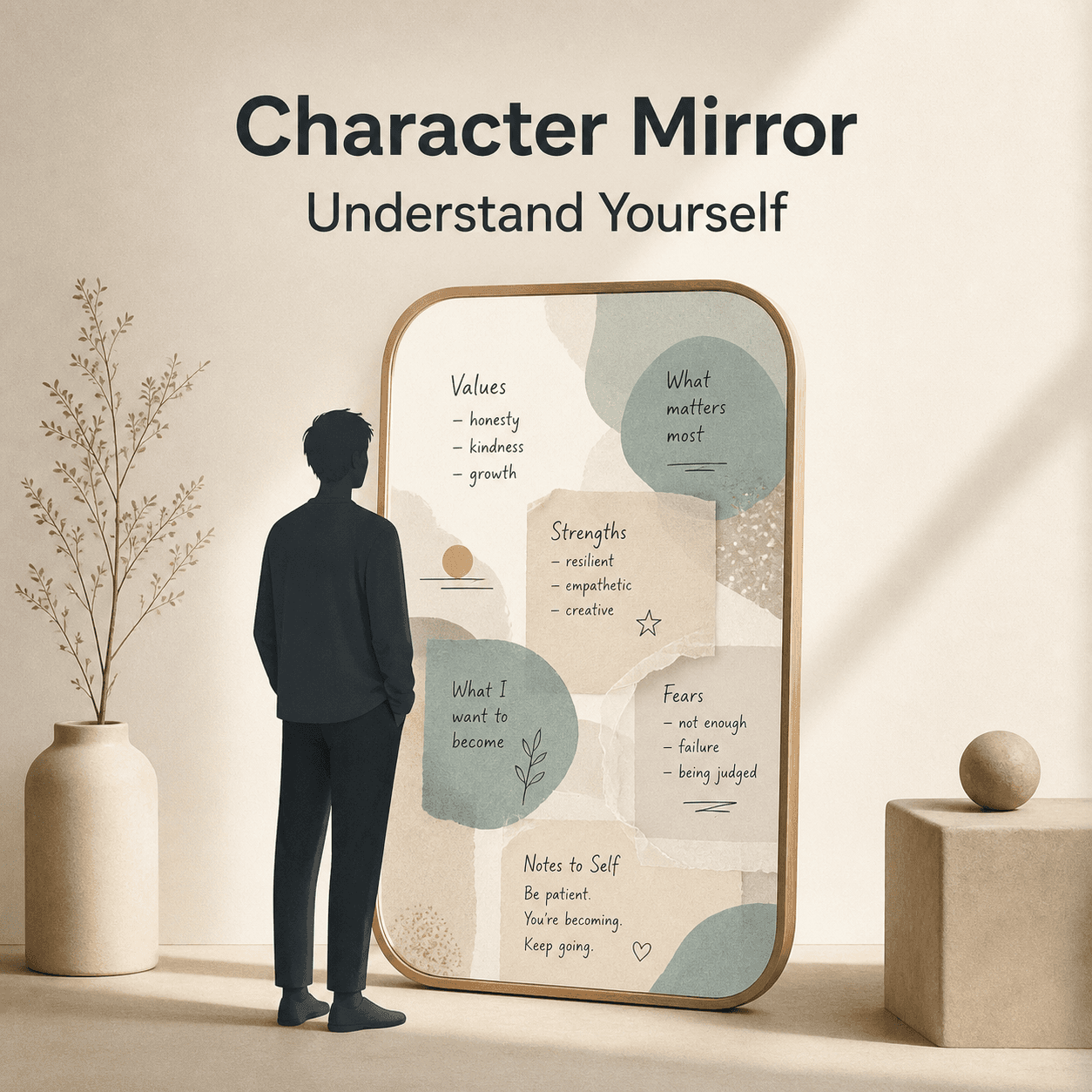
Sometimes I finish a book and I’m not even thinking about the plot anymore. I’m thinking about that one line someone said. Or the choice a character made that annoyed me way more than it should have. Or the quiet part where nothing “happened” but I felt… exposed. Like the story reached out and tapped something in me I hadn’t named.
That’s the whole thing, really.
Books are not just entertainment. They are mirrors. But not the obvious kind. More like the funhouse mirror you walk past and then, two hours later, you’re still thinking, wait, why did that hit so hard?
So here’s a journaling prompt I keep coming back to. I call it the Character Mirror prompt. It’s simple. It’s also kind of sneaky. And when you do it honestly, you learn things.
This is perfect for the kind of reading we talk about in the Reading Room here on GlimmerReads. Not just “what did I rate it”, but what did it change in me, even a little.
What is a Character Mirror, exactly?
A Character Mirror is when you use a character as a reflection surface.
Not “I relate to them” in a general way. More specific than that.
It’s asking:
- Why do I admire them?
- Why do I judge them?
- Why do they irritate me?
- What are they doing that I secretly do?
- What are they refusing to do that I’m also refusing to do?
And then the key part.
You write it down. Without cleaning it up.
Because the point is not to sound wise. The point is to catch yourself in the act of being yourself.
The Character Mirror prompt (copy and paste this)
Set a timer for 12 minutes. Pick one character from your current read or your most recent book.
Then write, in order. No skipping ahead.
1) The Character I Can’t Stop Thinking About
Character:
Book:
The scene or moment I keep replaying:
2) My Strongest Reaction to Them (be blunt)
I feel: (circle one or write your own)
Protective / jealous / disgusted / inspired / annoyed / tender / bored / angry / seen / suspicious / relieved
What I want to say to them is:
3) The Trait I’m Actually Reacting To
If I strip the plot away, the trait underneath is:
And my reaction is probably because:
4) The Mirror (this is the point)
Where do I have this trait in me. Even a small version.
Where do I avoid this trait in me. Even a small version.
5) The Hidden Need
What does this character want more than anything.
What do I want more than anything, in the same category.
(Examples: safety, recognition, rest, control, belonging, freedom, forgiveness, stability)
6) The Cost
What is the cost of how they are living.
What is the cost of how I am living, in the similar spot.
7) One Gentle Experiment
If I could borrow one brave thing from them, for 7 days, it would be:
If I could release one heavy thing I do, for 7 days, it would be:
What would that look like in one tiny, boring, real-life action.
A quick example (so it’s not abstract)
Let’s say you’re reading a book with a character who is relentlessly competent. The fixer. The one who makes everything work.
You might write:
- Strongest reaction: inspired, but also annoyed.
- Trait: control as a survival strategy.
- Mirror: I’m proud of being reliable, but I also don’t let people help me. I act like it’s “fine”.
- Hidden need: safety. To not be disappointed.
- Cost: loneliness. Exhaustion. Quiet resentment.
- Gentle experiment: ask for one specific kind of help this week without apologizing.
That’s it. That’s the whole mechanism.
You’re not diagnosing yourself. You’re noticing yourself.
Why this works (and why it’s different than normal journaling)
Normal journaling often stays in the realm of what happened. What you did today. What you should do next.
Character Mirror journaling does something else. It uses story as a shortcut to emotion.
Because when you talk about yourself directly, your brain gets defensive. It starts managing your image. It starts negotiating. It starts lying, a little.
But when you talk about a character, your guard drops.
You’ll say things like:
- “I hate how needy she is.”
- “He’s so selfish.”
- “She needs to just leave already.”
And then, if you’re willing, you ask: Why did I say it like that?
That’s where the gold is.
How to choose the right character (a tiny checklist)
Not every character is a good mirror. Pick one that triggers a reaction.
Here are a few signs you’ve found a good one:
- You highlight their dialogue.
- You keep defending them to other people, or attacking them.
- You feel weirdly protective.
- You feel secondhand embarrassment.
- You feel called out.
- You keep thinking, “I would never do that”, a little too loudly.
If the character makes you feel nothing, it’s not a mirror. It’s wallpaper.
Three “Character Mirror” variations (depending on your mood)
Sometimes the full prompt feels like too much. Or you’re tired. Or you only have five minutes.
So here are three versions I use.
Variation A: The Irritation Mirror (5 minutes)
The character who annoys me most is:
They annoy me because they:
The trait underneath is:
I do this trait when:
I judge it in others because:
A kinder thought I could try is:
This one can be spicy. Also useful.
Variation B: The Longing Mirror (8 minutes)
The character I envy is:
I envy their: (freedom, love, confidence, clarity, softness, power)
I think they can have it because:
I tell myself I can’t because:
If I wanted 10 percent more of this, I could:
This one usually reveals the story you’re telling yourself.
Variation C: The Wound Mirror (10 minutes, go slow)
The moment that hurt to read was:
It hurt because it reminded me of:
The belief it poked is:
The younger part of me wants to hear:
The adult part of me can offer:
You don’t need to fix anything here. Just witness it.
Add images to make this a “ritual” (not homework)
If you’re posting this into your own reading journal, it helps to make the page feel like a place you want to return to. Not a worksheet.
Here are a few cozy image ideas you can drop into your entry.
1) A quiet journaling setup

2) A stack of books, mid-read energy

3) A calm reading corner

If you’re building a personal practice around this kind of reflection, this is basically what we do all the time over on GlimmerReads, especially in the bookish journaling prompts. Make it feel like a small ceremony. It matters more than we admit.
What to do with what you learn (without spiraling)
This prompt can surface stuff fast. So here’s the part I wish someone had told me earlier.
You don’t have to do anything dramatic with the insight.
You’re allowed to learn something true about yourself and then just… live with that knowledge for a week.
Let it settle. Let it be a quiet companion.
But if you do want to do something with it, keep it small. Make it almost laughably small.
Instead of:
- “I’m going to stop people pleasing forever.”
Try:
- “This week, I’m going to pause before I say yes. Just pause.”
Instead of:
- “I’m going to become confident.”
Try:
- “I’m going to wear the thing I actually like, not the thing that hides me.”
Instead of:
- “I’m going to heal my abandonment issues.”
Try:
- “I’m going to text a friend first once this week, without rehearsing it.”
Tiny is real. Tiny sticks.
A few gentle cautions (because this can get intense)
A couple notes, especially if you tend to overanalyze.
- Don’t turn it into a trial.
The goal is not to prove you’re bad. Or good. It’s to notice your patterns without flinching. - Don’t force trauma mining.
If a question opens a door you’re not ready to walk through today, that’s fine. Close it. Pick the irritation mirror instead. - Characters are not diagnoses.
You can relate to a villain and still be a decent person. Sometimes the villain is just holding your unexpressed anger. Or your hunger. Or your refusal to stay quiet. - Do not confuse insight with obligation.
You’re not required to change overnight because you had a revelation on a Wednesday.
A simple way to make this a weekly habit
If you want to make this part of your reading life, here’s an easy structure that doesn’t demand perfection.
- Once a week (or once per book), pick one character.
- Do the full prompt or one variation.
- End with one gentle experiment.
- In your next reading session, notice if you see the pattern again in a different character.
Over time, you’ll start seeing repeating themes.
Your personal classics, basically.
Control. Belonging. Voice. Rest. Approval. Freedom. Softness. Anger.
And then reading becomes less like consumption, more like conversation.
If you want a place to keep doing this
If this prompt clicks for you, you’ll probably like what we’re building at GlimmerReads. The whole vibe is cozy, reflective, no pressure to be performative about reading.
You can:
- Browse the Reading Room posts and essays on reading as a personal practice.
- Steal more bookish journaling prompts like this one.
- Join The Weekly Chapter newsletter, where each month has a theme and each week gives you a small, doable reflection to go with your reading life.
Link: https://glimmerreads.com
(No big promise here. Just a quiet place to return to.)
One last nudge before you close the tab
Pick a character. Any character.
The one you love. Or the one you hate. Or the one you can’t understand.
Set 12 minutes. Write messy.
And when you get to the Mirror section, don’t make it poetic. Make it honest.
That’s where the story starts reading you back.


No responses yet