
There’s a specific kind of stress that only book people understand.
It’s not the “I have nothing to read” stress. It’s the opposite. The mild panic of staring at a TBR pile that has quietly turned into a small ecosystem. Books on the nightstand. Books in the bag. Ebooks in three different apps. Library holds you forgot you placed. A screenshot folder titled “Books!!” that is now… 900 screenshots.
And then somehow, you end up rereading the same comfort book because choosing feels like homework.
So. Let’s reset it.
Not a full weekend project. Not a new spreadsheet you’ll abandon in nine days. Just a quick, calm reset you can do in 20 minutes, with a timer. You’ll finish with a smaller, clearer TBR and a reading life that feels like yours again.
(Also, if you like this kind of gentle, practical reading ritual, that’s basically what we do here on GlimmerReads. Cozy structure. A little meaning. No guilt.)
What this reset is and what it is not
This reset is:
- a quick declutter, not a personality overhaul
- permission to let go of “should” books
- a way to get back to reading with momentum
This reset is not:
- a command to read fewer books
- a demand that you become a minimalist
- a moral judgment of your taste, your pace, or your chaotic Kindle
You’re just clearing the doorway. That’s it. You can still have a big TBR. You just don’t need a TBR that constantly sighs at you.
Before you start: set a timer and grab one container
Set a timer for 20 minutes. Not 45. Not “until it feels done.” Twenty.
Grab one thing to collect your TBR candidates:
- a tote bag
- a laundry basket
- a cardboard box
- a single note in your phone titled “TBR SHORTLIST”
You’re going to gather, sort, and decide fast. This is a reset, not a trial.
The 20 minute plan (exactly what to do)
Minute 0 to 3: gather the obvious stuff
Walk around your space and grab the books that are clearly part of the “reading soon” ecosystem.
- the nightstand stack
- the coffee table book you keep moving around
- the floor pile (no shame, floors are temporary shelves)
- the library books you meant to start
- the book you bought because someone on the internet said it “destroyed them”
If you have ebooks, don’t spiral. Just open your main reading app and take a quick glance at your “Want to Read” list. You’re not fixing it yet. You’re just noticing what you’re dealing with.
Image suggestion:
Minute 3 to 7: make a fast “maybe” pile
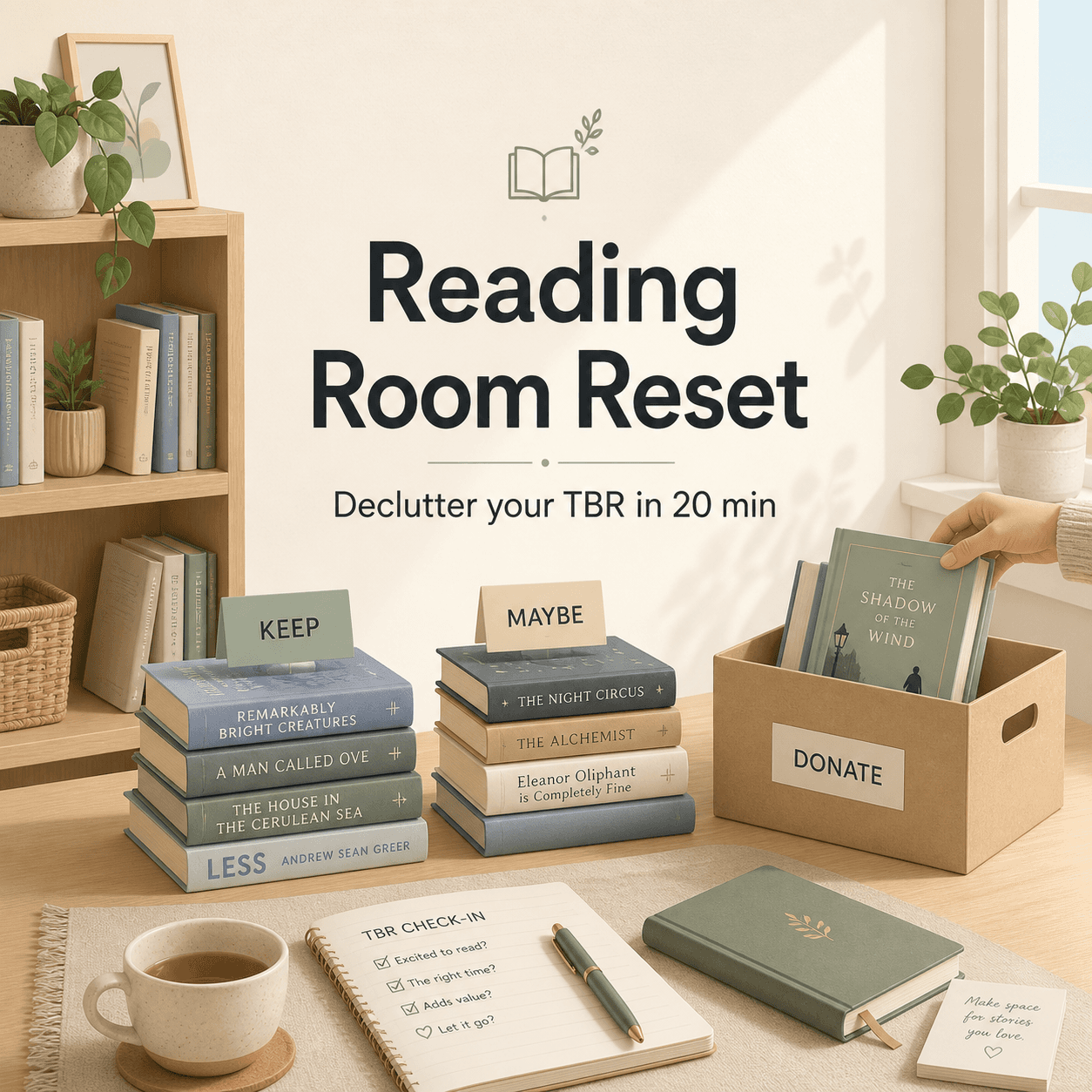
Now, with everything in front of you, do a quick sort into three groups:
- Yes, soon
- Maybe
- No, not now
No overthinking. If your body reacts with a little spark, that’s a “Yes, soon.” If it feels like swallowing a spoonful of obligation, that’s “No, not now.” If it’s just… neutral? “Maybe.”
Here’s the most important line in this whole post:
You are allowed to not be in the mood for a book you would probably love.
Not now is not never. It’s just not now.
Minute 7 to 12: apply the “5 question filter” to the Maybe pile
Pick up each “Maybe” book and ask one question at a time. You’re looking for a reason to keep it close, or a reason to release it.
1) Would I start this in the next two weeks?
If the honest answer is no, it probably doesn’t belong in the front row of your life right now.
2) Do I actually want this, or do I want the version of me who reads this?
This one gets people. Because sometimes the book is fine. It’s just… aspirational. And aspirational books are not bad. They’re just loud.
3) Do I know why I added it?
If you can’t remember, that’s a clue. Not a crime. A clue.
4) Is it still matching the season I’m in?
Season can mean weather, emotional capacity, attention span, hormones, grief, burnout, new job brain, all of it.
5) If I found this at the library today, would I check it out?
This is a magic question because it removes sunk cost. You’re not deciding if you “should” read it. You’re deciding if you’d choose it now.
After those questions, move each book into either:
- Yes, soon
- No, not now
Try to keep your “Yes, soon” stack to something that feels friendly. Not intimidating.
A good number for a 20 minute reset is 7 to 12 books. Enough options to match your moods, not enough to make you freeze.
Image suggestion:

Minute 12 to 15: deal with the “No, not now” stack in one move
This is where most people stall. Because “No, not now” feels like failure.
It’s not. It’s curation.
Pick one destination for those books, based on your life:
- Return to shelf (still yours, just not staring at you)
- Donate (someone else gets the moment you didn’t have)
- Sell (if you actually do that kind of thing, no pressure)
- Library return (immediately, if you can)
- Wishlist it again (if it’s an ebook you can re-add later)
If you’re not ready to donate, do the gentlest version:
Put them in a box labeled Later. Date it. Put it out of sight. That’s still a win.
Minute 15 to 18: make a tiny “Next 3” shortlist
Now look at your Yes, soon stack and pick your Next 3.
One rule that helps: choose across moods.
- One comfort pick (easy entry, low resistance)
- One curious pick (something you genuinely want to know)
- One stretch pick (a little challenging, but exciting)
If you don’t like the word “stretch,” call it “slightly spicy.” Same thing.
Write your Next 3 somewhere you’ll see it:
- sticky note in the book
- note app widget
- the first page of your reading journal
This shortlist is the antidote to decision fatigue. It’s small. It’s kind. It gets you reading tonight, not someday.
Image suggestion:

Minute 18 to 20: do the “reading room close”
This part is tiny, but it changes the feeling.
Do one closing action:
- put the Next 3 in a neat stack where you actually read
- clear the nightstand surface except lamp, book, water
- open the book you’re starting and read one page
- place a bookmark and set out a pen for margins or notes
It’s like resetting a kitchen after cooking. You’re telling your brain, we live here. This is ready.
If your TBR is digital and chaotic (Kindle, Libby, Goodreads, StoryGraph, screenshots)
Ok. Digital TBRs breed in the dark. I get it.
Here’s a quick version that still fits the 20 minute spirit, even if you have 600 titles saved.
The 3 list method (fast, no spreadsheets)
Create three lists in whatever system you actually use:
- Next 10
- Later
- Release (or “Not for me”)
Now scroll your current “Want to Read” list and do only one job:
If you see something you’d genuinely start soon, move it to Next 10.
That’s it. Don’t curate the whole backlog. Just build a good front shelf.
If you have time left, do one more pass and move obvious dead weight to Release. Books you added in 2018 because someone said “essential.” Books you don’t even like the premise of anymore. Stuff you only saved because it was on sale.
Screenshot folder detox (the gentle way)
Your screenshots are probably full of:
- covers
- quotes
- “best books for when you feel lost” lists
- random BookTok recs at 1 a.m.
Do this:
- pick five screenshots you still care about
- add those titles to your Next 10 or Later list
- delete the rest without rereading them
Yes, it feels reckless. No, you won’t miss them. If it mattered, it would come back around.
A few “permission slips” that make this easier
You can abandon books
You can DNF at 30 pages or 130 pages. The time was not wasted if it taught you something about what you want.
You can reread instead of pushing forward
Rereading is not cheating. Sometimes you need a story to hold you steady. That counts as reading. That counts as care.
You don’t have to finish your TBR
A TBR is not a debt. It’s a menu. And menus change.
You’re allowed to have seasonal reading tastes
Some months are literary fiction months. Some months are cozy mystery months. Some months are “I can only read dialogue because my brain is fried” months.
Normal.
Want to keep the momentum? Try this 5 minute journaling prompt
This is the part where GlimmerReads gets very… GlimmerReads.
If you keep a reading journal, take five minutes and answer:
- What kind of reader am I this month?
- What do I want reading to do for me right now? Comfort, challenge, escape, perspective, rest?
- What’s one theme I’m craving? (found family, reinvention, quiet resilience, adventure, etc.)
- What book on my Next 3 fits that best?
If you want more prompts like this, you can browse the Reading Room on GlimmerReads, or hop into The Weekly Chapter newsletter when you want a steady nudge and a monthly theme to anchor your reading.
Troubleshooting: common TBR clutter problems (and quick fixes)
Problem: “I keep buying books but never reading them”
Fix: Put new purchases in a separate stack called New In and pull from that first for two weeks. No guilt, just a rule.
Problem: “My TBR is mostly heavy books and I avoid it”
Fix: Add two “snack reads” immediately. Short stories. Essays. Graphic novels. Romance. Anything that gets you turning pages again.
Problem: “I borrow too many library books and panic”
Fix: Keep only one active loan plus one backup. Pause holds until you finish one. You can always unpause later.
Problem: “I forget what I own”
Fix: Take one photo of your physical TBR stack after the reset. That’s your visual inventory. No cataloging required.
The mini checklist (so you can do this again next month)
If you want a quick recap, here it is:
- Set a 20 min timer
- Gather obvious TBR books
- Sort into Yes, Maybe, No
- Filter Maybe with 5 questions
- Move No stack out of sight (shelf, box, donate)
- Pick your Next 3
- Reset your reading spot
- Read one page
That’s the reset.
Not dramatic. Just clarifying.
Wrap up (and a small nudge)
A decluttered TBR doesn’t just look nicer. It feels quieter. Like you can hear your own taste again.
And honestly that’s the whole point.
If you want, tell me your Next 3 after this reset. Or swing by GlimmerReads and explore the Reading Room for bookish journaling prompts, reflective recs, and the kind of reading life that fits in real life.
Because reading is supposed to be a place you go to breathe.
Not another pile you have to manage.


No responses yet