
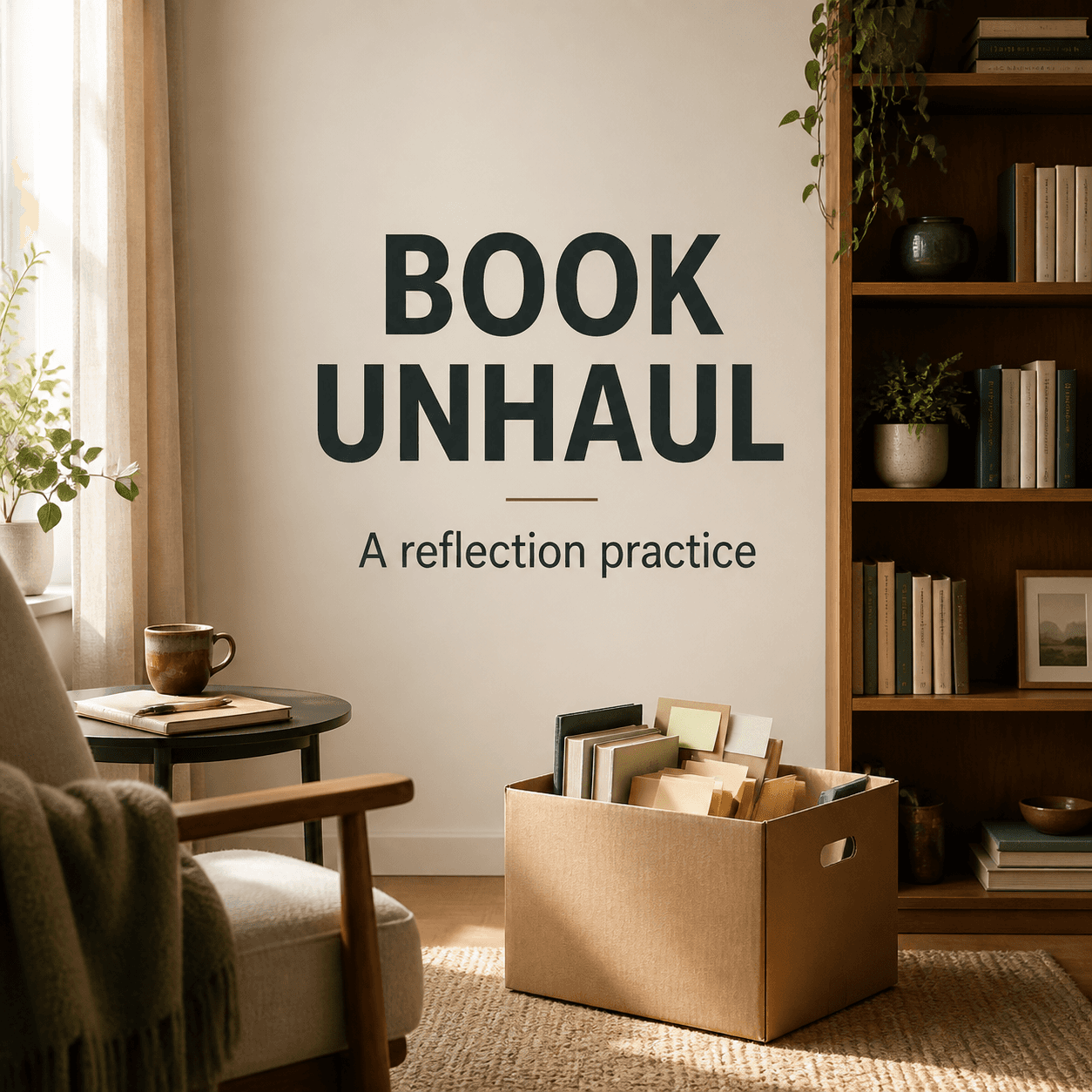
There’s this oddly intimate moment that happens when you stand in front of your bookshelf and realize you don’t really see the books anymore.
You see the you who bought them.
The you who swore you’d finally read that 800 page classic when life calmed down. The you who went through a romcom only phase. The you who needed grief memoirs like oxygen. The you who bought five productivity books during one stressed out week and then never touched them again. (Yeah. Same.)
A book unhaul sounds like a practical thing. Declutter. Make space. Donate. Done.
But if you do it slowly, with even a tiny bit of attention, it turns into something else. It turns into a reflection practice. A low key inventory of who you’ve been, what you’ve needed, and what you’re ready to carry forward.
Not in a dramatic way. Just honest. Like, quietly honest.
This is that kind of post.
And since you’re here at GlimmerReads, a cozy little corner of the internet that treats reading like a life practice, not just a hobby, I’m going to lean into that. We’re not just “getting rid of books” today. We’re listening to what your shelves have been trying to say.
What is a book unhaul, really?
A book unhaul is basically the reverse of a haul. Instead of showing what you bought, you’re choosing what leaves your shelves.
Typically, that means:
- donating to a library or thrift store
- giving books to friends
- selling them (if you have the patience)
- recycling what’s genuinely unusable
- moving some to storage, or a “later” pile
But a reflection based unhaul adds one more step.
You pause. You ask why the book is there. What it represented. Whether you still want that version of you in the room.
And you let the answer be a little messy.
Because it usually is.
Why your shelves feel weirdly personal
Books are objects, sure. Paper and glue. Ink.
But books also act like receipts for our inner life.
Your shelves might hold:
- your aspirational self (the books you think you should read)
- your comfort self (the books you reread when you’re tired)
- your survival self (the books that got you through something)
- your social self (the books you bought because everyone else did)
- your curious self (the weird niche ones you’re kind of proud of)
And that’s why unhauling can feel… emotional. Even when you’re not a sentimental person.
It’s not about the item. It’s about the identity thread attached to it.
Sometimes you’re not donating a book.
You’re releasing a season.
A gentle myth to drop right now: “keeping means you loved it”
A lot of us treat shelves like proof.
Proof we read. Proof we’re smart. Proof we’re “a reader”. Proof we’ve got taste.
So we keep books as evidence.
But a shelf is not a résumé. It’s a living space. It should support your current life, not guilt you into performing a past one.
You can love a book and still let it go.
You can keep a book you didn’t love, if it taught you something that still matters.
You can donate a book you never read without being a bad reader.
Actually, that last one might be the most freeing.
The Book Unhaul as a reflection practice (not a purge)
Let’s make this practical, but in the GlimmerReads way. Cozy, intentional, a little journal adjacent.
This is a reflection based process you can do in an afternoon, or spread across a week. Put on music. Make tea. Light a candle if that’s your thing.
And yes, take breaks. This stuff can sneak up on you.
Step 1: Start with one shelf. Not the whole bookcase.
If you start with everything, you’ll either freeze or speed run it and regret it.
Choose:
- one shelf
- one stack
- one category (like unread books, or memoirs)
Small enough that you can actually finish.
Take every book off that shelf and wipe it down. Dust is weirdly grounding. Like a reset button.
Image suggestion: a cozy shelf mid unhaul, books stacked on the floor, mug of tea nearby.

Step 2: Make four piles (keep it simple)
Label them:
- Keep (I want this on my shelf, now)
- Release (donate, sell, gift)
- Maybe (I need time, don’t rush me)
- Memory (I don’t want the book, I want what it meant)
That last pile is the secret.
Because sometimes you’re holding onto a book because it was there during a hard time, or it reminds you of a person, or you underlined half of it during a life shift.
You don’t need to keep the object to keep the meaning. But you do need to honor the meaning so your nervous system stops treating the donation box like a loss.
Step 3: Use better questions than “Will I read this?”
That question is too blunt. Also, we lie to ourselves.
Try these instead.
Pick one or two. You don’t need to interrogate every book like it’s on trial.
Questions for each book:
- Who was I when I bought this?
- What did I hope this book would fix or change?
- Do I want to be the kind of reader who keeps this close?
- Does this book make me feel supported… or judged?
- If I saw this at a library today, would I check it out?
- Am I keeping it for me, or for an imaginary version of me?
Sometimes the answer is immediate.
Sometimes you realize you’re keeping a book because you liked the idea of being a person who reads Russian literature in cafés. Not because you want to read Russian literature in cafés.
No shame. Just information.
What your shelves might be saying (common patterns)
This part is not a personality test. It’s more like… shelf anthropology.
See what pings.
1. The “aspirational stack” is taking over
These are the books that signal effort. Growth. Intelligence. Improvement.
Often unread. Often heavy. Often purchased in bursts.
If your shelves are packed with these, it might mean:
- you’ve been in a season of self repair
- you’re craving structure
- you’ve been trying to out-read your anxiety
- you believe “better” is always on the other side of another book
A reflection based unhaul here isn’t about getting rid of “serious books”.
It’s about choosing the ones that genuinely meet you where you are.
Keep the ones you actually want to spend time with. Release the ones that feel like homework assigned by your inner critic.
Image suggestion: a stack of self-help / productivity books with sticky notes.
2. You have duplicates because you buy comfort on repeat
Multiple cozy mysteries. Five similar romance tropes. Three books that are basically the same “gentle life” essay collection.
This is not a problem. It’s actually kind of sweet.
It might mean:
- you’ve been tired
- you’ve been needing predictability
- reading has been your nervous system care, not a challenge
The question becomes: do you want all of them, or do you want the best of them?
Curate your comfort. Don’t apologize for it.
3. The “obligation books” keep staring at you
Books you keep because someone gave them to you. Or because you spent money. Or because you feel like you should.
These books can create a subtle pressure field in your room. A little guilt fog.
Try this:
If you release it, you’re not rejecting the person who gave it to you. You’re just admitting it doesn’t fit your life right now.
If it’s sentimental, move it to the Memory pile and write down what it represents.
Then decide if you want the reminder in object form, or in words.
4. Your shelves are a time capsule of past selves
This is the one that makes people pause.
Old YA you adored. A genre you grew out of. College era theory. The spiritual books from that phase. The breakup books. The travel books from the year you thought you’d move abroad.
Sometimes you keep these because you don’t want to “lose” that self.
But letting go doesn’t erase you.
It just makes room for who you are now.
And honestly, it can be really beautiful to keep one or two books from a past self. Like a photo. A marker.
Just not… all of them. Not if they’re weighing down the shelf and your mind.
The “Memory pile” trick (so you can let go without regret)
Here’s a practice I love, and it fits perfectly with the bookish journaling vibe at GlimmerReads.
When a book lands in your Memory pile, do one of these:
Option A: Photograph the cover (and your favorite page)
Snap a quick photo. Save it to an album called “Books I Carried”.
Option B: Copy one quote into your journal
Not ten quotes. One. The one that still hits.
Option C: Write a tiny goodbye note
Just a few lines.
- What did this book help you through?
- Who were you then?
- What do you hope the next reader gets from it?
That’s it. You’ve kept the meaning.
Now the book can go.
Image suggestion: an open journal with a quote being copied down beside a book.

A simple “shelf reset” you can do after the unhaul
Once you’ve decided what stays, don’t just shove everything back in.
Do a reset that reflects your current season.
Try one of these:
1. The “Reachable Joy” shelf
Put the books you want to read next at eye level. Not hidden. Not buried.
2. The “Reread corner”
If you reread (and a lot of us do, quietly), make a small section for books that feel like home.
3. The “Glimmer shelf”
One shelf for books that changed you. Not necessarily five stars. Just meaningful. The ones that left a mark.
This is also a lovely anchor for your reading journal. When you don’t know what to write about, pick a book from the Glimmer shelf and reflect on what it shifted in you.
(That’s basically the entire heartbeat of GlimmerReads, if we’re being honest.)
Where should your released books go?
Quick practical note, because you will end up with a box.
Options:
- Local library donation (check their rules first)
- Little Free Libraries (great for popular fiction and clean copies)
- Thrift stores
- Schools, shelters, community centers (call ahead)
- Book swapping with friends
- Sell online if they’re in demand (but only if you enjoy the process)
If a book is moldy, water damaged, or falling apart, please don’t donate it. Recycle if possible.
Book unhaul journaling prompts (steal these)
If you want the reflection piece to actually stick, write for 5 minutes after you finish.
Pick a few.
- What kinds of books am I drawn to when I’m stressed?
- What genre on my shelf feels like “the real me”?
- Which book did I keep out of guilt, and what did that guilt sound like?
- What did I release today that I’m proud of releasing?
- If my shelf could only hold 25 books, which ones would make it?
- What do I want my reading life to feel like this month?
- What theme keeps showing up across my shelves (belonging, survival, reinvention, softness)?
If you like this kind of prompt, you’ll probably love The Weekly Chapter on GlimmerReads. It’s literally built around monthly themes and weekly reflection. Very gentle, very doable. You can find it over at https://glimmerreads.com.
A quick word on minimalism (because it comes up)
You don’t have to be a minimalist to unhaul.
This isn’t about having an aesthetic shelf for Instagram.
This is about alignment.
A shelf that matches your life, your energy, your attention span, your tastes. A shelf that doesn’t scold you every time you walk past it.
Some people want 30 books. Some people want 300. The number is not the point.
The point is that the books you keep feel like yours.
Not like clutter. Not like pressure. Not like unfinished business.
What you might notice after a reflection based unhaul
Usually, people expect to feel either triumphant or regretful.
But what tends to happen is quieter.
You might feel:
- lighter in your body, which is strange but real
- clearer about what you actually like to read
- less tempted to impulse buy
- more willing to DNF books without guilt
- more connected to your reading identity, not the performative one
And you might also feel a tiny sting.
Because sometimes the book you let go of is linked to a hope you’re releasing.
That’s okay too. That’s part of it.
The real point: your shelf is a mirror, not a shrine
Your shelf is allowed to change.
You are allowed to change.
A book unhaul as reflection practice isn’t about proving you’re disciplined. It’s not about being ruthless. It’s not about curating your personality.
It’s just a way to ask, gently:
What am I holding onto. And why.
And then decide, with care, what you want around you for the next chapter.
If you want more posts like this, the kind that mix reading life with actual inner life, the Reading Room on GlimmerReads is where they live. And if you want a steady rhythm of prompts and themes, The Weekly Chapter newsletter is the easiest way to stay close to it.
Your shelves are talking.
You don’t have to overhaul everything overnight.
Just start with one shelf. One stack. One honest question.


No responses yet