

Have you seen (or heard) that guy capture everyones attention by talking about something as random as Salt?! That man (named wyattderman on Instagram) surely caught my attention simply by building a VERY big case for storybuilding, but also by talking straight to the Booktok/Bookstagram Community. He fed us historical data, connections to every day and our love for eloquent speech on a spoon and we licked it cleanly off.
But did you know that Mark Kurlansky’s Salt: A World History came out in 2002? It is long. It is nonfiction. It is, on paper, the opposite of what goes viral.
And yet it recently resurfaced because one reader went online and started sharing what they were learning with that unmistakable energy of someone who can’t believe this is real. Not “here’s my formal review.” More like: “Do you know what salt has done to the world? Do you know what people did for it?”
That’s the part I can’t stop thinking about.
Not that the book went viral. That would be convenient. Also suspicious.
The interesting part is how it went viral. And what that tells you about the kind of reading that actually sticks.
Even funnier, the author of the book ALSO went viral after posting this lovely photo on his channel: 
I took this screenshot while I was just doomscrolling through my phone, but it instantly clicked.
Isn’t it funny how some stories just … stick with you? Draw you in? I was utterly fascinated. So much so, that I wrote a whole flipping article about it!

A 500-page book about an ordinary thing, suddenly everywhere
If you haven’t read Salt, here’s the simplest way to describe it: Kurlansky takes one ingredient and uses it as a thread through human history.
Preservation. Trade routes. Empires. Taxation. Labor. Religion. Power. War. Control.
It is the kind of book that makes you pause mid sentence and stare at your own kitchen. Like, wait. That little shaker has… a backstory?
And that is exactly what the viral posts captured. Not a list of chapters. Not a neat summary. Just the reader’s amazement spilling over.
Which is a different kind of persuasion, isn’t it?
You can feel when someone is performing “I read a smart book.” You can also feel when someone is genuinely rattled by what they learned, in the best way.
One invites you to admire them. The other invites you to come closer.
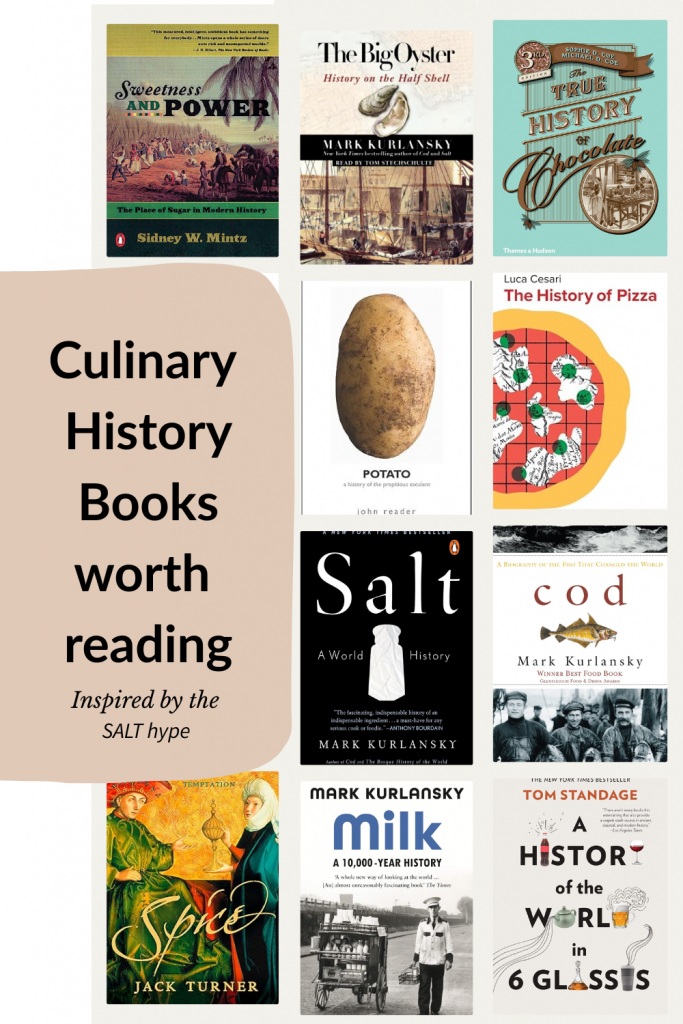
Culinary History might be a mouthful of a word, but you just get it, right?
Here are a few more options to explore foods history:
Kurlansky himself published many more books besides Salt, including Cod: A Biography of the Fish That Changed the World, Milk!: A 10,000-Year Food Fracas, Salmon: A Fish, the Earth, and the History of Their Common Fate and The Big Oyster: History on the Half Shell.
John Reader portraits another important crop in Potato: A History of the Propitious Esculent. He explores how a single crop transformed agriculture, population growth, migration, famine, and industrialization. The potato becomes a lens through which to understand the development of the modern world. One of the closest books in scope and ambition to Salt.
Then there is Tom Standage, who wrote An Edible History of Humanity and A History of the World in 6 Glasses. These books reminds us that the most ordinary things in our daily lives—beer, wine, coffee, tea, spirits, and soda—can quietly shape civilizations, proving that history is often hidden inside the things we barely notice. Oh and by the way, it draws attention to the families that build lives upon basic everyday conveniences that now shape our lives (and our vocabularies). Imagine you built a brand that is recognized around the world?! That’s huge.
Just be warned, it quickly gets political as well!
Imagine your history teacher had introduced you to Sidney W. Mintz‘ Sweetness and Power: The Place of Sugar in Modern History – a landmark work in food history and anthropology. Mintz argues that sugar didn’t simply become popular. Mintz argues that sugar didn’t simply become popular—it fundamentally shaped capitalism, colonialism, slavery, industrial labor, and the modern global economy. Less narrative than Salt, but one of the most influential books ever written on food history.
Not sweet enough for you? Then let us dive into The True History of Chocolate by Sophie D. Coe & Michael D. Coe. Explore chocolate from its sacred role in Maya and Aztec civilizations through Spanish colonization to its transformation into the global treat we know today. Blends archaeology, history, anthropology, and culinary traditions.
And finally, my favorite food of all fast foods, The History of Pizza by Luca Cesari. The book separates pizza’s real history from popular myths. Beginning in Naples, Cesari follows pizza’s evolution from humble street food to a worldwide cultural icon, while examining migration, identity, tourism, and globalization. Only annoying details about this one (I gifted it to a friend of mine who married an Italian): It’s not as witty as most of the other books. But thats okay, still made a great gift.
Now, what foods did I miss? Let me know 😉


No responses yet